
Equipment
Food Truck Equipment: What a Kitchen on Wheels Needs (and the Hygiene Rules Behind It)
A food truck needs five groups of equipment: a cooking line with extraction, cold and hot holding, a handwashing sink, a way to wash utensils, and water tanks with the power or gas to run it all. The exact list depends on your menu. The hygiene rules in the US, the UK and the EU don't hand you a shopping list, but they do say what the kitchen must be able to do.
By Ozan Food TruckPublished 10 min read
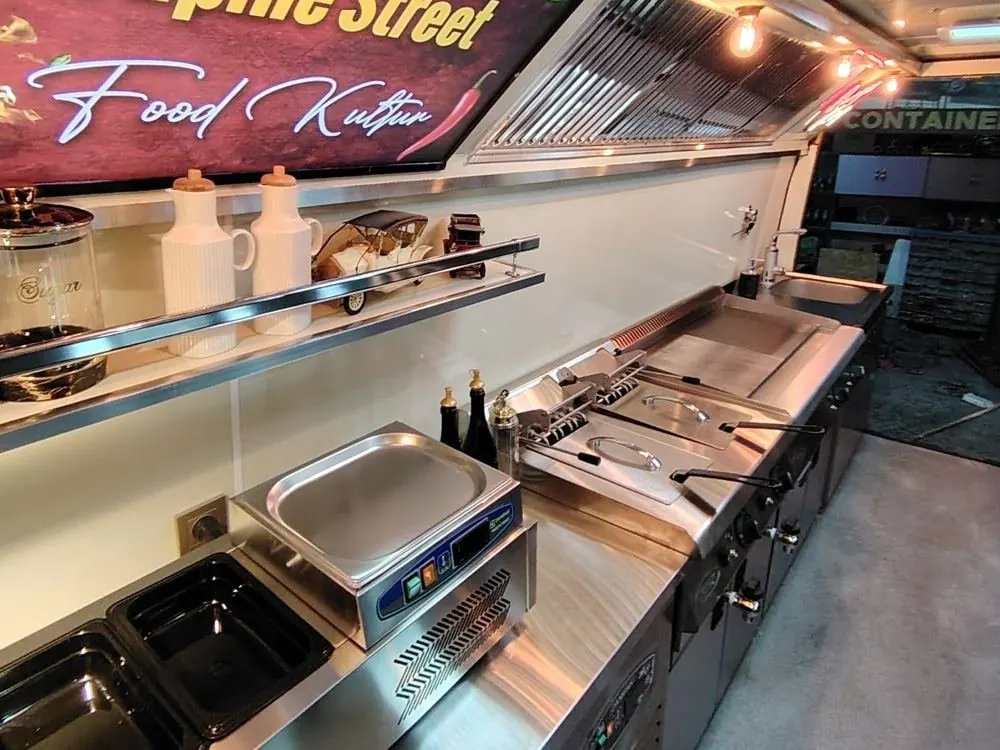
We quote the FDA Food Code, Regulation 852/2004 and UK government guidance, and take power figures from the makers' spec pages. Your local health department may ask for more. Check with them before the layout is fixed.
Checked on 28 September 2026.
Start from the menu, not a catalogue
The FDA's mobile food establishment matrix is organised around the menu. It is a plan review guide based on what you serve and how you operate, and it covers everything from push carts to catering vehicles. A truck that only sells prepackaged food reads a different column from one that cooks on board.
When a state or county follows the Food Code, you submit plans before construction. Those plans can include "EQUIPMENT types, manufacturers, model numbers, locations, dimensions, performance capacities". So the equipment list is a document the inspector may read.
That is also how we work. On our food truck page, the grills, fryers, hobs, extraction and refrigeration are "chosen for the food you will serve".
The food truck equipment list at a glance
| Group | Typical items | What the rules ask for |
|---|---|---|
| Cooking line | Grill, griddle, fryer, burners or induction hob | Hoods that keep grease off food and walls (US) |
| Cold and hot holding | Undercounter fridge, freezer, bain marie | Safe temperatures and a way to monitor them (US, UK, EU) |
| Hand hygiene | Handwash sink, soap, towels | Facilities to wash and dry hands (US, UK, EU) |
| Warewashing | Multi-compartment sink, drainboard | A way to clean and disinfect utensils (US, UK, EU) |
| Water and waste | Fresh tank, waste tank, pump, water heater | Drinking water and waste storage (US, UK, EU) |
| Power and gas | Generator, shore power or batteries, LPG | Gas work by a Gas Safe-registered business (UK) |
Handwashing sink
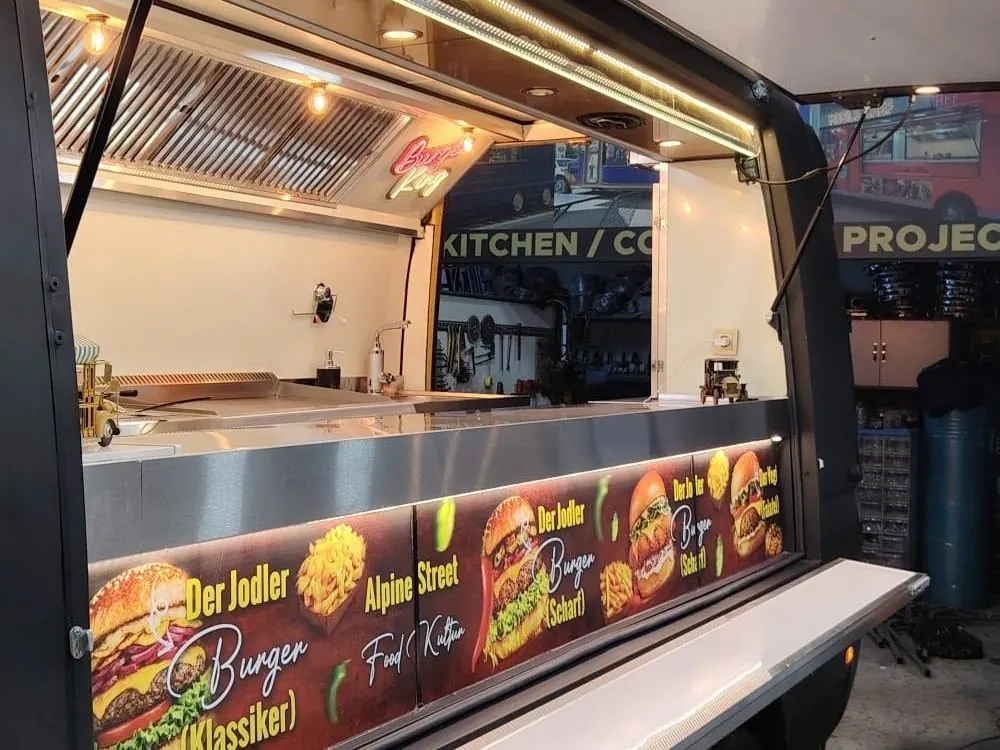
Under the Food Code, a truck needs at least one handwashing sink. It has to sit where staff can reach it easily from the prep, serving and dishwashing areas. The code also fixes some details:
- water at 29.4°C (85°F) or warmer, through a mixing valve or combination faucet,
- if the faucet is self-closing, slow-closing or metering, at least 15 seconds of flow per press,
- soap, and disposable towels or a hand dryer,
- a sign telling staff to wash their hands.
A sink used for food prep or washing utensils may not carry the handwashing soap and towels. Our reading: plan the handwash sink as its own basin, and keep it apart from the washing-up sink.
In the EU and the UK, Regulation 852/2004 asks for "facilities for the hygienic washing and drying of hands" in mobile sales vehicles, where necessary. It sets no sink count, so ask your local authority what it expects for your menu.
Washing utensils
The Food Code asks for a sink with at least three compartments for washing, rinsing and sanitising, each large enough for the largest pan or utensil. A two-compartment sink is allowed only if the regulatory authority approves it, and only for limited batch washing. You also need drainboards or racks for dirty and clean items.
The European rule is shorter. Adequate provision must be made for "the cleaning and, where necessary, disinfecting of working utensils and equipment". UK guidance adds a practical step: keep a cleaning schedule and use disinfectants labelled BS EN 1276 or BS EN 13697.
Water and waste tanks
The Food Code lets a mobile facility take its water from an enclosed vehicular water tank, bottled water, closed portable containers or a hose to an approved source. For a mobile food establishment it adds hard numbers:
- The waste tank must be 15 percent larger than the fresh-water tank. With a 100-litre fresh tank, the waste tank holds at least 115 litres.
- The water inlet is 19.1 mm (three-quarters of an inch) or smaller, with a hose fitting that can't be used for anything else.
- The waste tank slopes to a drain of at least 25 mm with a shut-off valve.
- Waste is emptied at an approved servicing area.
The code gives no fixed fresh-tank size. It asks for enough water, and enough hot water, to meet peak demand. Ask your health department whether it sets its own minimum.
In the EU and UK the rule is "an adequate supply of hot and/or cold potable water" plus hygienic storage and disposal of liquid waste.
Refrigeration and hot holding
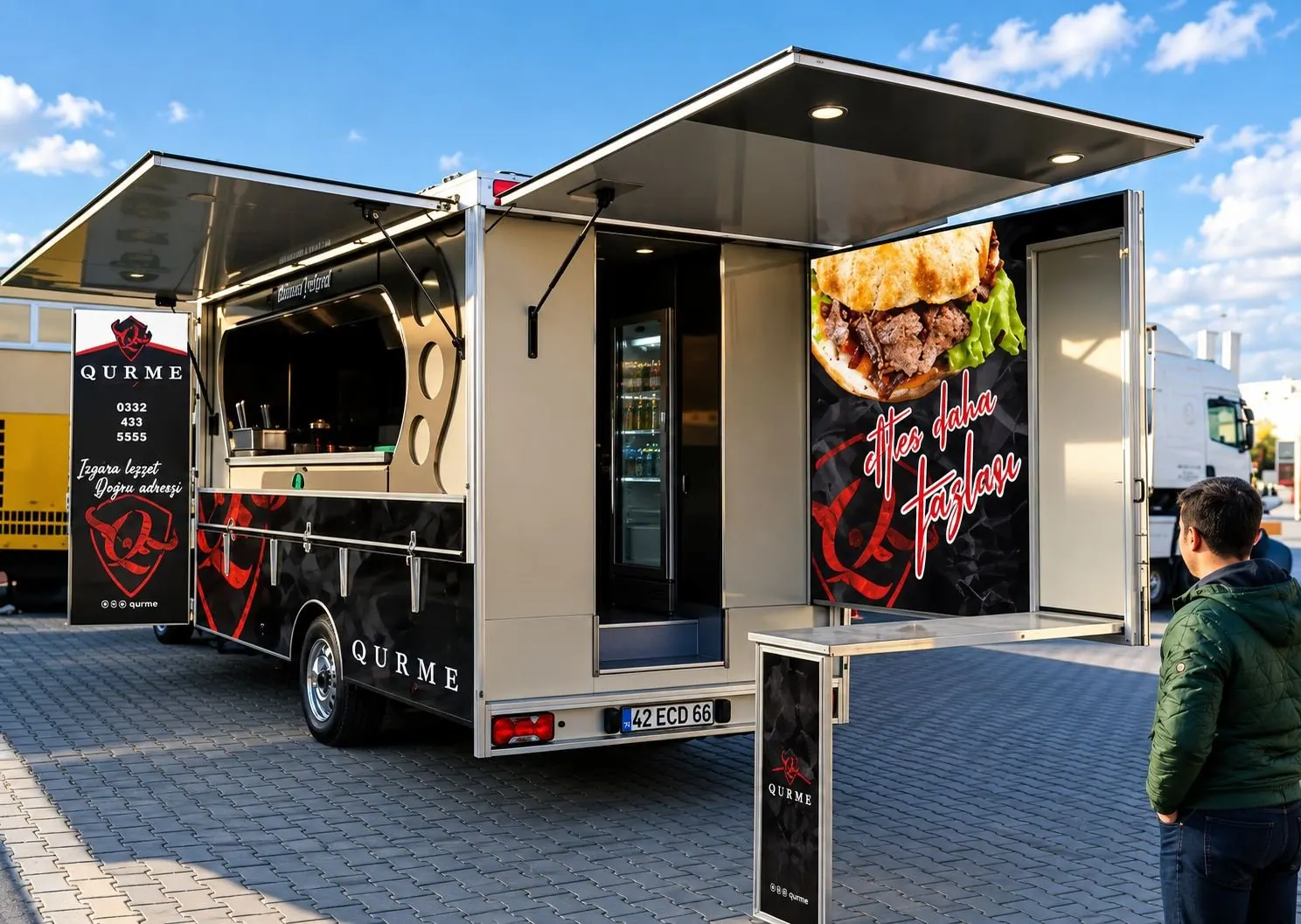
The limits differ by country.
| Cold holding | Hot holding | Source | |
|---|---|---|---|
| US (Food Code) | 5°C (41°F) or less | 57°C (135°F) or above | FDA Food Code 3-501.16 |
| UK | 8°C or below (legal in England, Wales and Northern Ireland). Set the fridge to 5°C or below | 63°C or above | GOV.UK food hygiene guide |
| EU | "Suitable" temperatures, kept and monitored | Same | Reg. 852/2004, Annex II, Ch. III |
The Food Code also says holding equipment must be "sufficient in number and capacity" to keep those temperatures. Fridges holding food that needs temperature control for safety must have a built-in thermometer you can read easily, and staff need a probe thermometer.
True lists its TUC-27-HC undercounter fridge at 33°F to 38°F (0.5°C to 3.3°C), and states it is "NSF/ANSI Standard 7 compliant for open food product". The Food Code treats equipment certified for sanitation by an ANSI-accredited program as meeting its equipment design rules. Our reading: for a US-bound truck, ask the builder for the certification listing of every appliance.
The cooking line and extraction
Your menu picks the cooking line. The rules cover what sits around it.
The Food Code requires hoods "sufficient in number and capacity" to stop grease or condensation collecting on walls and ceilings, and designed so nothing drips onto food. In the EU and UK, food-contact surfaces call for "smooth, washable, corrosion-resistant and non-toxic" materials unless the authority accepts others. Our builds use stainless worktops with the grill, fryer, burners, extraction, fridge, freezer, sink and storage "laid out for your menu".
For fire safety around the hood and the gas cylinders, ask your local fire authority which rules apply before the hood is ordered.
Gas has its own rules in the UK. HSE says gas work on catering equipment, mobile catering included, must be done by a Gas Safe-registered business. The vehicle must be ventilated, and pilot lights must be off while it moves. Our reading: if your truck is built outside Great Britain, budget time for a UK Gas Safe engineer to check the installation before you trade.
Power: read the rating plate, then add it up
Two single-basket fryers from the same maker can differ threefold in power. These are the figures the makers print for some common appliances:
| Appliance (maker, model) | Rated power | Supply as listed |
|---|---|---|
| Counter-top fryer, 1 basket (Lincat LDF) | 3.0 kW | 230 V, single phase |
| Counter-top fryer, 1 basket (Lincat DF39) | 9.0 kW | 39 A single phase, or 13 A per line on three phase |
| Electric griddle, 600 mm (Lincat GS6/T) | 4.0 kW | 17.4 A single phase |
| Induction hob, 2 zones (Lincat PHEH01) | 3.7 kW | 230 V, single phase |
| Wet bain marie, 600 mm (Lincat BM6W) | 2.0 kW | 230 V, single phase |
| Undercounter fridge (True TUC-27-HC) | 2.0 A | 115 V, 60 Hz. A 220 to 240 V option is listed |
| Propane griddle, 450 mm (Lincat GS4/P) | 5.5 kW gas | No electrical rating listed |
Voltage matters too. Lincat lists 230 V appliances. True's standard US fridge runs on 115 V.
La Marzocco's espresso manual puts the rule plainly: check that the rating plate matches the supply, make sure the electrical system can handle "the maximum power consumption", fit a 30 mA residual current device, and avoid extension cords.
Our reading: list every appliance with its rated power and voltage from the spec sheet before anyone sizes a generator. Buy appliances for the voltage of the country where you will trade. None of the makers we read gives a generator size, so we don't either.
On our trucks the supply is a generator, shore power or batteries, with clean and waste water tanks and a pump sized for a full service.
Coffee truck equipment
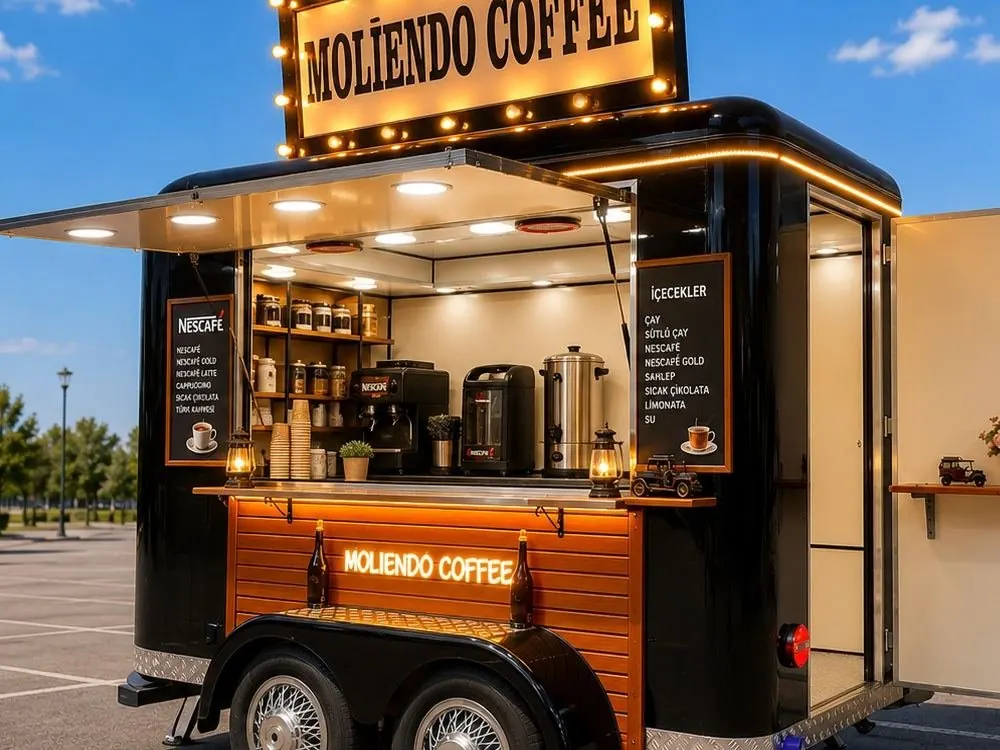
A coffee trailer's list is built around the espresso machine and its water supply. On our coffee trailer page the fit-out is an espresso machine, grinder, drinks counter, stainless worktops, fridge, sink and storage for one or two baristas.
Rancilio lists its Classe 5 S one-group tank version at 1,800 W on 220 to 240 V, with a built-in 2-litre tank. La Marzocco lists the two-group Linea PB at 4,600 W on its web page, and between 3,750 W and 5,450 W in its brochure. The Mahlkönig E65S grinder is listed at 440 W.
Check the water side before you choose the machine:
- Rancilio's tank version "does not require fixed water connection".
- The multi-group Rancilio and La Marzocco machines we checked need a fixed water connection.
- La Marzocco asks for 0.2 to 0.6 MPa supply pressure, and "an additional water supply system" if that isn't available.
- It wants water hardness between 70 and 100 ppm, with a filter if yours is outside that.
Our reading: a machine that needs a fixed connection will need a pump between the tank and the machine, plus a filter if your water is outside the maker's range. Ask the machine's supplier which setup they approve.
What to ask your builder before the build
- Can I have a scaled layout and an equipment list with model numbers and spec sheets?
- Is the handwash sink separate, and how many compartments does the washing-up sink have?
- What are the fresh and waste tank volumes?
- What is the total rated power, per phase, at the voltage I will trade on?
- Who installs and certifies the gas system?
Frequently asked questions
What equipment do I need in a food truck?
A cooking line and extraction chosen for your menu, cold and hot holding, a handwashing sink, a way to wash utensils, and water tanks with a power or gas supply. Where the FDA Food Code applies, add a three-compartment warewashing sink unless an alternative is approved, and a waste tank 15 percent larger than the fresh tank. Your local health department has the final word.
What equipment do you need for a coffee trailer?
An espresso machine, a grinder, a fridge, a sink, a drinks counter and storage. The machine choice depends on water: some one-group machines have a built-in tank, while the multi-group Rancilio and La Marzocco machines we checked need a fixed water connection with enough pressure, so plan for pressure and filtration.
How do you power a food trailer?
Our trucks use a generator, shore power or batteries. Whichever you choose, start from the equipment list: take each appliance's rated power and voltage from its spec sheet and add them up. La Marzocco, for one, asks for a supply that matches the rating plate and can carry the maximum load, with a 30 mA residual current device.
If you want an equipment list checked against your menu, send it to us through the quote form with the country where you will trade. We reply with questions first, then drawings. You can also see how we lay out custom food trucks for different menus.
Related guides
- Electric and Battery-Powered Food Trucks: What the Batteries Have to Carry
- Stainless Steel in Food Truck Kitchens: What Grade and Finish to Ask For
- Powering a Food Truck: How to Size a Generator from Your Equipment List
- New vs Used Food Truck: What to Check Before You Buy
Sources
- FDA Food Code 2026 (sections 3-501.16, 4-204.11, 4-204.112, 4-205.10, 4-301.11 to 4-301.14, 4-302.12, 5-104.12, 5-202.12, 5-203.11, 5-204.11, 5-303.13, 5-401.11, 5-402.14, 6-301.11 to 6-301.14, 8-201.12, Annex 7 Chart 4-D)
- FDA, FDA Food Code overview
- Regulation (EC) No 852/2004, Annex II (EU consolidated text)
- Regulation (EC) No 852/2004, Annex II (UK version)
- GOV.UK, Food hygiene for businesses
- GOV.UK (Food Standards Agency), Running a food business
- HSE, Catering Information Sheet 23, Gas safety in catering and hospitality
- Lincat, Lynx 400 electric fryer LDF
- Lincat, Silverlink 600 electric fryer DF39
- Lincat, Silverlink 600 electric griddle GS6/T
- Lincat, Silverlink 600 propane griddle GS4/P
- Lincat, Silverlink 600 bain marie BM6W
- Lincat, Phoenix induction hob PHEH01
- True Manufacturing, TUC-27-HC
- True Manufacturing, TUC-27F-HC
- Rancilio, Classe 5 S
- La Marzocco, Linea PB
- La Marzocco, Linea PB brochure
- La Marzocco, Linea PB operating manual
- Mahlkönig, E65S

By
Ozan Food Truck
This guide is based on the laws, regulations, official guidance and manufacturer documents linked in the text. It is general information, not legal or engineering advice. Rules differ by country, state and city, so confirm the details with your local authority before you build or buy.