
Equipment
Powering a Food Truck: How to Size a Generator from Your Equipment List
The right generator for a food truck is the one that covers your own equipment list, so start with the list, not with a generator size. Add up the running watts of everything that works at the same time, then add the biggest starting surge from any motor on board. That total is your planning figure.
By Ozan Food TruckPublished 9 min read
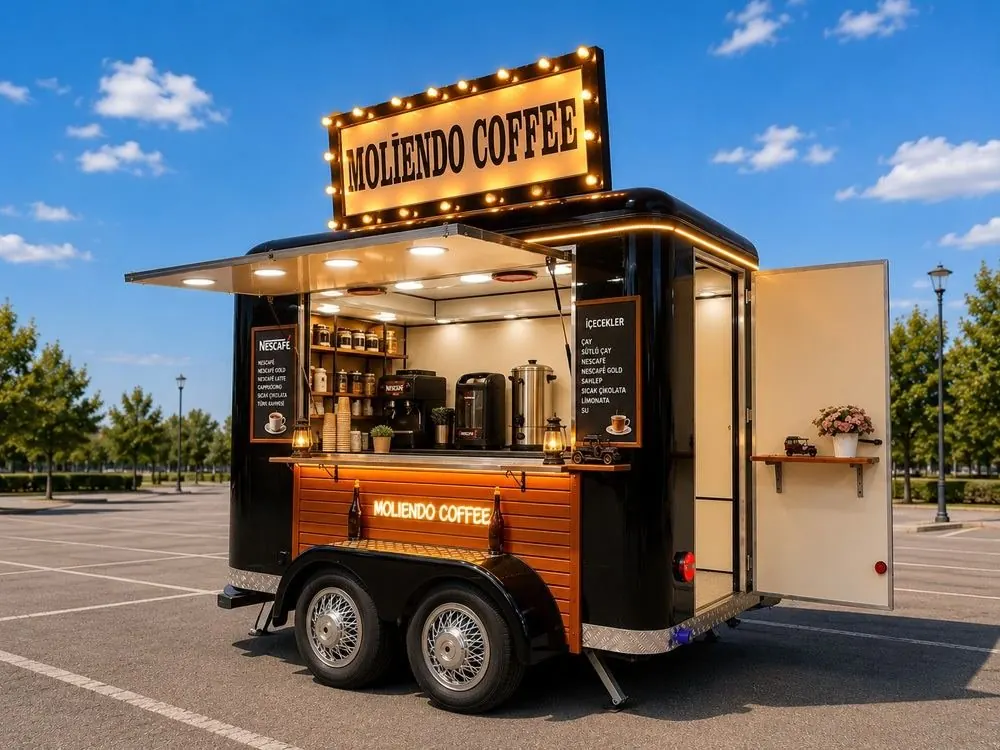
Below is the method as the generator makers describe it, with one worked example built only from appliance spec sheets. The last part covers carbon monoxide, which decides where the generator can sit. Local fire and health rules vary, so check yours before you buy.
Checked on 28 September 2026.
Why there is no standard food truck generator size
A single generator size for every food truck would be convenient. The makers do not give one. Cummins puts it plainly for RVs: the size you need "depends on the specific equipment" on board. Generac says to match the generator to your peak electrical load.
The spread between kitchens is large. Across the espresso machine spec sheets we read for our coffee trailer research, power ratings ran from 1,450 W to 9,470 W, and within one model family, more groups meant more power. Grinders ran from 140 W to 1,300 W.
So a generator sized for someone else's truck tells you very little about yours.
Running watts and starting watts
Every appliance has a running figure. Generac defines running wattage as the steady power an appliance draws in normal use. Appliances with a motor also have a starting figure, sometimes called surge wattage. That is the burst the motor needs to get going, and Generac says it is "often two to three times the running figure." Cummins describes the same effect: air conditioners can draw up to three times more power in the first few seconds, and it is common to all electric motors.
Honda's wattage table shows the pattern clearly. Heating appliances such as the electric fry pan or the tabletop electric grill have the same starting and running figure. Motor appliances do not: Honda lists an Energy Star refrigerator at 1,200 W to start and 132 to 192 W to run, and a blender at 850 W and 400 W. Honda also notes that all its wattages are estimates, so treat the table as a guide to the pattern, not as the figure for your fridge.
Generac singles out anything with a motor, naming refrigerators and air conditioners among others. Our reading: on a food truck that means the refrigeration, the extraction fans, grinders and blenders, the water pump and any air conditioning.
The sizing method, step by step
Generac gives the working formula: add the running watts of everything, then add the highest single starting burst. Honda's worked example does the same thing in two columns, a continuous need and the largest occasional need.
- List every electrical item on the truck. Include the small ones: lights, the card terminal charger, the water pump, the menu board.
- Read the figures off the rating plate or the maker's spec sheet. Generac points you to the nameplate or the manufacturer's specifications. Some sheets give amps, not watts. Cummins gives the conversion: volts multiplied by amps equals watts.
- Mark the items with a motor. These need a starting figure.
- Add up the running watts of everything that can be on at the same moment.
- Add the largest single starting figure. If a spec sheet gives no starting value, ask the appliance maker. Generac's two to three times rule is a fallback estimate, not a spec.
Check the voltage at step 2. Several of the appliances we read come in a 120 V version and a 220 to 240 V version with different figures, and many multi-group espresso machines are also sold in three-phase versions. La Marzocco's manual says to check that the rating plate matches the supply the machine will be connected to. Our reading: the generator's output has to match the version you buy, including the phase, so confirm the version before you size anything.
A worked example: a small coffee trailer
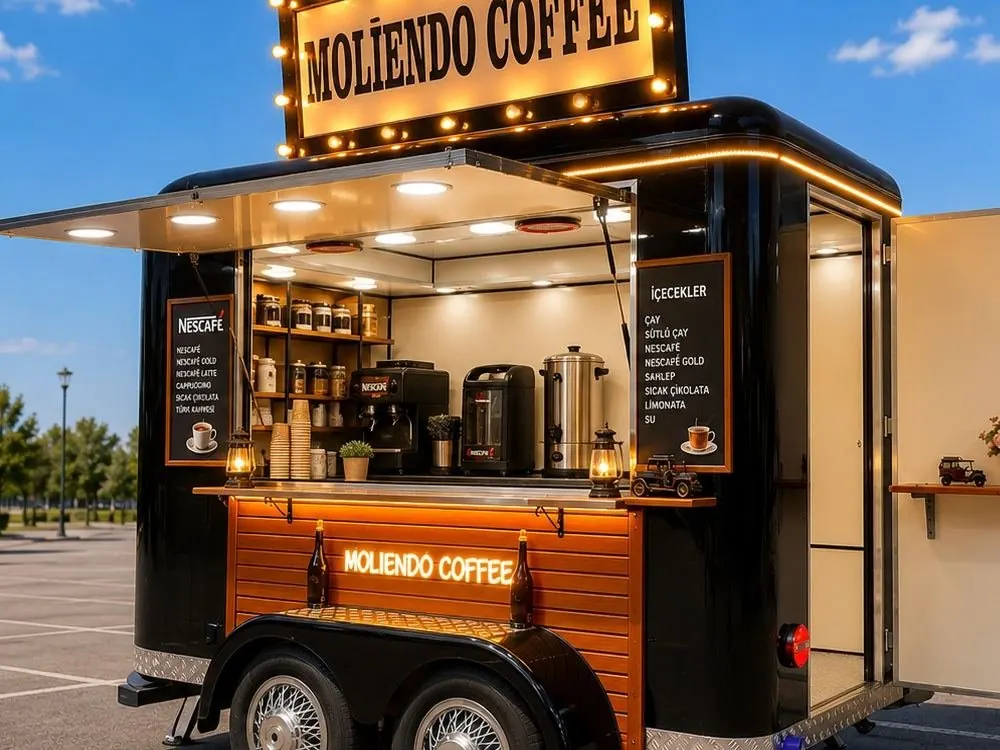
This is an example to show the arithmetic. It is not a recommendation of these models or of a generator size.
Assume a coffee trailer on a 120 V US supply with three items. The figures are the makers' own.
| Item | Maker's figure | Running watts used |
|---|---|---|
| Espresso machine: Rancilio Classe 5 S, 1 group, 120 V | 1.8 kW | 1,800 W |
| Grinder: Mahlkönig E65S, 110–127 V | 580 W nominal | 580 W |
| Undercounter fridge: True TUC-27-HC, 115 V | 2.0 A | 230 W (115 V × 2.0 A) |
| Running total | 2,610 W |
The grinder and the fridge compressor both have motors. Neither page we read gives a starting figure. Mahlkönig says other electrical specifications are available on request, so that is the first question to ask.
If you had no answer and used the top of Generac's range on the motor with the highest running figure, the grinder, you would get 3 × 580 W = 1,740 W. Generac's formula then gives 2,610 W + 1,740 W = 4,350 W as the planning figure.
Two points follow from the example. The espresso machine is most of the running load, so the choice of machine moves the result more than anything else. And the starting estimate is only as good as the multiplier, which is why a real figure from the grinder maker is worth more than the rule of thumb.
Keep the peak down with start-up order
Honda's advice is not to simply add up every wattage. In its own example, starting two motor appliances at different times cut the peak from 3,200 W to 1,600 W. On a truck, that means staggering the motor loads instead of switching everything on at once.
Cummins adds two habits for onboard generators. Turn off large loads before you start the generator, and let it warm up for a few minutes before you switch appliances on.
Warm-up time on the equipment side matters too. La Marzocco's manual says the Linea PB steam boiler takes about 25 minutes to reach operating pressure. Our reading: plan that heating time into your morning, because the machine is drawing power the whole time.
What the espresso machine makers ask of the supply
The La Marzocco manuals we read ask for a supply that can carry the maximum power shown on the machine, proper grounding, and a residual current device (RCD) of 30 mA or less. They do not recommend adapters, multiple plugs or extension cords. None of the espresso manuals or pages we read mention generators, so they neither approve nor rule out running on one. If you plan to, ask the machine's maker or its authorised service agent.
Where the generator can sit: carbon monoxide
This part is not optional. Generator exhaust contains carbon monoxide, which HSE describes as colourless, odourless and tasteless. Honda warns that breathing it can kill in minutes.
- Outside only. Honda says never to run a generator in any enclosed or partially enclosed space, and never near open doors or windows. CPSC adds that portable generators should not be used indoors or in garages "even if doors and windows are open."
- Distance. CPSC's guidance is at least 20 feet from homes with the exhaust facing away. That figure is written for homes, not for food trucks. Honda asks for at least three feet of clearance on the top and all four sides for cooling.
- Weather and fuel. Generac says never to run a generator in the rain or on a wet surface, and to refuel only after shutting it down and letting it cool.
- Alarms and monitors. CPSC recommends CO alarms at home. For workplaces, OSHA's fact sheet tells employers to provide personal CO monitors with audible alarms where exposure is possible, and to ban gasoline engines in poorly ventilated areas.
Our reading: the box of a food truck or trailer counts as an enclosed or partially enclosed space, so a portable generator never runs inside it, hatches open or not. Point the exhaust away from your serving hatch and the queue. For the distance your site requires, check with your local fire authority.
At UK events, HSE's guidance lists power for catering equipment, generator use and earthing among the points to consider when planning, and says generator enclosures should, where possible, be kept apart from public areas. Ask the organiser what they need from you before the day.
Built-in generator or portable
A generator can travel in its own compartment or sit beside the truck. For RV installations, Cummins says the set must meet the safety standard for engine generator sets for recreational vehicles, be properly ventilated and be kept separate from flammable vapours. We did not find a source that applies that standard to food trucks, so ask your builder how a built-in compartment is ventilated and sealed from the kitchen, and ask your local authority which code applies.
On our food trucks and food trailers, the power system is part of the specification. It can be a generator, a site power connection or a battery system, specified for your menu and reflected in the quote.
Frequently asked questions
What is a good size generator for a food truck?
The one that covers your own list. Add the running watts of everything used at the same time, then add the largest single starting surge, as Generac's formula sets out. Espresso machines alone range from 1,450 W to 9,470 W across the spec sheets we read, so one size cannot fit every truck.
What is the best generator for a food trailer?
We do not recommend a brand. Size it from your equipment, match the voltage and phase of your appliances, and check that it can sit outside the trailer, clear of openings, as Honda, Generac and CPSC advise.
How do you power a food trailer?
With a generator, a site power connection or a battery system. With site power, the hookup sets the limit: Cummins works out a 30-amp, 120 V cord at 3,600 W maximum and a 50-amp, 240 V cord at 12,000 W. Either way, the equipment list decides what you need.
If you send us your menu and equipment list through the quote form, the power system will be reflected in the quote. You can see the range on our custom food trucks page.
Related guides
- Food Truck Equipment: What a Kitchen on Wheels Needs (and the Hygiene Rules Behind It)
- Electric and Battery-Powered Food Trucks: What the Batteries Have to Carry
- Stainless Steel in Food Truck Kitchens: What Grade and Finish to Ask For
- New vs Used Food Truck: What to Check Before You Buy
Sources
- Generac, What Size Generator Do I Need?
- Generac, Portable Generator Safety
- Honda Power Equipment, Generator Wattage Estimation Guide
- Honda Power Equipment, How Much Power Do I Need?
- Honda Power Equipment, Generator Wattage Calculator
- Honda Power Equipment, Generator Safety
- Cummins, RV Generator Power Basics
- Cummins, Best Generator for RV Air Conditioners
- Cummins, Your guide to purchasing an onboard RV generator
- Rancilio, Classe 5 S specifications
- Mahlkönig, E65S specifications
- True Manufacturing, TUC-27-HC spec sheet
- La Marzocco, Linea PB operating manual
- La Marzocco, Linea Mini operating manual
- CPSC, Carbon Monoxide Information Center
- OSHA, Carbon Monoxide Poisoning fact sheet
- HSE, Carbon monoxide awareness FAQ
- HSE, Event safety: Electrical safety

By
Ozan Food Truck
This guide is based on the laws, regulations, official guidance and manufacturer documents linked in the text. It is general information, not legal or engineering advice. Rules differ by country, state and city, so confirm the details with your local authority before you build or buy.