
Equipment
Stainless Steel in Food Truck Kitchens: What Grade and Finish to Ask For
For a food truck kitchen, ask for three things in writing: the stainless grade by name and UNS number (304 is S30400, 316 is S31600, 430 is S43000), the surface finish, and how the welds and wall joints will be treated. The FDA Food Code does not name a grade. It asks for food-contact surfaces that are corrosion-resistant, smooth and easy to clean, and it uses 100-grit number 3 stainless as its yardstick for smooth.
By Ozan Food TruckPublished 10 min read
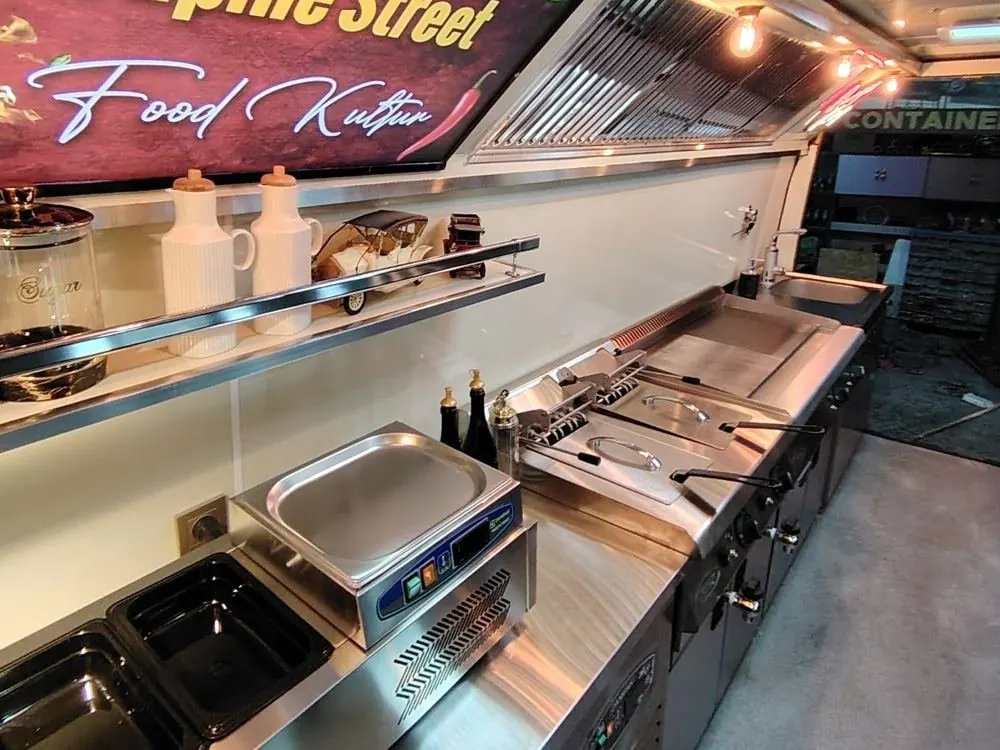
Below: what the hygiene rules ask of the metal, how the three common grades differ, and what to check on the drawing before you sign it. Grade facts come from two industry bodies, the British Stainless Steel Association (BSSA) and the Specialty Steel Industry of North America (SSINA). The rules come from the FDA Food Code 2026 and EU Regulation 852/2004.
Checked on 29 September 2026.
What the rules ask of the metal
Under Food Code 4-101.11, materials for food-contact surfaces must be safe, durable, corrosion-resistant and nonabsorbent. They must be heavy enough to survive repeated washing, finished smooth and easy to clean, and resistant to pitting, chipping, scratching and distortion.
The code's definition of "corrosion-resistant" is practical. The surface has to stay cleanable under "prolonged influence" of the food it touches, the cleaning compounds, the sanitizing solutions and the conditions around it. Our reading: your menu and your cleaning routine are part of the grade question.
Stainless appears in the definitions themselves. "Smooth", for a food-contact surface, means cleanability "equal to or exceeding that of (100 grit) number 3 stainless". The "easily cleanable" definition mentions "the appropriateness of stainless steel for a food preparation surface". Surfaces that are not food-contact but get splashed must still be corrosion-resistant, nonabsorbent and smooth (4-101.19).
In the EU, Annex II Chapter III of Regulation 852/2004 covers "mobile sales vehicles". Food-contact surfaces there need "smooth, washable, corrosion-resistant and non-toxic materials", unless you can satisfy the competent authority that other materials are appropriate.
Neither text names a grade. Our reading: the grade is something you agree with your builder, within what your inspector accepts. The Food Code is a model code, and states and counties adopt it in different editions, so ask your local health department which one it uses.
304, 430 and 316 side by side
| 304 (S30400) | 430 (S43000) | 316 (S31600) | |
|---|---|---|---|
| Family | Austenitic | Ferritic | Austenitic, with molybdenum |
| Chromium % (SSINA) | 18.0-20.0 | 16.0-18.0 | 16.0-18.0 |
| Nickel % (SSINA) | 8.0-10.5 | 0.75 max | 10.0-14.0 |
| Molybdenum % (SSINA) | none listed | none listed | 2.0-3.0 |
| Corrosion (BSSA) | "Good" | "Fair" | First to consider where 304 is inadequate |
| Magnet | Negligible pull | "Magnetic" | Negligible pull |
| Uses listed by BSSA | Sinks, catering surfaces, food processing | Catering equipment, kick plates, cooker hobs, air extraction | Food processing, marine structures |
304 gets good corrosion resistance, good weldability and hygienic surfaces in the BSSA profile. The European number is 1.4301.
430 has almost no nickel (0.75% maximum in the SSINA table), and the BSSA gives "cost effectiveness due to absence of nickel" as one of its traits. It also lists "fair" weldability in thin sections. Its note says indoor conditions "are usually compatible" with 430, and that mild detergents and cleaning fluids are safe on it.
316 adds about 2% molybdenum. The BSSA says 1% of molybdenum is worth about 3% of chromium for corrosion resistance. Where 304 falls short, 316 is "the natural first grade to be considered", typically in "high chloride (saline, coastal)" or acidic conditions. The European number is 1.4401.
The BSSA says the only practical difference in the "L" versions, 304L and 316L, is carbon (0.03% maximum against 0.08%), to avoid "weld decay" at welds.
Why chlorides matter in a truck
SSINA says pitting and crevice corrosion generally occur in the presence of chloride. Its list of sources includes coastal salt, de-icing salt and bleach (sodium or calcium hypochlorite). Higher temperatures and lower pH make attack more likely.
Our reading: a truck can meet all three: sea air, winter road salt and chlorine sanitizer inside. If you trade by the coast or wash down with chlorine, ask the builder which grade goes on the most exposed parts, and why. For 430, a dry panel that sees only mild cleaners fits the BSSA note. A sink surround next to the sanitizer bucket is a different question.
Finish: what to write instead of "satin"
Beyond the Food Code's No. 3 benchmark, the finish is between you and the builder, and finish names alone can mislead. A BSSA technical-library article by a polishing firm's managing director traces how "dull polish" was a No. 1 finish in the 1960s, then No. 4 under British Standard BS 1449, and is now 1J or 2J under EN 10088-2. It quotes the EN standard's own note that "more specific requirements may need to be agreed between manufacturer and purchaser (e.g. grade of grit or surface roughness)". The same article warns not to confuse "N" roughness numbers with finish numbers: N8 is a coarse ground finish, No. 8 is a bright polish.
Roughness affects corrosion as well as looks. A paper in the BSSA library found that polished finishes rougher than 1 micron Ra had "deep grooves where chloride ions can accumulate", while finishes under 0.5 micron Ra showed few such sites. It concludes that a description such as "satin polish" does not guarantee a smooth finish. That study was on outdoor architectural panels. Our reading: the lesson for your spec is the same. Name a grit or a maximum Ra, or approve a sample.
Welds, heat tint and contamination
Under 4-202.11, food-contact surfaces must be free of "breaks, open seams, cracks, chips, inclusions, pits", free of sharp internal angles and crevices, and "finished to have smooth welds and joints". The code's annex explains why: cracks and pits let microorganisms attach and form biofilms, which are "highly resistant to cleaning and sanitizing".
Welding also leaves heat tint, the yellow-to-blue colour beside the weld. The BSSA explains it as a thickening of the surface oxide layer. A bulletin article in the BSSA library, by the managing director of a pickling and finishing firm, puts it plainly: "the combination of surface contamination and heat tint can lead to stainless steel under-performing". It describes pickling paste and electrochemical cleaning as ways to remove it.
Contamination is the other risk. SSINA calls it "the number ONE problem" in stainless fabrication. Carbon steel particles from shared machinery, carbon steel wire brushes or used grinding wheels embed in the surface and later rust, "so it will appear that the stainless steel is 'rusting.'" The BSSA adds that stainless cannot passivate unless the surface is "clean and free from contamination and scale from welding operations".
So ask how welds on food-contact surfaces are finished, how heat tint is removed, and whether stainless is worked with tools kept away from carbon steel.
Sealing to walls and floor
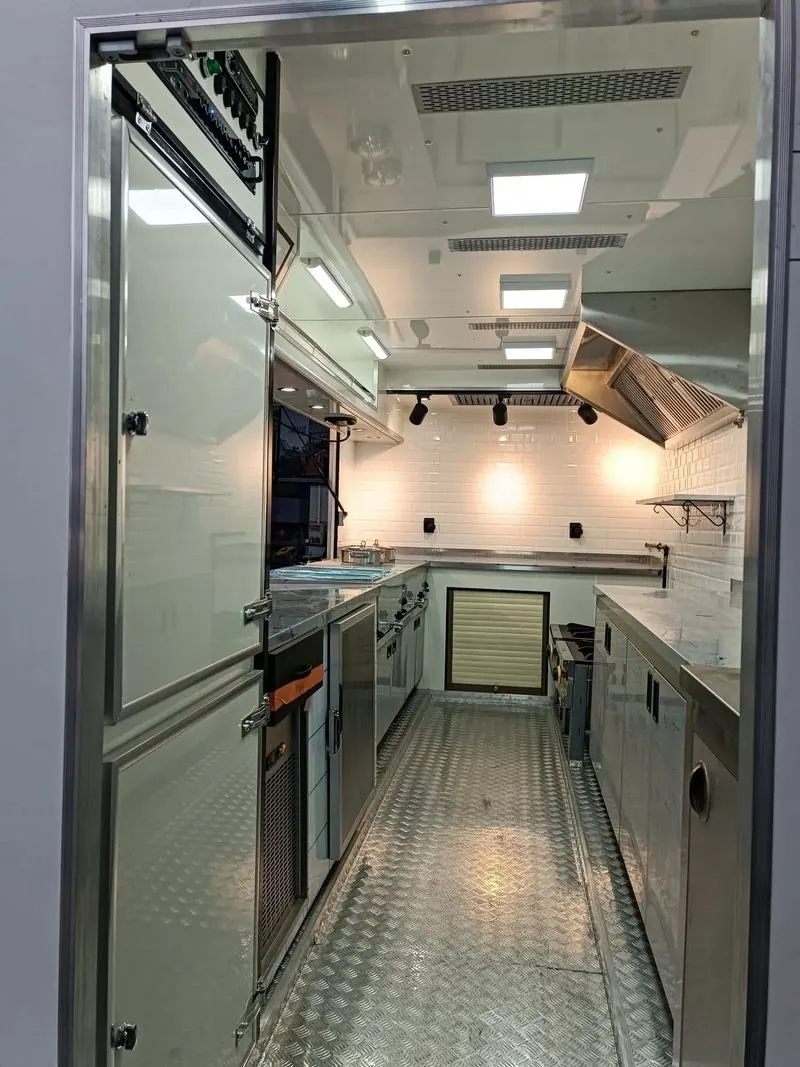
Food Code 4-402.11 gives fixed equipment three options: spaced for cleaning at the sides, back and top; no more than 1 mm (1/32 inch) from walls and other equipment; or sealed to them where it faces spillage or seepage. "Sealed" means free of cracks or openings that let moisture in.
Floor-mounted equipment that is not easily movable is sealed to the floor or stands on legs giving at least 15 cm (6 inches) clearance, or 10 cm (4 inches) where no part of the floor underneath is more than 15 cm from the cleaning access. Counter-mounted equipment of that kind is sealed or stands on legs giving at least 10 cm (4 inches), with smaller gaps allowed on shallow tables. Floor-to-wall junctions must be coved and closed or sealed (6-201.13). In the EU, equipment must be installed "to allow adequate cleaning of the equipment and the surrounding area".
SSINA says crevice corrosion occurs where oxygen cannot circulate, "such as tight joints, under fastener heads", and that sealing or removing tight joints at the design stage often prevents it.
Watch the fixings. SSINA's example: a stainless window frame held with carbon steel screws, where the screws "will probably corrode at an accelerated rate". A plastic washer or paint film that breaks the metal-to-metal contact stops the effect. Our reading: where stainless sheet meets a body frame of a different metal, ask what the fixings are and how the two are kept apart.
How to check what you got
The BSSA says ferritic grades such as 430 pull strongly on a hand-held magnet, while austenitic grades such as 304 and 316 show a negligible response. Bending and welding can raise the pull: its example is a sink whose flat drainer barely responds while the pressed bowl does. Our reading: a magnet on a flat panel can separate 430 from 304 or 316. It cannot tell 304 from 316, and a slight pull at a bend proves nothing on its own.
For that, you need paper. SSINA advises listing the UNS number next to the common name, and the BSSA lists EN 10204 as the standard for inspection documents on metal products. Our reading: ask for the sheet supplier's inspection document naming the grade, and make sure it matches the grade on your drawing.
One exterior note: Avery Dennison's SW900 wrap film data sheet lists stainless steel as an unsuitable surface. Our wrap guide covers films.
How we work with stainless
Stainless steel fabrication is done in our own factory, alongside bodywork, insulation, gas, electrics and equipment fitting. Our custom food trucks come with "food-grade stainless worktops and cabinets", specified for your menu. The layout, exterior design and equipment list go to you for approval, and production follows the approved drawings.
Our service pages do not list a grade or finish. Put the grade and finish you want in your brief and check them on the drawing you approve. Where your jurisdiction follows the Food Code, the plans for review can include "construction materials, and finish schedules". Our reading: one drawing with grades and finishes serves both the build and the plan review. For the appliances themselves, see our equipment guide.
What to send for a quote
- Where the truck will trade: coast or inland, and whether roads are salted in winter.
- Your menu, noting brines, acidic sauces or salty prep.
- How you clean and sanitize, and with what.
- The grade you want for each zone (worktops, sinks, splashbacks, hood, lower cabinets, exterior trim), with common name and UNS number.
- The finish for each zone: a name plus grit or maximum Ra, or a sample you approve.
- Weld finishing on food-contact surfaces and heat tint removal.
- How equipment meets walls and floor: sealed, spaced or on legs.
- Fixings between stainless and the body frame.
- Whether you want the sheet supplier's inspection documents.
- Which Food Code edition or local code your health department uses.
Frequently asked questions
Does a food truck kitchen have to be stainless steel?
The Food Code and Regulation 852/2004 set properties rather than a metal: safe, corrosion-resistant, nonabsorbent, smooth and easy to clean. The Food Code uses No. 3 stainless as its benchmark for smooth and calls stainless appropriate for food preparation surfaces. Your health department decides what it accepts.
Is 430 stainless OK for a food truck?
The BSSA lists catering equipment, cooker hobs and air extraction among 430's uses, and rates its corrosion resistance "fair" against "good" for 304. It says indoor conditions and mild cleaners usually suit it. For wet, salty or chlorine-heavy spots, ask your builder why that grade was chosen.
Should I choose 304 or 316?
The BSSA calls 316 the first grade to consider where 304 is inadequate, typically with high chloride from salt or coastal air, or with acids. A magnet cannot tell the two apart, so check the grade on the drawing and the supplier's documents.
When your list is ready, send it through the quote form. We reply with questions first, then drawings and a quote. Our builder guide covers what else to ask before you order.
Related guides
- Powering a Food Truck: How to Size a Generator from Your Equipment List
- Electric and Battery-Powered Food Trucks: What the Batteries Have to Carry
- Food Truck Equipment: What a Kitchen on Wheels Needs (and the Hygiene Rules Behind It)
- New vs Used Food Truck: What to Check Before You Buy
Sources
- FDA Food Code 2026 (1-201.10 definitions of "Corrosion-resistant material", "Easily cleanable", "Sealed" and "Smooth"; 4-101.11, 4-101.19, 4-202.11, 4-202.16, 4-402.11, 4-402.12, 6-201.13, 8-201.12; Annex 3)
- FDA, FDA Food Code
- Regulation (EC) No 852/2004, consolidated text, Annex II Chapters III and V
- SSINA, Composition/Properties
- SSINA, Alloy Families
- SSINA, Pitting and Crevice Corrosion
- SSINA, Galvanic Corrosion
- SSINA, Care and use in shop
- BSSA, Stainless Steels to Behold, 304
- BSSA, Stainless Steels to Behold, 430
- BSSA, Stainless Steels to Behold, 316/L
- BSSA, Comparison of 304 or 316 and 304L or 316L type compositions and effect on corrosion resistance
- BSSA, Magnetic Properties
- BSSA, Is stainless steel non-magnetic?
- BSSA, Heat Tint (Temper) Colours on Stainless Steel Surface Heated in Air
- BSSA, Passivation of stainless steels
- BSSA, British and American standards for tolerances, surface finish and testing of stainless steels
- BSSA library, P. Davies, "More than just scratching the surface" (PDF)
- BSSA library, C. Honess and A. Harrison, "Importance of Surface Finish in the Design of Stainless Steel" (PDF)
- BSSA library, J. Swain, "Beware the Shoddy Finish" (PDF)
- Avery Dennison, SW900 Supreme Wrapping Film, Product Data Sheet

By
Ozan Food Truck
This guide is based on the laws, regulations, official guidance and manufacturer documents linked in the text. It is general information, not legal or engineering advice. Rules differ by country, state and city, so confirm the details with your local authority before you build or buy.