
Buying guide
Mobile Bar Trailers: What to Plan for Drinks Service on Wheels
A mobile bar trailer is planned around four decisions: who holds the alcohol licence where you will serve, how hands and glasses get washed, how much ice and cold storage the menu needs, and how the bar staff move behind the counter. The licence comes first. It is local, and it decides where and how often the bar can trade.
By Ozan Food TruckPublished 10 min read
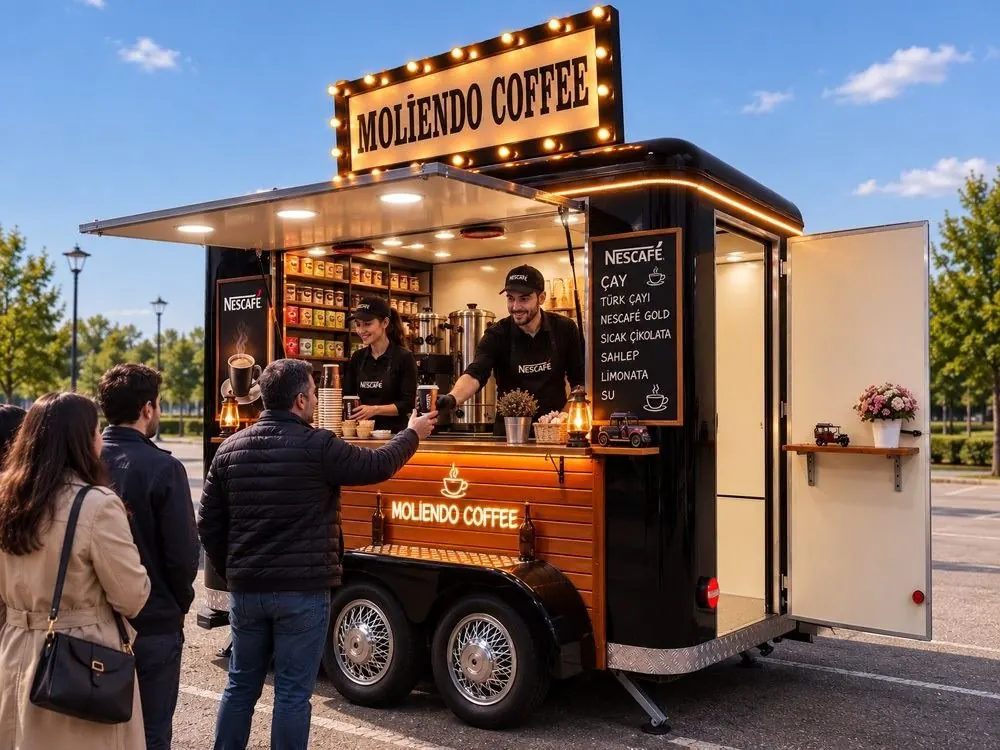
Licensing examples come from GOV.UK and the California ABC, hygiene rules from the FDA Food Code and EU Regulation 852/2004, and equipment figures from maker spec sheets. We do not recommend a model. Your licensing authority and health department have the final word.
Checked on 29 September 2026.
Start with the licence, because it is local
Alcohol rules differ from place to place. The two cases below are examples only. Check with your local licensing authority before you fix the design.
England and Wales. GOV.UK says anyone who wants to sell or supply alcohol "must have a licence or other authorisation from a licensing authority - usually a local council". The Licensing Act 2003 defines premises as any place, and that "includes a vehicle, vessel or moveable structure". A business selling alcohol on a permanent basis needs a premises licence. The application asks for a designated premises supervisor who holds a personal licence, an operating schedule and "a detailed plan of the premises".
For one-off events there is the Temporary Event Notice. The event must have fewer than 500 people at all times, staff included, and last no more than 168 hours. You apply at least 10 clear working days before. You can get up to 5 a year, or up to 50 with a personal licence. The police or environmental health can object. For Scotland, GOV.UK points to an occasional licence instead.
California. The state's Department of Alcoholic Beverage Control issues a Type 58 caterer's permit, but only to holders of certain existing licences. Each catered event then needs its own authorization from ABC. There is a limit of 36 catered events per year at any given location. An event may also need the property owner's approval, law enforcement approval or a site diagram. Approval is not automatic when you pay.
Our reading: in both examples the licence follows the seller and the place or event. Neither source says a trailer can arrive licensed from the factory. If the trailer itself becomes licensed premises in England or Wales, the builder's layout drawing is the kind of plan the council asks for. Ask your council what format it wants.
Drinks and ice count as food
The health rules apply to a bar as well as to a kitchen.
In the FDA Food Code, "food" includes ice and beverages, and a food establishment includes an operation "conducted in a mobile, stationary, temporary, or permanent facility". The code excludes a business that offers only pre-packaged foods that do not need temperature control. The Food Code is a model, and states and localities adopt some edition of it.
Our reading: a trailer that pours drinks over ice is inside the definition. One that sells only sealed cans may be treated differently. Ask your health department which applies to your menu.
In the EU, Regulation 852/2004 uses the food definition of Regulation 178/2002, and that definition "includes drink". Annex II, Chapter III covers mobile sales vehicles.
Handwashing: a sink that is only for hands
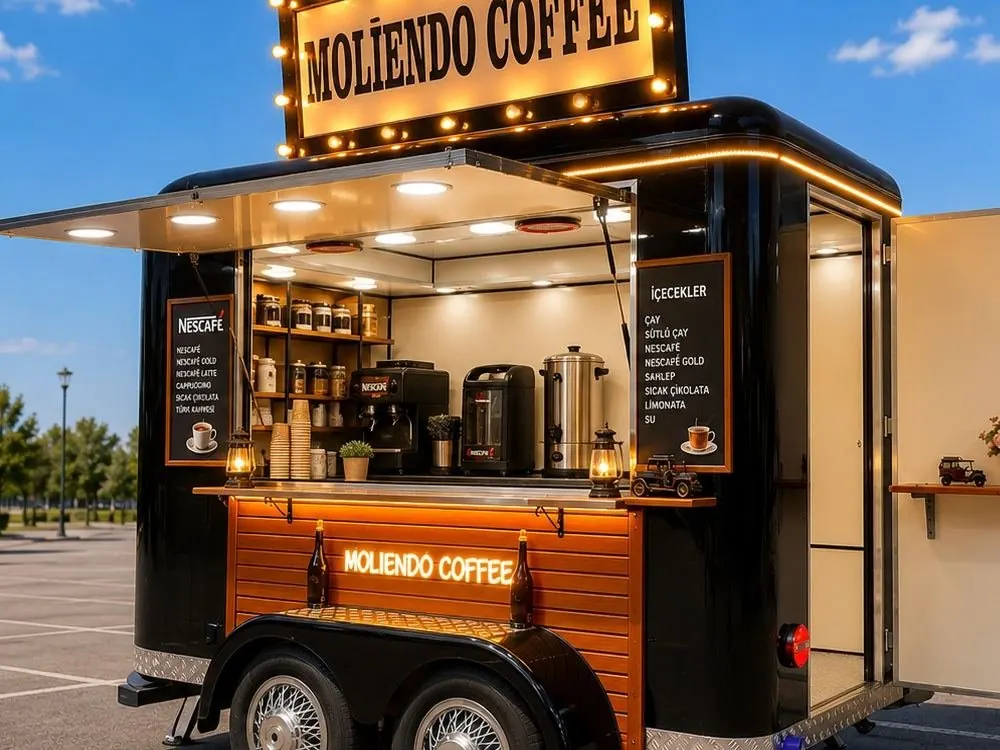
Where your health department follows the Food Code, plan for:
- at least one handwashing sink, placed for convenient use where staff prepare food, dispense it and wash equipment,
- water of at least 29.4°C (85°F),
- a self-closing, slow-closing or metering tap that runs for at least 15 seconds,
- a sink that stays accessible and is used for nothing but handwashing.
Our reading: emptying ice or rinsing bar tools in the hand sink is a use other than handwashing. So those jobs need their own sink or drain point.
The EU regulation asks, where necessary, for facilities to wash and dry hands hygienically. It sets no sink count, so ask your authority.
Glass washing: sinks or a machine
Glasses are utensils under the Food Code. Its definition of tableware names cups and tumblers. Clean glasses must be handled so the lip-contact surface is not contaminated.
For washing by hand, the code's default is a sink with at least three compartments, each big enough to immerse the largest item. A two-compartment sink or other alternatives need approval. The wash water must be at least 43°C (110°F), or what the detergent label says. Sanitizing by hand means immersion in water of 77°C (171°F) or more for at least 30 seconds, or a chemical sanitizer used with the contact time on its label.
A glasswasher changes the numbers. A hot-water machine with a stationary rack and a single temperature must wash at 74°C (165°F) or more. A machine that sanitizes with chemicals must wash at 49°C (120°F) or more.
Hobart's two LXGn glasswashers show what that choice means on a trailer:
| Hobart model | Sanitizing | Electrical | Heating | Water at maximum use |
|---|---|---|---|---|
| LXGnR | hot water, 180°F rinse | 120/208 V at 23.7 A, or 120/208-240 V at 34.0 A (rated) | 1.8 kW tank heat, 4.9 kW booster | 18.6 US gal per hour |
| LXGnPR | chemical | 120 V, 14.9 A rated | 1.8 kW tank heat | 33.0 US gal per hour |
The hot-water model accepts incoming water at 55 to 85°F. The chemical model asks for at least 120°F. Both need 15 to 65 PSIG of flowing water pressure and have a pumped drain.
Our reading: on a trailer, the hot-water machine is a power decision and the chemical machine is a hot-water decision. At maximum use, the chemical model would take 33 gallons in an hour from your fresh tank and send them to your waste tank.
Moist air escapes from the door, so Hobart asks for moisture-resistant materials beside and above the machine. The drawings show a counter opening of at least 35 1/16 inches for the machine on its feet. Check the drawing for the version you buy.
In the EU, Regulation 852/2004 asks for adequate provision for cleaning and, where necessary, disinfecting utensils. It sets no temperatures, so ask your authority.
Ice and cold storage
The Food Code says ice for drinks or cooling must be made from drinking water. Ice that has cooled the outside of canned or other packaged drinks may not then go into a glass. Between uses, the ice scoop is kept in a clean, protected place or in the ice with its handle above it. EU Regulation 852/2004 says ice that touches food must be made from potable water and handled and stored so it stays clean.
The code's list of foods that need temperature control includes heat-treated animal food. Ask your health department how it treats milk and cream in drinks. Cold food under that rule is held at 5°C (41°F) or below, in a fridge with a thermometer you can read. The EU text gives no figure but says the cold chain must not be interrupted.
Here is what four makers' sheets say:
| Model | Size (W x D x H) | Electrical | Maker's figures |
|---|---|---|---|
| True TUC-27-HC undercounter fridge | 27 5/8 x 30 1/8 x 29 7/8 in | 115 V, 2.0 A, 15 A dedicated outlet | holds 33 to 38°F; NSF/ANSI 7 for open food product |
| True TBB24-48-2S-Z1-SFT-S-1 back bar cooler | 48 1/8 x 24 7/8 x 34 3/4 in | 115 V, 1.8 A, 15 A dedicated outlet | 35°F; NSF/ANSI 7 for packaged or bottled product |
| Hoshizaki AM-50BAK ice machine | 14 7/8 x 22 5/8 x 33 1/2 in | 115 V, 2.0 A, 15 A max fuse | up to 54 lb a day, 27 lb bin |
| Hoshizaki KM-301BAK ice machine | 30 x 28 x 39 in | 115 V, 5.7 A, 15 A max fuse | up to 285 lb a day, 100 lb bin |
Three things stand out.
First, the rating. The back bar cooler is listed for packaged or bottled product, the undercounter fridge for open food. Our reading: cut garnishes and open dairy belong in the second kind. Check the rating on the sheet of the exact model.
Second, water and drains. Both ice machines need water at 10 to 113 psig, and the AM-50BAK ships without a drain pump. The Food Code wants water under pressure at every fixture that uses it. Our reading: a trailer on tanks needs a water pump, and the ice machine drain has to reach the waste tank by gravity or through a pump.
Third, heat and power. The ice machines reject 1,400 and 5,200 BTU an hour and are rated for ambient air from 45 to 100°F. Ask your builder how that heat leaves the bar on a hot day. Each True sheet asks for a 15 A dedicated outlet. Our guide to sizing a food truck generator shows how to add up rating plates.
Layout behind the bar
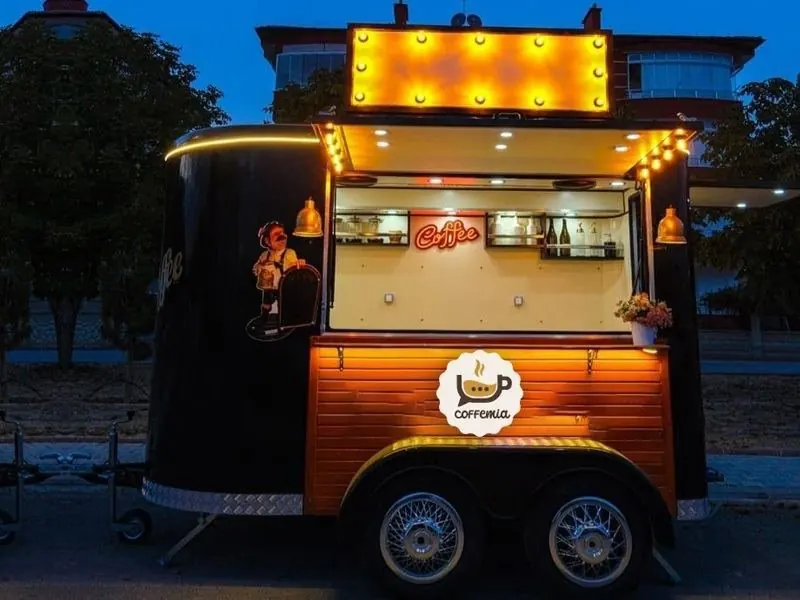
Where the Food Code applies, your health department can ask for plans that show the menu, the expected volume, the layout and each piece of equipment by maker, model number and dimensions. So choose the fridges, ice machine and glasswasher before the drawing.
The sheets then fix much of the layout. The back bar cooler wants 1 inch of clearance at the sides and back. Both ice machines take in and blow out air at the front, and Hoshizaki says this removes the need for side and rear clearance on the AM-50BAK. The handwashing sink sits within easy reach of the pouring and washing areas.
Then the water. Where the Food Code applies, the waste tank is 15 percent larger than the fresh tank, the fresh tank inlet is 19.1 mm (three-fourths of an inch) or less, and waste is emptied at an approved servicing area. Plan the drains from the ice machine, sinks and glasswasher into it.
On the Sauce Hotel project, we built a three-wheel Ape with a wooden body, a lift-up awning and a coffee and drinks bar inside. It carries the hotel brand and is sized to stand on a hotel terrace. For hotels and resorts, we build food trucks, coffee trailers and mobile bars for pool, beach and garden service, designed around the hotel's concept. You can see the Ape and our other mobile cafes on the coffee trailer page.
What to send for a quote
Send these with your enquiry:
- where the bar will trade: one site, events, or both, and in which country, state or council,
- which licence route you are taking, and who will hold it,
- the drinks menu, including anything with dairy or cut garnishes,
- the number of staff behind the bar and your busiest hour,
- glass or single-use cups, and sinks or a glasswasher (hot water or chemical),
- the fridges and ice machine you want, or the ice you expect to use in a day,
- the power and water available on site, or whether the bar runs on tanks,
- anything your health department has already asked for,
- your branding and the look you want.
Frequently asked questions
What is a mobile bar?
A bar built into a trailer, vehicle or moveable structure so it can serve drinks where it parks. In England and Wales the Licensing Act 2003 counts a vehicle or moveable structure as premises. Elsewhere, ask your licensing authority.
How do you make a mobile bar trailer?
Settle the licence route first, then the menu. Choose the fridges, ice machine and glasswasher from their spec sheets, because their power, water, drain and clearance needs shape the layout. Where the FDA Food Code applies, the waste tank is 15 percent larger than the fresh tank.
How much does it cost to build a mobile bar?
It depends on the build, so there is no single figure. The main drivers are the base trailer or vehicle, the refrigeration and ice machine, the glass washing, the water and power systems, and the serving side and branding.
Send your menu and the list above through the quote form, with where the bar will stand. You can see our full range on What We Build and the Sauce Hotel Ape on the coffee trailer page.
Related guides
- New vs Used Food Truck: What to Check Before You Buy
- Taco Trucks: Kitchen Line, Holding and Service Window Planning
- How Much Does a Food Truck Cost to Build? The Parts That Drive the Price
- Hot Dog Carts vs Hot Dog Trailers: What Changes for the Buyer
Sources
- GOV.UK, Alcohol licensing
- GOV.UK, Temporary Events Notice (England and Wales)
- GOV.UK, Premises licence (England and Wales)
- Licensing Act 2003, section 193
- California Department of Alcoholic Beverage Control, Caterer's Permit
- FDA Food Code 2026 (PDF), sections 1-201.10, 3-202.16, 3-303.11, 3-304.12, 3-501.16, 4-204.112, 4-301.11, 4-301.12, 4-501.19, 4-501.110, 4-501.111, 4-703.11, 4-904.11, 5-103.12, 5-202.12, 5-203.11, 5-204.11, 5-205.11, 5-303.13, 5-401.11, 5-402.14, 8-201.12
- Regulation (EC) No 852/2004, Article 2 and Annex II, Chapters III, VII and IX
- Regulation (EC) No 178/2002, Article 2
- True Manufacturing, TUC-27-HC spec sheet
- True Manufacturing, TBB24-48-2S-Z1-SFT-S-1 spec sheet
- Hoshizaki America, AM-50BAK
- Hoshizaki America, KM-301BAK
- Hobart, LXGn series glasswashers and spec sheets F48667 (LXGnR) and F48664 (LXGnPR)

By
Ozan Food Truck
This guide is based on the laws, regulations, official guidance and manufacturer documents linked in the text. It is general information, not legal or engineering advice. Rules differ by country, state and city, so confirm the details with your local authority before you build or buy.