
Buying guide
Taco Trucks: Kitchen Line, Holding and Service Window Planning
Plan a taco truck around four stations that feed one service window: a plancha or griddle, hot holding at 135°F (57°C) or above, a cold topping rail at 41°F (5°C) or below, and a tortilla warmer. Decide first whether raw meat is cooked on board or arrives cooked and is reheated. In Los Angeles County that choice is tied to the permit class, and it changes what the kitchen must do.
By Ozan Food TruckPublished 10 min read
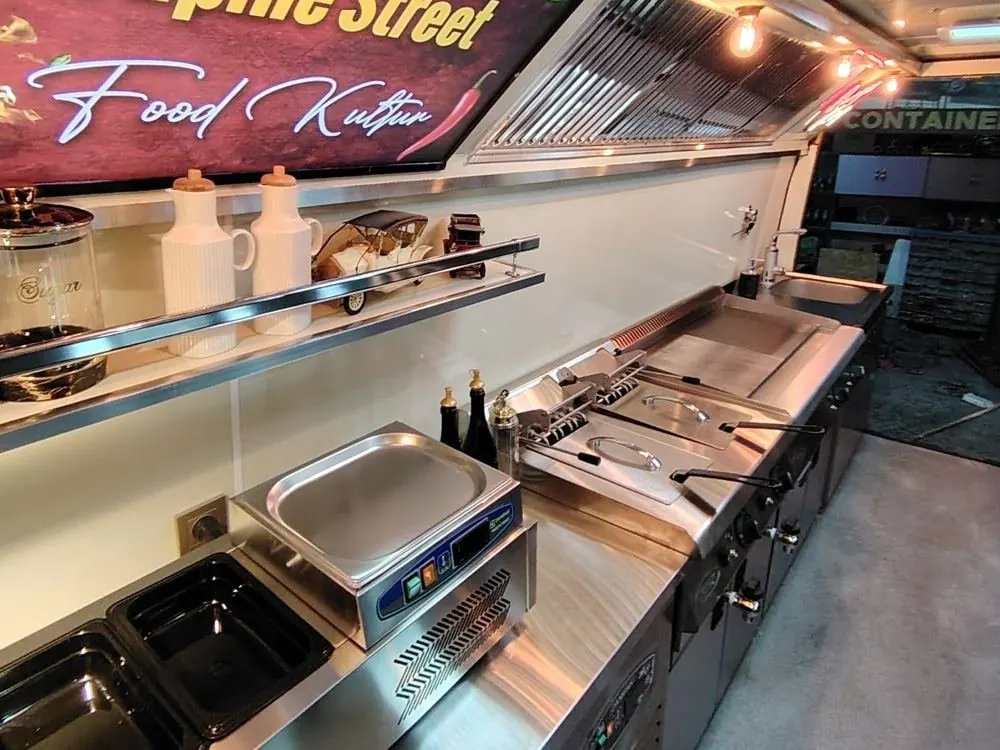
This is a neutral buyer guide for US taco truck orders. It draws on the FDA Food Code 2026, California's mobile food facility law, LA County Public Health as a worked example, and maker spec sheets. The appliances are examples, not recommendations.
Checked on 29 September 2026.
Raw meat on board or not
In Los Angeles County, the menu sets the class. The county's fee schedule gives "taco truck, kebab truck, BBQ truck, sandwich truck handling raw meats" as examples of a high-risk mobile food facility. For plan check, the high-risk category reads "tacos, sandwiches, seafood (with raw meat, poultry or fish on the MFF)". A "sandwich truck handling precooked meats" is listed as moderate risk.
The class matters after you open, too. LA County schedules high-risk trucks for two inspections a year. Others get one.
If your meat is cooked at the commissary and finished on the truck, the Food Code sets the reheat. Food that is cooked, cooled and reheated for hot holding must reach 165°F (74°C) for 15 seconds, and the time between 41°F and that temperature may not exceed two hours. Whether a precooked-meat taco menu changes your class is for the county to say. Ask them before the plans are drawn.
In California, potentially hazardous food held at 135°F or above on a mobile food facility "shall be destroyed at the end of the operating day." Our reading: in California, size your hot-holding pans for one day's service, not more.
The kitchen line, station by station
| Station | Example (maker) | Printed values | Rule behind it |
|---|---|---|---|
| Plancha, gas | Star Ultra-Max 836TA, 36 in | 90,000 BTU; 30,000 BTU per 12 in section, each with its own control; 1 in steel plate; 150 to 550°F; about 150 kg installed | Hoods that keep grease off walls and ceilings (Food Code 4-301.14) |
| Plancha, electric | Lincat Silverlink GS6/T, 600 mm | 4.0 kW; 17.4 A single phase at 230 V | Same |
| Hot holding | Lincat BM6W wet-heat bain-marie | 2.0 kW, 230 V; six 1/4-size gastronorm pans | 135°F (57°C) or above |
| Hot holding, drop-in | APW Wyott HFW-2, two wells | Listed at 208/240 V only | Same |
| Cold rail | True TSSU-48-12M-B-HC prep table | Holds 33 to 41°F in the pans; 12 sixth-size pans; 5.8 A at 115 V; 141 kg | 41°F (5°C) or below |
| Tortilla warmer | Star RTW14EA rolling warmer | 14.9 A, 1,787 W at 120 V; up to 900 six-inch tortillas an hour; target 160°F | Maker asks for a dedicated line |
The plancha
Star's spec sheet says the griddle's sides and back "must be at least six [6] inches (152 mm) from any wall or surface [combustible or non-combustible]." Our reading: a 36-inch griddle then takes 48 inches of wall on its own. Get that into the drawing before you choose the body length.
Gas or electric is also a power question. Lincat's electric griddle draws 17.4 A on single phase, while Star's gas model takes a 3/4-inch gas connection. In California, LPG equipment must be installed to fire authority standards and approved by the fire authority, with a separate rule for some vehicles covered by another part of the code.
Fire rules differ by city. Austin, Texas, for one, asks trucks permitted after May 1, 2022 for an IFC-compliant fire suppression system if they have appliances that produce grease-laden vapors, and it names flat tops. California asks for a mounted 10 BC-rated extinguisher inside any mobile food facility with cooking equipment. Check with your fire authority before the hood is ordered.
Hot holding and the cold rail
The Food Code holds hot food at 135°F or above and cold food at 41°F or below. It also asks for a built-in, easy-to-read thermometer on cold and hot holding equipment. Bain-maries and steam tables are among the exceptions. A food probe thermometer must be on hand either way.
True's prep table holds 33 to 41°F in the pans. It offers a factory-installed exterior temperature display and a sneeze guard as options.
If the truck trades at more than one place a day, California wants steam tables fitted with positive closing lids and a secure latch, so hot liquid doesn't spill inside in a sudden stop.
The tortilla warmer
Star rates the RTW14EA at up to 900 six-inch tortillas an hour, heated to a target of 160°F. Its manual asks for a dedicated AC line only.
Star's two documents also disagree. The manual says the sides and back need no extra clearance, while the spec sheet asks for one inch. Even the plug type is given differently in different places. Design to the rating plate of the warmer you receive.
Our reading: on 120 V, the tortilla warmer and the prep table alone add up to 20.7 A, before any fridge, fan, pump or light. True and Star each want a dedicated outlet. Our generator sizing guide shows how to add up the rating plates.
How the line feeds the window
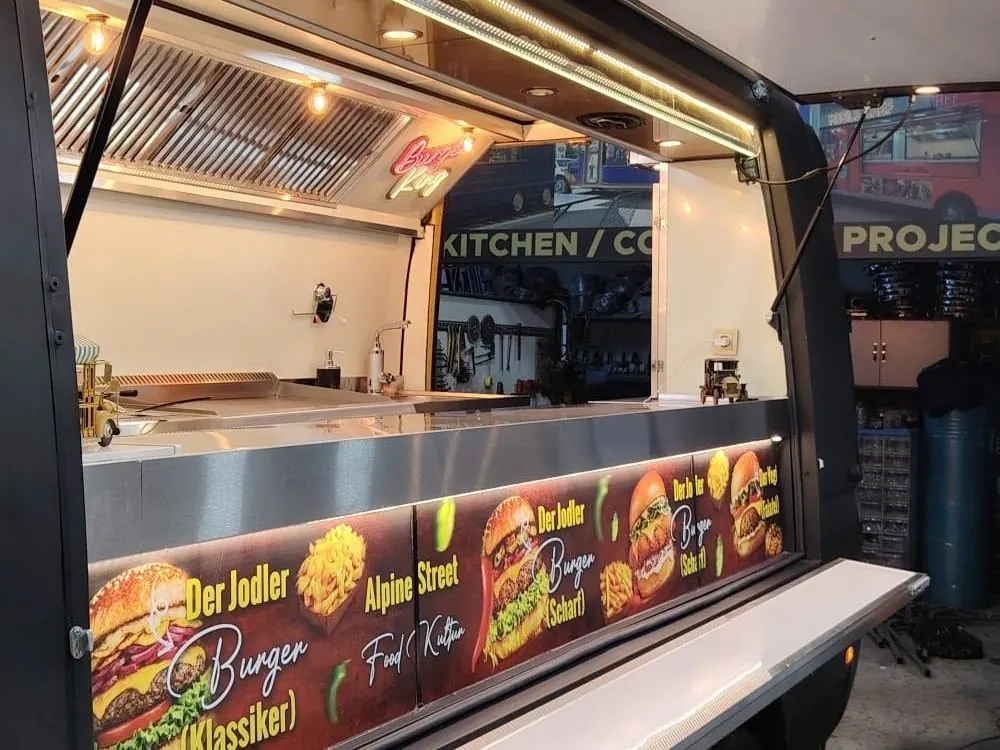
On our custom trucks, "the layout starts with what you cook and how many people work inside," and the cooking line, storage and refrigeration "are placed so your team moves as little as possible during a busy service."
California sets some of the geometry. Prep counter space must be "adjacent to all cooking equipment." An occupied truck needs 74 inches of clear height over the aisle and 30 inches of clear aisle width. A generator must sit in an area completely separated from food preparation and storage, reached from outside.
Under the Food Code, staff may not touch ready-to-eat food with bare hands and use utensils or single-use gloves instead. Our reading: a finished taco is ready-to-eat food, so put the tortilla warmer and the cold rail side by side at the window end, with the hot pans behind, so assembly happens in one place and the plate goes straight out.
The service window
Our trucks use "lift-up hatches on gas struts, counters and menu panels placed for the way your customers queue." A window that stays open through service brings in the pest rules.
The Food Code says openings kept open must be protected by 16-mesh screens, air curtains or other effective means, unless flying insects are absent where you trade. LA County's inspection guide marks "Missing/torn window screens" and "Pass-thru window exceeds 432 square inches and missing an air curtain." 432 square inches is, for example, 24 by 18 inches. Our reading: a long hatch passes that size quickly, so ask Plan Check whether yours needs an air curtain before the opening is cut.
Toppings on show at the window count as food on display. The Food Code asks for food guards, display cases or other effective means. Condiments go in protective dispensers or single portions. LA County marks food "displayed without a sneeze guard."
California also wants the business name on the customer side in letters at least 3 inches high, with the city, state and ZIP code in letters at least one inch high. A motorized truck carries it on two sides. Plan it into the wrap from the start.
Where the handwash sink goes
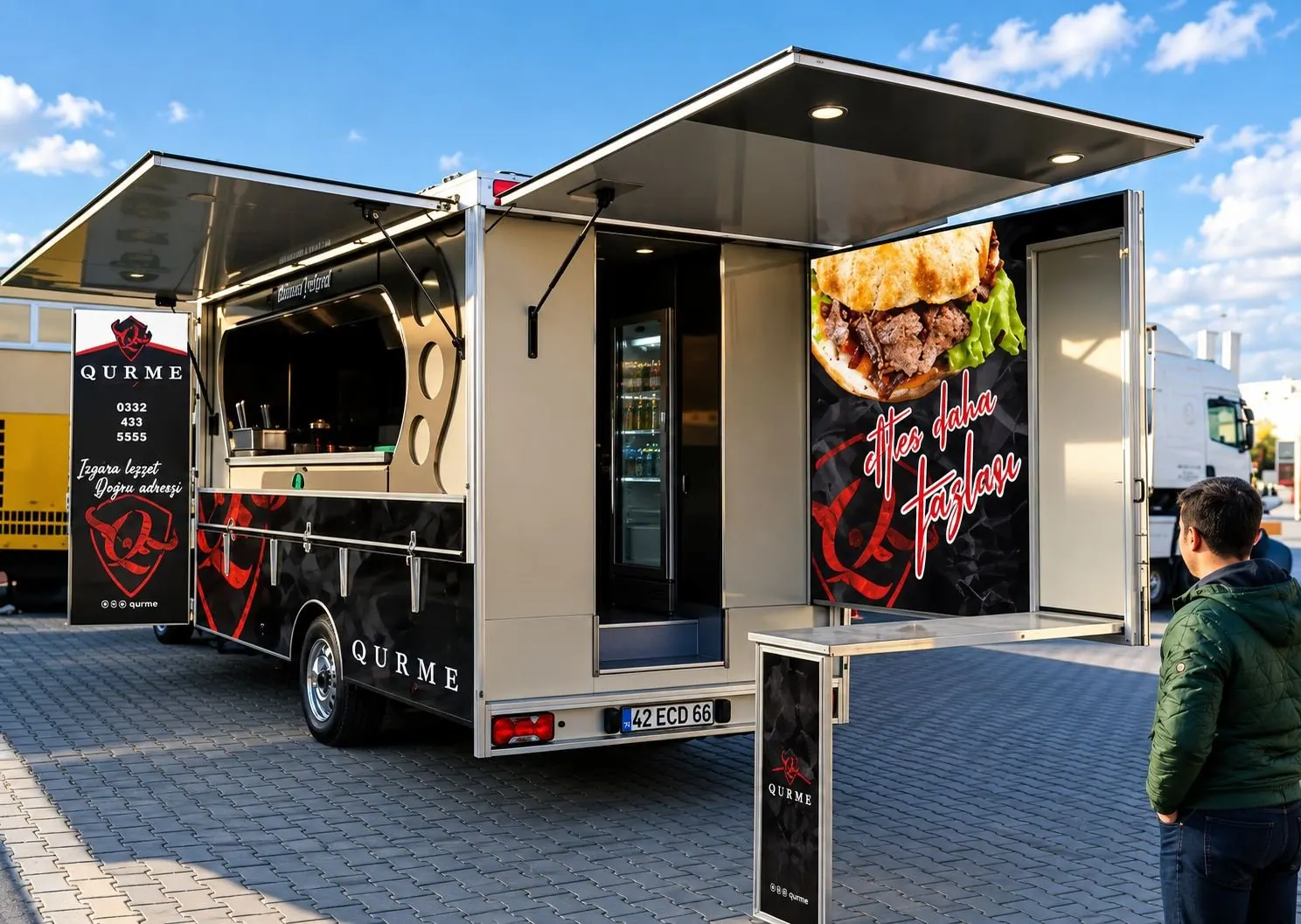
The Food Code places a handwash sink "to allow convenient use by EMPLOYEES in FOOD preparation, FOOD dispensing, and WAREWASHING areas." Its notes call a sink in the immediate work area, or between work areas, properly located. It must be always accessible and used for nothing but handwashing. Water must reach at least 85°F through a mixing valve or combination faucet.
Our reading: in a taco truck the window is a dispensing area, so the handwash sink belongs within reach of both the assembly station and the window, not only at the back door.
California is more exact:
- The handwash sink is at least 9 by 9 inches and 5 inches deep.
- It is separated from the warewashing sink by a metal splashguard at least 6 inches high, or the drainboards are 24 inches or more apart.
- The warewashing sink has three compartments with two metal drainboards, each compartment at least 12 by 12 by 10 inches or 10 by 14 by 10 inches.
- A water heater reaches at least 120°F, runs independently of the engine, and holds at least four gallons when there is a warewashing sink.
Under the Food Code, the waste tank is sized 15 percent larger than the fresh water tank. The wider water and equipment list is in our food truck equipment guide.
LA County permits for a taco truck
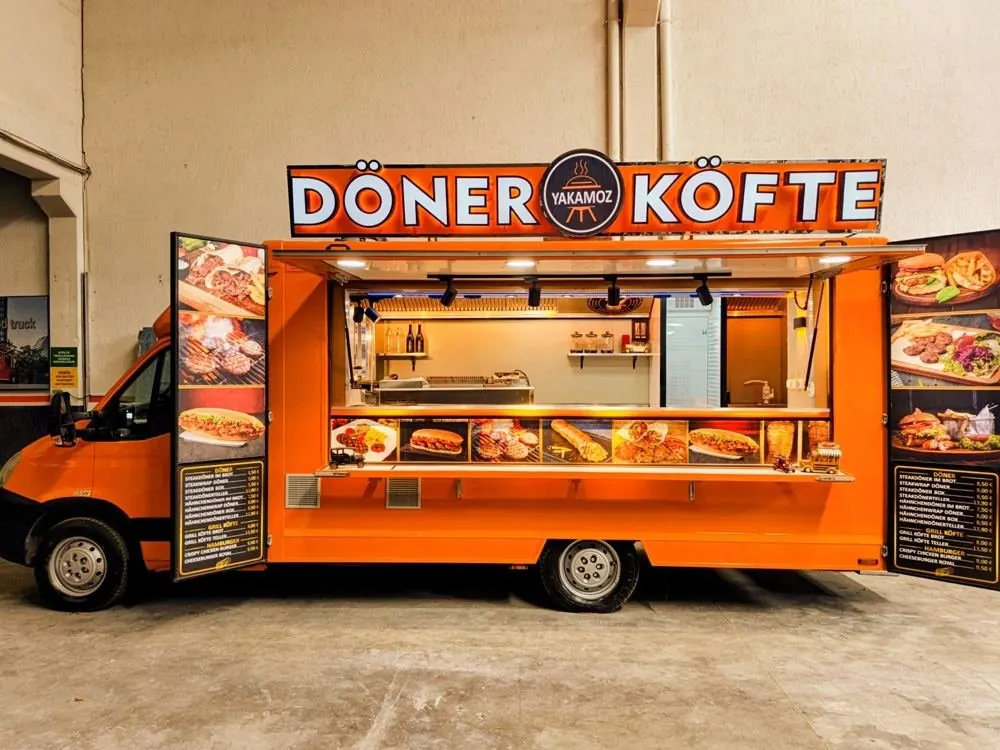
Public Health permits and inspects mobile food facilities across the county, except in Long Beach, Pasadena and Vernon, which run their own departments. New trucks go through Plan Check, and you build only after the plans are approved.
The county's getting-started sheet starts with your menu, its risk level and the preparation it needs. It then lists the documents: permit application, plan check service request, route information, commissary contract, ownership documents, a standard operating procedure and the menu. Every truck must report its route and schedule, and update it when the route changes significantly.
Texas, for example, gives "taco truck" as an example of its Type III licence, for vendors who "prepare, cook, hold, and serve food". Check with your local health department for the class you would fall into.
What to send the builder for a quote
- Your menu, and whether raw meat is cooked on board or meat arrives precooked.
- The county or city where you will trade, and its class for your menu if you know it.
- Gas or electric plancha, with width, and any models you want, with spec sheets.
- Hot-holding pan count and size, and the cold rail pan count.
- Tortilla warmer or griddle heating, and the tortillas per hour at your busiest hour.
- How many people work inside.
- Window length, which side it opens on, and whether you want a screen or an air curtain.
- The power source: generator, shore power or batteries.
- The base: box body on a chassis cab, panel van or trailer.
Frequently asked questions
What is a taco truck called?
California law and LA County call it a mobile food facility, and the county lists "taco truck" as an example of its high-risk class. In Texas the vehicle is a food vending vehicle, and a taco truck is an example of the Type III licence.
Is a taco truck healthy?
We can't speak to nutrition. What the rules cover is food safety: under the Food Code, hot food held at 135°F or above, cold toppings at 41°F or below, and no bare-hand contact with ready-to-eat food. In LA County a high-risk truck is scheduled for two inspections a year, and an approved truck should carry a letter grade.
What equipment do I need for a taco truck?
The line in this guide is a plancha or griddle, hot holding, a refrigerated topping rail and a tortilla warmer. In California you also need a handwash sink, a three-compartment warewashing sink and a water heater. Your health department approves the final list at plan review.
If you want a taco kitchen drawn around your menu, send the list above through the quote form. We reply with questions first, then drawings and a quote. You can see our other builds on the food trucks and trailers page.
Related guides
- New vs Used Food Truck: What to Check Before You Buy
- How Much Does a Food Truck Cost to Build? The Parts That Drive the Price
- Hot Dog Carts vs Hot Dog Trailers: What Changes for the Buyer
- How to Choose a Food Truck or Food Trailer Builder: What to Check Before You Order
Sources
- FDA Food Code 2026 (sections 3-301.11, 3-306.11, 3-306.12, 3-403.11, 3-501.16, 4-204.112, 4-301.14, 5-202.12, 5-204.11, 5-205.11, 5-401.11, 6-202.15)
- California Health and Safety Code, Chapter 10, Mobile Food Facilities (114294-114327)
- LA County Public Health, Food Service Trucks, Trailers, and Boats
- LA County Public Health, New Mobile Food Facility Fees (Summary), for category names
- LA County Public Health, New Permit Fees and Categories for Mobile Food Facilities
- LA County Public Health, Mobile Food Facility Inspection Guide
- LA County Public Health, MFF How to Get Started
- LA County Public Health, MFF New Construction Checklist
- Texas DSHS, Mobile Food Vendors
- City of Austin Fire Department, Mobile Food Vending Fire Inspections
- Star, Ultra-Max 836TA gas griddle
- Star, Ultra-Max gas griddle spec sheet
- Star, RTW14EA rolling tortilla warmer
- Star, RTW series spec sheet
- Star, RTW series owner manual
- Lincat, Silverlink 600 electric griddle GS6/T
- Lincat, Silverlink 600 wet-heat bain-marie BM6W
- APW Wyott, HFW series hot food wells
- True, TSSU-48-12M-B-HC prep table

By
Ozan Food Truck
This guide is based on the laws, regulations, official guidance and manufacturer documents linked in the text. It is general information, not legal or engineering advice. Rules differ by country, state and city, so confirm the details with your local authority before you build or buy.