
Buying guide
Bubble Tea Trailers and Trucks: Equipment, Water and Layout
A bubble tea trailer is specified around the drinks line: a tapioca pearl cooker, a cup sealer, a fructose dispenser, an ice machine and fridges, plus the water that feeds them and a plan for holding cooked pearls. Pick your cup and your pearl first. The cup decides the sealer, and the pearl's cooking directions decide how long the cooker runs.
By Ozan Food TruckPublished 10 min read
The hygiene rules below come from the FDA Food Code 2026, a model code that states and localities adopt in their own versions. Equipment values come from maker spec sheets and product pages. Where we could not find a readable sheet, we say so, and you should ask the seller for one. We do not recommend any model.
Checked on 29 September 2026.
What makes a bubble tea trailer different
Most of the machines on a bubble tea line cool, sweeten or seal. If your menu has no hot food, the pearl pot may be the only cooking on board.
Possmei, a bubble tea supplier, says the basic machines for a bubble tea shop are mainly the fructose machine, the shaking machine and the sealing machine. Add the pearl cooker, the ice and the fridges, and you have the equipment list that shapes your trailer's power, water and layout.
The machines, one by one
Tapioca pearl cooker
We found no readable maker spec sheet for a pearl cooker. Before you order, ask the seller for the sheet and check the voltage, the wattage, the pot capacity, the dimensions and whether it needs a water connection or a drain.
The pearl packs themselves tell you a lot. Bossen and Possmei both give a ratio of 1:10, pearls to water, so 100 g of pearls go into 1,000 ml of water. Bossen's classic pearls cook for 25 minutes on low heat, then rest covered for 35 minutes. Its quick-cook pearls take 5 minutes in boiling water and 5 minutes of resting. Possmei's quick-cook pearls take 5 minutes of cooking and 10 of resting. Bossen's directions then rinse the pearls in cold water.
Our reading: the pearl you choose changes how long the cooker is in use and how long steam goes into the trailer. The amount of water follows the 1:10 ratio and the size of each batch. The Food Code asks for mechanical ventilation where it is needed to keep a room free of excessive heat, steam and condensation. Ask your builder how steam leaves the trailer.
Cup sealer
Karat's spec sheet for its sealing machines lists cutter rims of 90, 95, 98 and 120 mm, for PP or PET cups. The models are the Y8009EPH (90 mm), Y8019EPH (95 mm), Y8029EPH (98 mm) and Y8028EPH (120 mm). The maximum sealing cup height for all of them is 180 mm (7.08 in).
Our reading: the sealer is matched to the cup rim, so choose the cup before the sealer. If you want a taller cup later, check it against the height limit.
The sheet gives no voltage, wattage or machine dimensions. Ask for them before the electrical plan is drawn.
Fructose dispenser
The same Karat sheet lists the Y8201EPH fructose dispenser machine. It gives no electrical data, so get that from the seller too.
A dispenser pours a liquid food. The Food Code says that in equipment dispensing liquid food unpackaged, drips from condensation and splash must be diverted from the cup opening, and the delivery tube and orifice must be protected from hand contact, for example by being recessed. Our reading: ask the dispenser maker how its design meets this.
Ice machine and fridges
Here is what four makers' sheets say:
| Model | Size (W x D x H) | Electrical | Maker's figures |
|---|---|---|---|
| True TUC-27-HC undercounter fridge | 27 5/8 x 30 1/8 x 29 7/8 in | 115 V, 2.0 A, 15 A dedicated outlet | holds 33 to 38°F; NSF/ANSI 7 for open food product |
| True TBB24-48-2S-Z1-SFT-S-1 back bar cooler | 48 1/8 x 24 7/8 x 34 3/4 in | 115 V, 1.8 A, 15 A dedicated outlet | 35°F; NSF/ANSI 7 for packaged or bottled product |
| Hoshizaki AM-50BAK ice machine | 14 7/8 x 22 5/8 x 33 1/2 in | 115 V, 2.0 A, 15 A max fuse | up to 54 lb a day, 27 lb bin |
| Hoshizaki KM-301BAK ice machine | 30 x 28 x 39 in | 115 V, 5.7 A, 15 A max fuse | up to 285 lb a day, 100 lb bin |
Look at the rating first. One True model is listed for open food, the other for packaged or bottled product. Our reading: open milk, brewed tea and cooked pearls belong in the first kind. Check the rating on the sheet of the exact model you buy.
Then the water. At the maker's rated conditions, the AM-50BAK uses 65 gallons of potable water per 100 lb of ice and the KM-301BAK uses 31 gallons. Our reading: ice made on board takes more from your fresh tank than the ice weighs, and the rest goes to the drain. Both machines need water at 10 to 113 psig, and the AM-50BAK comes without a drain pump.
Then heat. The two ice machines reject 1,400 and 5,200 BTU an hour and are rated for air from 45 to 100°F. Each True sheet asks for a 15 A dedicated outlet. Our guide to sizing a food truck generator shows how to add the rating plates together.
Water: source, tanks and waste
Where the Food Code applies, drinking water must come from an approved source, and bottled water from approved sources too. A mobile facility can be supplied from commercially bottled water, closed portable containers, an enclosed vehicle tank, a storage tank on the premises, or hoses from an adjacent approved source.
For a trailer with its own tanks, the code sets these points:
- the water system has enough capacity for peak demand, and so does the hot water,
- water reaches every fixture and machine that needs it under pressure,
- the fresh tank is enclosed and sloped so it drains completely,
- the tank inlet is 19.1 mm (three-fourths of an inch) or less inside, with a hose connection that can't be used for anything else,
- the tank, pump and hoses are flushed and sanitized after construction, repair or modification and after periods of nonuse, and are used for drinking water only,
- the waste tank is 15 percent larger than the fresh tank, with a drain of at least 1 inch and a shut-off valve.
Our reading: the pressure rule and the ice machines' 10 psig minimum mean a tank-fed trailer needs a water pump. The pearl water, the ice machine drain and the sinks all end up in the waste tank, so count them when the tanks are sized.
You also need a handwashing sink placed for convenient use where drinks are prepared and dispensed and where equipment is washed. It gives water of at least 29.4°C (85°F), a self-closing, slow-closing or metering tap on it runs for at least 15 seconds, and it is used for nothing but hands. Shakers and pots are washed in a sink with at least three compartments by default. A two-compartment sink needs your health department's approval.
Ice
Ice for drinks or for cooling must be made from drinking water. Ice that has cooled the outside of canned drinks or packaged food may not then go into a cup. Between uses, an ice scoop can be kept in a clean, protected place.
Holding cooked pearls
This is the question to settle with your health department before the layout is final.
The Food Code's list of foods that need time or temperature control includes a plant food that is heat-treated. Our reading: cooked pearls fit that wording. The definition also has pH and water-activity tables that can change the result for a given product, and the code text does not name tapioca. Your health department decides how it treats your pearls.
For food that needs control, the code gives three routes:
- Hot: hold at 57°C (135°F) or above.
- Cold: hold at 5°C (41°F) or below. Cooked food is cooled from 135°F to 70°F within two hours, and to 41°F within six hours in total.
- Time: use time as the public health control under section 3-501.19. Written procedures are prepared in advance, kept on site and shown to the inspector on request. Under the four-hour option, the food normally starts at 41°F or below or at 135°F or above. It is marked with the time four hours after it left temperature control, and then served or discarded by that time. Unmarked food is discarded. A six-hour option exists only for food that starts at 41°F or below and stays at 70°F or below.
The FDA's own notes on this section say that B. cereus is commonly associated with outbreaks involving inadequate hot holding of starchy foods. They add that the four-hour limit is designed to prevent significant growth or toxin formation.
Bossen tells you to rinse cooked pearls in cold water. The code text we read does not say how the four-hour clock applies to pearls handled that way. Ask your health department, and ask early. The answer decides whether your trailer needs hot holding, fridge space for pearls, or only timers and labels.
Layout for fast drink service
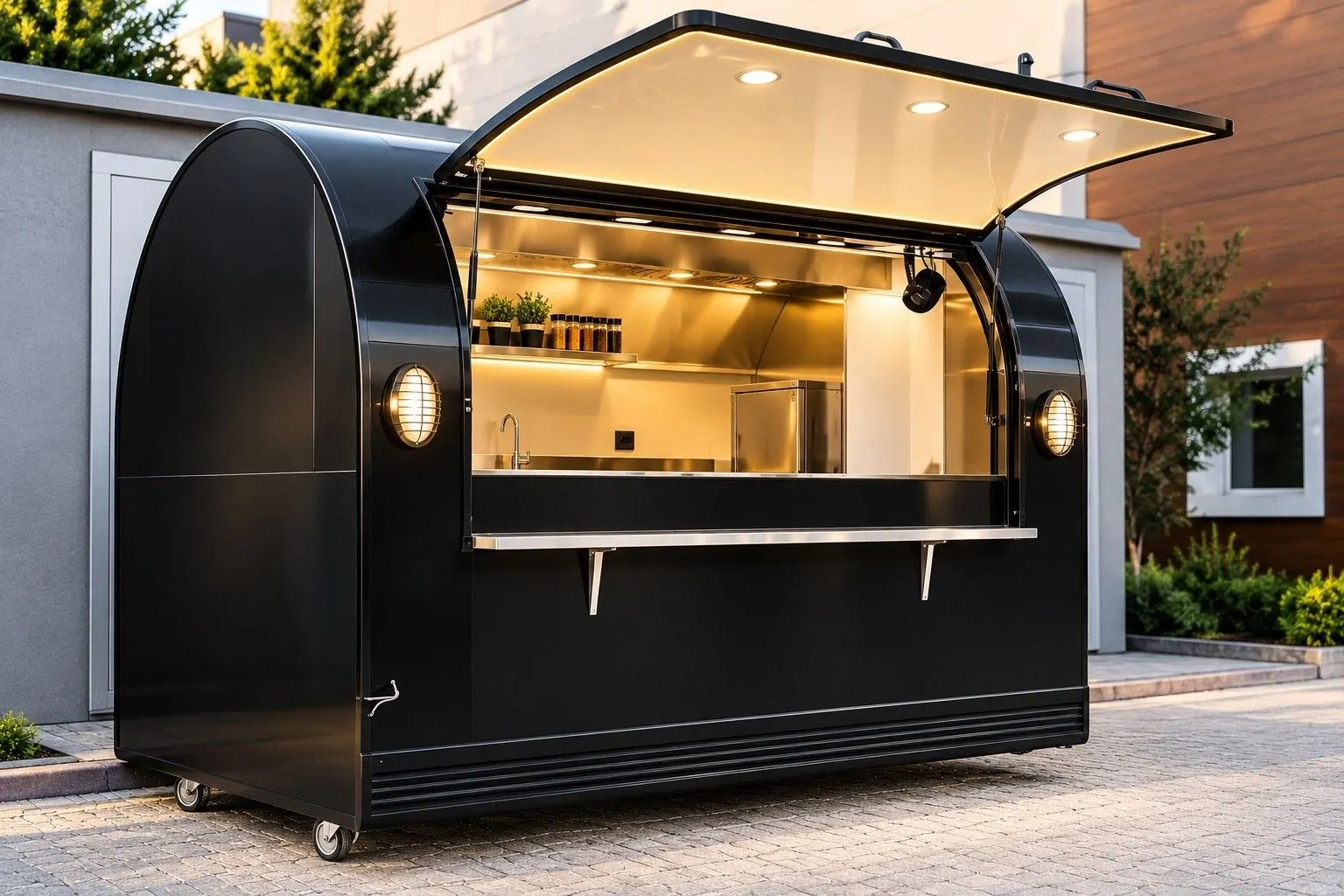
Where the Food Code applies, your health department can ask for plans before you build. They can include the menu, the expected volume, the layout, and every piece of equipment by maker, model number, dimensions and performance. So choose the machines before the drawing.
Then write out the steps of your best-selling drink, from order to sealed cup, and ask the builder to place the stations along the counter in that order. The spec sheets fix some of the spacing. The True back bar cooler wants 1 inch of clearance at the sides and back. Hoshizaki says the AM-50BAK's front airflow removes the need for side and rear clearance. The handwashing sink sits within easy reach of the stations where drinks are made and handed out.
On our concept trucks page you can see Hemingway, a yellow vintage food truck for ice cream and bubble tea, with a white roof box and lift-up glass hatches. Its interior carries a display freezer, counters and storage in yellow and stainless. Our coffee trailers and mobile cafes are built as a single or tandem-axle trailer, a fixed kiosk or a small vehicle, chosen for where the cafe will stand.
What to send for a quote
Send these with your enquiry:
- where you will trade, and in which country, state or county,
- your drinks menu, with anything that uses milk or fresh fruit,
- the cup you will use (PP or PET, rim size and height),
- the pearls you will use, and how your health department wants them held,
- the sealer, dispenser, cooker and ice machine you have chosen, with their spec sheets,
- how many staff work inside and your busiest hour,
- the power and water available on site, or whether the trailer runs on tanks,
- anything your health department has already asked for,
- your branding and the look you want.
Frequently asked questions
What is bubble tea?
Bossen calls tapioca pearls what makes a bubble tea drink complete. The pearl packs we read list tapioca starch as the first ingredient, and Bossen suggests sweetening the pearls with brown sugar, honey or fructose. The cup is closed with a lid or, on a sealing machine, with film.
What machines does a bubble tea trailer need?
Possmei lists mainly a fructose machine, a shaking machine and a sealing machine. Add a way to cook the pearls, ice and cold storage, and where the Food Code applies, a handwashing sink and a warewashing sink. Take every value from the spec sheet of the model you buy.
Is a bubble tea truck planned differently from a trailer?
The Food Code covers operations in a mobile facility, and the rules we read do not separate a truck from a trailer. Our reading: the equipment list above applies to both. Our food truck equipment guide covers the rest of the kitchen.
Send your menu, your cup and the list above through the quote form, with where the trailer will stand. You can see our range on the coffee trailer page.
Related guides
- New vs Used Food Truck: What to Check Before You Buy
- Taco Trucks: Kitchen Line, Holding and Service Window Planning
- How Much Does a Food Truck Cost to Build? The Parts That Drive the Price
- Hot Dog Carts vs Hot Dog Trailers: What Changes for the Buyer
Sources
- FDA Food Code 2026 (PDF), sections 1-201.10, 3-202.16, 3-303.11, 3-304.12, 3-501.14, 3-501.16, 3-501.19 and Annex 3, 4-204.13, 4-301.12, 5-101.11, 5-101.13, 5-103.11, 5-103.12, 5-104.12, 5-202.12, 5-203.11, 5-204.11, 5-205.11, 5-301.11, 5-302.11, 5-303.13, 5-304.11, 5-304.14, 5-401.11, 6-304.11, 8-201.11, 8-201.12
- Karat Packaging, Sealing & Fructose Dispenser Machine spec sheet (Version 2026.08.19)
- True Manufacturing, TUC-27-HC spec sheet
- True Manufacturing, TBB24-48-2S-Z1-SFT-S-1 spec sheet
- Hoshizaki America, AM-50BAK
- Hoshizaki America, KM-301BAK
- Possmei, What are basic machinery required for a bubble tea shop?
- Possmei, 5 Mins Cook Tapioca (cooking directions)
- Bossen, Tapioca Pearls - Large Boba (cooking directions)
- Bossen, Fast Cook Big Tapioca (cooking directions)

By
Ozan Food Truck
This guide is based on the laws, regulations, official guidance and manufacturer documents linked in the text. It is general information, not legal or engineering advice. Rules differ by country, state and city, so confirm the details with your local authority before you build or buy.