
Containers
Shipping Container Bars: Layout, Openings and Site Questions
A shipping container bar comes down to where the counter runs, how that wall opens, and where the kegs and stock go in a box only about 2.35 m (7 ft 8 in) wide inside. Settle those on paper before you order, together with the site. In England and Wales the bar and its site are licensed as premises, and in England a bar sits outside the planning use classes.
By Ozan Food TruckPublished 10 min read
This guide covers what is specific to a bar in a container. Box sizes and general planning law are in our guide to container cafe design, and licence basics, glass washing and ice machines in our mobile bar trailer guide. Your licensing, planning and health authorities have the final word.
Checked on 29 September 2026.
Long side or end doors: where the counter goes
Start with Hapag-Lloyd's specification booklet. A standard 20 ft box is about 5,900 mm long and 2,352 mm wide inside. A 40 ft box is about 12,032 mm long with the same width. The cargo doors at the end open 2,340 mm wide.
So you have two very different fronts. Serve through the end doors and the bar is never wider than about 2.34 m. Run the counter along a long side and a 20 ft box offers close to 5.9 m of frontage, less whatever the doors, equipment and frame take.
Our reading: the long side is where a busy bar gets its length. The end doors suit a small pour point, or a box that stands with its end to the path.
The catch is depth. Say the keg cooler sits under the counter on one long wall and a back bar cooler stands on the other. True's TDD-3-HC is 689 mm deep and its TBB24-48 back bar cooler 632 mm. On the bare shell, before any lining, bumper or wall clearance, that leaves at most about 1,031 mm between them. The builder should write the finished aisle width on the drawing.
If guests come inside, the same 2.35 m has to hold the counter, the staff and the customers. Our reading: that is a strong reason to serve outward and put the seating on a terrace.
Openings: hatches, lift-up sides and fold-down fronts
Hapag-Lloyd describes its general purpose boxes as steel containers with corrugated walls. It notes that most of its 20 ft boxes are certified for operation with one door off, "but then with limited stack weight".
Our reading: if taking off one door changes the rating, a long cut-out in a side wall is a structural change. We found no primary source that says by how much. Before you approve the layout, get drawings that show how each opening is framed.
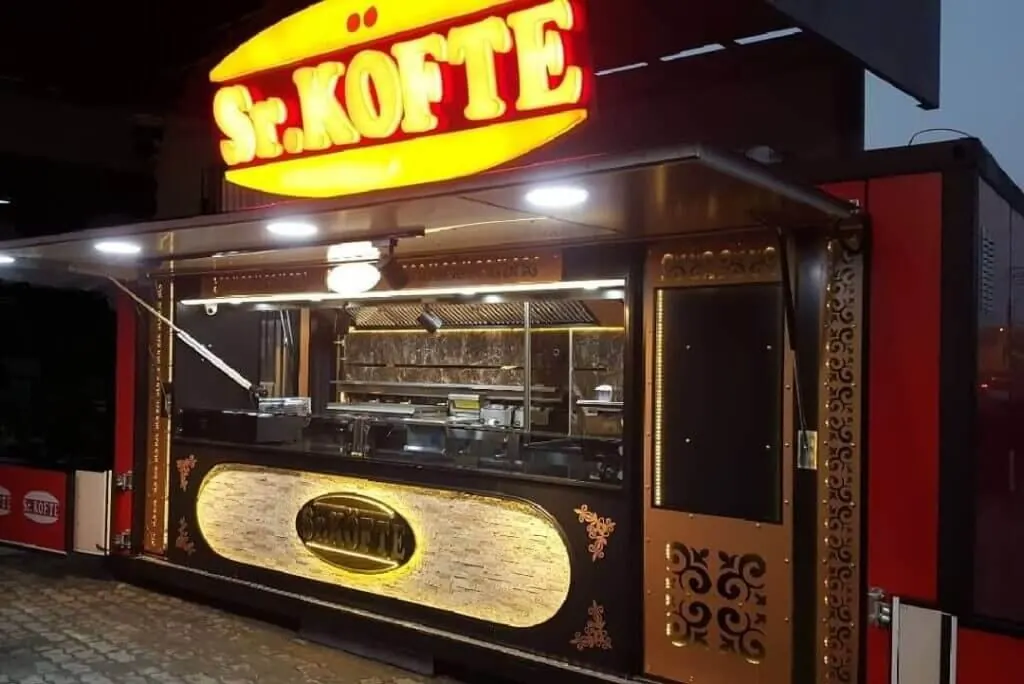
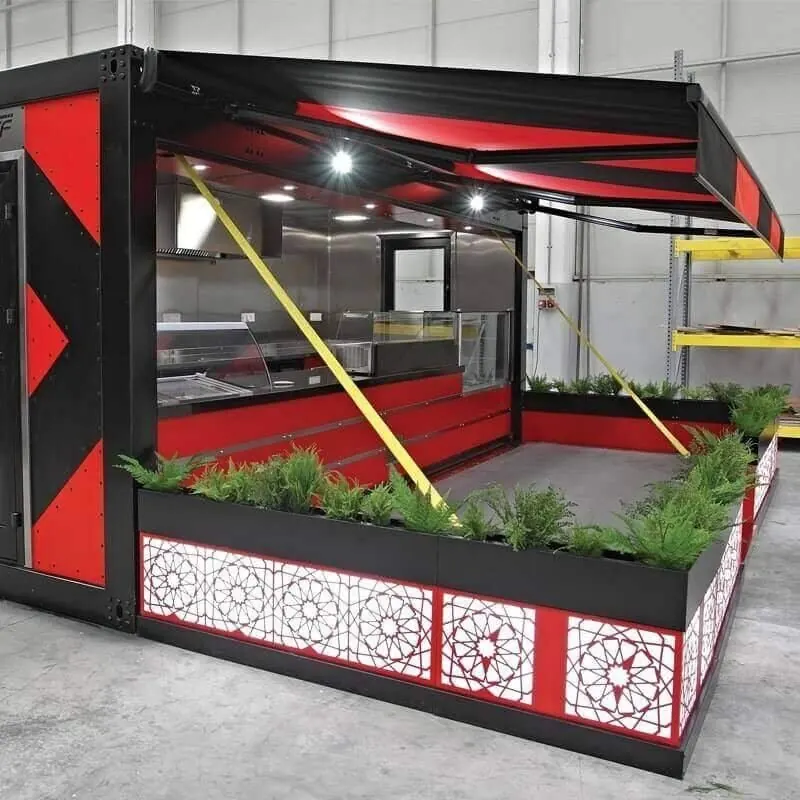
The opening shapes the bar. A lift-up side can become a canopy over the counter, and a fold-down side a drinks shelf or part of a deck. Glazed fronts and serving windows are the other route. On our container restaurants page, the terrace container's sides open into a covered terrace with a serving counter built in. Sr. Köfte has a lit sign, spotlights and an open serving window. Two rules follow the opening.
Insects. Where the FDA Food Code applies, an opening kept open during service needs screens, an air curtain or another effective means, unless pests are absent because of the location or weather.
Counter height. Where the 2010 ADA Standards apply, at least one of each type of service counter needs a portion no higher than 36 inches (915 mm). That portion is at least 36 inches long for a side approach, or 30 inches with knee space for a forward approach. Surfaces where guests sit or stand to drink count as dining surfaces. At least 5 percent of the places there must meet the dining surface rules, including a height of 28 to 34 inches.
Our reading: the floor of a bare container sits about 170 mm above the ground, and a finished floor adds to that. A counter at a good height for staff inside can end up above 36 inches for a guest standing outside. Ask the builder to draw the counter height from both sides. Your building department can tell you how the ADA Standards apply to your bar.
Kegs: under the counter or in a cold room
Size the keg space from the keg. Schaefer lists its SUDEX half-barrel keg at 23.23 inches tall and 15.91 inches across, and its 50 L keg at 20.94 inches tall and 16.06 inches across. Other models differ slightly. US federal beer regulations define a barrel as 31 gallons, so a half barrel holds 15.5.
For two to four kegs, one option is a direct-draw cooler under the counter. True's spec sheets:
| True model | Half-barrel kegs | Size (W x D x H) | Electrical |
|---|---|---|---|
| TDD-2-HC | 2 | 58 7/8 x 27 1/8 x 37 1/4 in (1496 x 689 x 940 mm) | 115 V, 2.8 A |
| TDD-3-HC | 3 | 69 1/8 x 27 1/8 x 37 1/4 in (1756 x 689 x 940 mm) | 115 V, 2.8 A |
| TDD-4-HC | 4 | 90 3/8 x 27 1/8 x 37 1/4 in (2296 x 689 x 940 mm) | 115 V, 2.8 A |
The height excludes 15 3/4 inches for the draft arms, and the depth a 1 inch rear bumper. Each sheet gives a cabinet range of 33 to 38°F and asks for a 15 A dedicated outlet.
Our reading: the four-keg model is 2,296 mm wide against 2,352 mm of bare inside width. Across an end wall it barely fits before lining. Along a long side it takes about 2.3 m of counter.
Beyond that, the option is a keg cold room. In the US, federal energy rules define a walk-in cooler as a refrigerated space above 32°F that can be walked into and is under 3,000 square feet. Walk-ins made since 2009 need automatic closers on standard-size doors, strip doors or spring-hinged doors or another way to limit warm air getting in, and at least R-25 insulation in the walls, ceiling and door. Ask the builder how the cold room meets those rules.
Then there is weight. Hapag-Lloyd rates a 20 ft box for a spread cargo load of 4.8 tonnes per running metre, and a 40 ft box for 3 tonnes. It warns that concentrated loads need special care. Our reading: those figures are for an unconverted box carrying cargo, and a keg room puts its weight in one corner. Get the design load for that part of the floor in writing.
If the beer runs on gas, ask the builder and your local authority where the cylinders go and how that space is ventilated.
Stock storage in a narrow box
Bottles, cans and crates need a home that is not the aisle. Plan it early. Where your health department follows the Food Code:
- Stock is kept in a clean, dry place, at least 6 inches (15 cm) off the floor.
- Pressurized beverage containers and cased bottles or cans may stand on a floor that is clean and not exposed to floor moisture.
- Nothing is stored in toilet rooms or mechanical rooms, or under pipes that leak or collect condensation.
- Cleaning chemicals are kept apart and not above drinks, glasses or equipment. Cleaners kept at the glass-washing area are allowed if stored so they cannot contaminate anything.
- Staff get lockers or another suitable place for their belongings.
Our reading: kegs and cased stock can go on a dry floor, and everything else on shelving. A compartment that houses refrigeration machinery, or the space under a condensate line, is the wrong place for it. Your health department decides how these rules read for your layout.
The site: licensed premises and planning use
England and Wales. The Licensing Act 2003 defines premises as "any place", including a moveable structure. A business selling alcohol on a permanent basis applies for a premises licence, with an operating schedule and a plan.
The schedule states the licensable activities and their hours, the other opening hours, and whether drinks are for consumption on or off the premises. It also sets out the steps you will take to promote the four licensing objectives. Those are preventing crime and disorder, public safety, preventing public nuisance and protecting children from harm.
The plan shows the boundary and walls, the points of access and exit, escape routes, and fixed structures that could block an exit. It also marks any steps, toilets and kitchen, and the fire safety equipment.
Our reading: the licensed area can be more than the box. If guests drink on a terrace, ask the council whether it belongs inside the boundary on the plan. The serving side matters too. A hatch facing a neighbour's windows is a public nuisance question as much as a design one.
Planning is a separate question. In England, the Use Classes Order puts a "public house, wine bar, or drinking establishment" outside every use class. Our reading: a bar cannot rely on the rule that lets a site switch between uses in the same class. Ask your local planning authority before you order.
United States. We have not researched state alcohol rules for fixed bars. Start with your state's alcohol beverage control agency and your city. Where the Food Code applies, plans go to the health department before construction or conversion. Ask your building department how it treats a shipping container used as a bar.
What to send the builder for a quote
- the site, the country and council or city, and a plan of the spot
- whether guests stay outside, come inside, or use a terrace
- which side faces the customers, and what is on the other sides
- the drinks menu: draught, bottles, cocktails, anything with ice or dairy
- how many kegs on tap and how many in reserve
- staff numbers behind the bar and your busiest hour
- the opening you have in mind: glazed front, hatch, lift-up or fold-down side
- the power, water and drainage on site
- anything your licensing, planning or health authority has already asked for
- your branding and the look you want
We build container restaurants and kiosks for restaurant brands, franchises and fixed trading sites, with the structure, glazed front, lighting and kitchen made in our own factory. Electrics, water and drainage are installed there too, so on site the container only needs to be placed and connected.
Frequently asked questions
What is a container bar?
A shipping container fitted out to serve drinks from a counter along a long side or through the end doors, set on a fixed site. In England and Wales the Licensing Act counts any place, including a moveable structure, as premises, so a container bar applies for a licence like any other premises.
How to turn a shipping container into a bar?
Pick the serving side first, then the openings, then the keg and stock space from the cooler spec sheets. Check the site with your licensing and planning authorities before the build. Get drawings that show the finished aisle, the counter height and how each opening is framed.
How much does a shipping container bar cost?
There is no single figure, because the price follows the scope. The main factors are the number and size of containers, the opening hatches, glazing, insulation and cladding, and the equipment. Branding, shipping and installation are quoted separately.
Are container bars a good investment?
We found no official statistic on this, so we will not give you a number. It depends on your site, your licence conditions and your local costs. What you control at design stage is a layout that fits your busiest hour.
Send your site, your drinks menu and the list above through the quote form. We reply with questions first, then drawings and a quote. You can see the terrace container and our other builds on the container restaurants page.
Related guides
- Container Cafe and Container Restaurant Design: Sizes, Layout and Site Questions
- New vs Used Food Truck: What to Check Before You Buy
- Taco Trucks: Kitchen Line, Holding and Service Window Planning
- How Much Does a Food Truck Cost to Build? The Parts That Drive the Price
Sources
- Hapag-Lloyd, Container Specification
- FDA Food Code 2026 (PDF), sections 3-305.11, 3-305.12, 6-202.15, 6-501.110, 7-201.11, 8-201.11
- U.S. Department of Justice, 2010 ADA Standards for Accessible Design, sections 226, 227, 305, 902 and 904
- 10 CFR 431.302 and 431.306, walk-in coolers
- 27 CFR 25.11, definition of barrel
- True Manufacturing, TDD-2-HC spec sheet
- True Manufacturing, TDD-3-HC spec sheet
- True Manufacturing, TDD-4-HC spec sheet
- True Manufacturing, TBB24-48-2S-Z1-SFT-S-1 spec sheet
- Schaefer Container Systems, SUDEX keg
- Licensing Act 2003, section 4
- Licensing Act 2003, section 17
- Licensing Act 2003, section 193
- The Licensing Act 2003 (Premises licences and club premises certificates) Regulations 2005, regulation 23
- The Town and Country Planning (Use Classes) Order 1987, article 3
- GOV.UK, Premises licence

By
Ozan Food Truck
This guide is based on the laws, regulations, official guidance and manufacturer documents linked in the text. It is general information, not legal or engineering advice. Rules differ by country, state and city, so confirm the details with your local authority before you build or buy.