
Buying guide
Crepe and Waffle Trailers: A Compact Dessert Setup, Step by Step
A crepe trailer is planned around its hot plates. Choose the crepe maker and the waffle iron first, in the voltage of the country where you will trade, because they set the power plan, the counter length and how much cold space the batter needs. Then plan how fillings and allergens stay apart on a short counter.
By Ozan Food TruckPublished 10 min read

Machine values come from the makers' own pages, spec sheets and manuals. Hygiene points come from the FDA Food Code 2026, a model code that states and localities adopt in their own versions, and from the UK Food Standards Agency. We name models to show real figures, not to recommend them.
Checked on 29 September 2026.
Step 1: Pick the plates
Waring's booklet sums up the cooking: pour batter on the middle of the plate, spread it with the spreader, flip it with the spatula, lift it off.
Crepe makers
| Model | Electrical | Size | Weight |
|---|---|---|---|
| Waring Commercial WSC160X | 120 V, 1,800 W, NEMA 5-15P | 19 x 19 x 5 in | not on the pages we could read |
| Sephra Commercial Crêpe Maker | 110-120 V, 1,400 W | 40 cm (15.75 in) plate, 4.8 in high | 37.9 lb (17.2 kg) net |
| Krampouz Standard CSRO4AA-KR, 40 cm | 220-240 V, 3,000 W | 40 x 40 x 16 cm | 17 kg |
| Krampouz Confort CTRO4AA-KR, 40 cm | 220-240 V, 3,600 W | 40 x 40 x 18 cm | 18 kg |
| Krampouz Confort double CTCA7AA-KR, 35 cm | 220-240 V, 2 x 3,000 W, two cords | 75 x 42 x 19.8 cm | 28 kg |
Krampouz says its Standard range is designed for occasional use, while the Confort models are listed for intensive use.
These Krampouz models are 220-240 V. For its USA and Canada range, the catalogue asks buyers to contact Krampouz. Krampouz also makes gas crepe makers: the 40 cm CSRS4PA-KR is rated at 5,000 W, weighs 15.5 kg and burns butane or propane, with an automatic cut-out if the flame goes out. Gas on board is a question for your local fire authority.
Waffle irons
| Model | Electrical | Size | Weight | Output (maker's figure) |
|---|---|---|---|---|
| Waring Commercial WW180X | 120 V, 1,200 W, 10 A, NEMA 5-15P | 10.5 W x 17 D x 8.5 H in | 13.3 lb out of box | up to 25 Belgian waffles an hour |
| Sephra Commercial Belgian Waffle Baker | 110-120 V, 1,700 W max | not listed | not listed | one 7 in waffle per cycle |
| Krampouz WECABAAO, single 4x6 Brussels | 230-240 V, 1,800 W | 44 x 26 x 22 cm | 20 kg | 2 waffles |
| Krampouz WECAEBAO, double 4x6 Liège | 230-240 V, 2,800 W | 52 x 44 x 22 cm | 30 kg | 4 waffles |
The Sephra baker takes interchangeable plates for classic Belgian, bubble, donut, filled, mini and skinny waffles. Our reading: spare plates can widen a menu without widening the counter.
Waring and Sephra both use nonstick plates. The Food Code says waffle bakers with a perfluorocarbon resin coating are used with nonscoring or nonscratching utensils, so ask the maker what the coating is. Waring's plates can be replaced on site if scratched. Sephra advises against release sprays, which wear the coating faster.
Step 2: Do the power sum
Use the method from our generator sizing guide. Watts are volts times amps. Add the running watts of everything on at once, plus the largest single starting surge. Generac puts a motor's starting figure at often two to three times its running figure. In this example the motor load is the fridge, rated by True at 1/6 HP.
A worked example for a US trailer:
| Item | Maker's figure | Running watts |
|---|---|---|
| Waring WSC160X crepe maker | 1,800 W at 120 V | 1,800 |
| Waring WW180X waffle maker | 1,200 W at 120 V | 1,200 |
| True TUC-27-HC fridge | 2.0 A at 115 V | 230 |
| Running total | 3,230 |
True publishes no starting figure. At the top of Generac's range, 3 x 230 W is 690 W, so the planning peak is about 3,920 W: a rule-of-thumb estimate, not a True value.
Cummins gives 3,600 W as the most a 30-amp, 120 V shore cord can carry. Our reading: this example runs under that figure, but its planning peak does not. A second crepe maker (5,030 W running) takes it well past. Ask the site what supply you will get.
An 1,800 W plate at 120 V draws 15 A, and True asks for a 15 amp dedicated outlet for the fridge. Ask your builder how the circuits are split.
For a 230 V trailer, the Krampouz manuals ask for an earthed single-phase socket with a 16 amp earth contact and a residual current device of no more than 30 mA. Our reading: 16 A at 230 V is 3,680 W, so a 3,600 W Confort plate uses nearly all of one socket. Plan one supply point per plate.
Step 3: Keep the batter cold

The Food Code never uses the word batter. It works through the definition of time/temperature control for safety (TCS) food, which includes an animal food that is raw or heat-treated.
Krampouz's recipes use raw animal food. Its wheat crepe batter has eggs and milk, and its Belgian waffle batter has three eggs and half a litre of milk. Our reading: a batter like that fits the TCS wording. One made from a dry mix and water may be treated differently. Your health department decides.
Where the batter counts as TCS, you have two routes:
- Cold: hold it at 41°F (5°C) or below. Eggs that have not been treated to destroy Salmonella are stored where the air is 45°F (7°C) or less.
- Time: the code allows time as the control for a working supply of TCS food before cooking. Written procedures are prepared in advance and shown to the inspector on request. Under the four-hour option, the batter leaves the fridge at 41°F or below, is marked with the time four hours later, and is cooked or discarded by then. Unmarked containers are discarded.
Krampouz's Belgian recipe rests the batter at least an hour. Our reading: that hour is spent in the fridge or on the clock.
The code asks for enough cold holding equipment, in number and capacity. The True TUC-27-HC holds 33 to 38°F, is compliant with NSF/ANSI 7 for open food product, and measures 27 5/8 x 30 1/8 x 29 7/8 in before castors. Dry mix goes elsewhere: Sephra says to store its mixes dry, at no more than 71.6°F (22°C).
Step 4: Plan fillings and allergens
The US has nine major food allergens: milk, eggs, fish, crustacean shellfish, tree nuts, peanuts, wheat, soybeans and sesame. The batter alone can carry several. Sephra's crêpe mix lists wheat, soy, egg and buttermilk. Krampouz's buckwheat recipe still adds a tablespoon of wheat flour.
The FDA explains that federal allergen labelling does not cover most food sold unpackaged at retail or food service establishments. Where the Food Code is adopted, the permit holder gives written notice of major food allergens in unpackaged food. The FDA's notes list menu notices, placards, table tents and label statements. The person in charge also makes sure staff are trained in food allergy awareness.
For England, Wales and Northern Ireland, the FSA lists 14 allergens, with hazelnuts under tree nuts, plus mustard, celery and lupin. For loose food, you give allergen information for every item that contains any of them. If wheat flour is handled in your kitchen and you cannot separate it by time and space, you should not make gluten-free claims.
Our reading: fillings are where cross-contact happens on a crepe plate. Krampouz says to wipe the plate before spreading the next crepe when you fill on the cooking plate. The FSA advises closed, labelled containers for allergen ingredients and cleaning utensils before each use.
Step 5: Fit it into a compact layout
Your health department can ask for plans before the build, including the menu, the expected volume, the layout, and each machine by maker, model, dimensions and performance. Send the sheets you chose in Step 1.
Place the stations in the order a crepe is made: fridge, plate, fillings, hand-over. The manuals fix some distances:
- Krampouz wants 20 cm between its plates and any surface that is not heat-resistant. Walls nearby should be non-flammable or covered with insulation.
- The top of a Krampouz plate or waffle iron should sit 85 to 95 cm off the ground. With the machine height, that sets your counter height.
- Waring asks for a stable countertop, away from hot burners and ovens.
Our reading: a 75 cm double crepe maker with 20 cm free on each side needs 115 cm of counter if both side walls are not heat-resistant.
Waring's crepe maker booklet and both Krampouz manuals say the machines are not for outdoor use. Krampouz's crepe maker pages list indoor and outdoor use, while its waffle maker pages say inside, so ask which applies. New plates are seasoned for 1 to 1.5 hours, under an extractor hood for Krampouz and in a well-ventilated area for Waring. The Food Code asks for mechanical ventilation where heat, vapour or smoke would build up.
Where the code applies, you also need a handwashing sink with water of at least 85°F (29.4°C), where a self-closing or metering tap runs at least 15 seconds, a three-compartment sink unless an alternative is approved, and a waste tank 15 percent larger than the fresh tank. Our sizes and layout guide covers length and weight.
Where Ozan fits
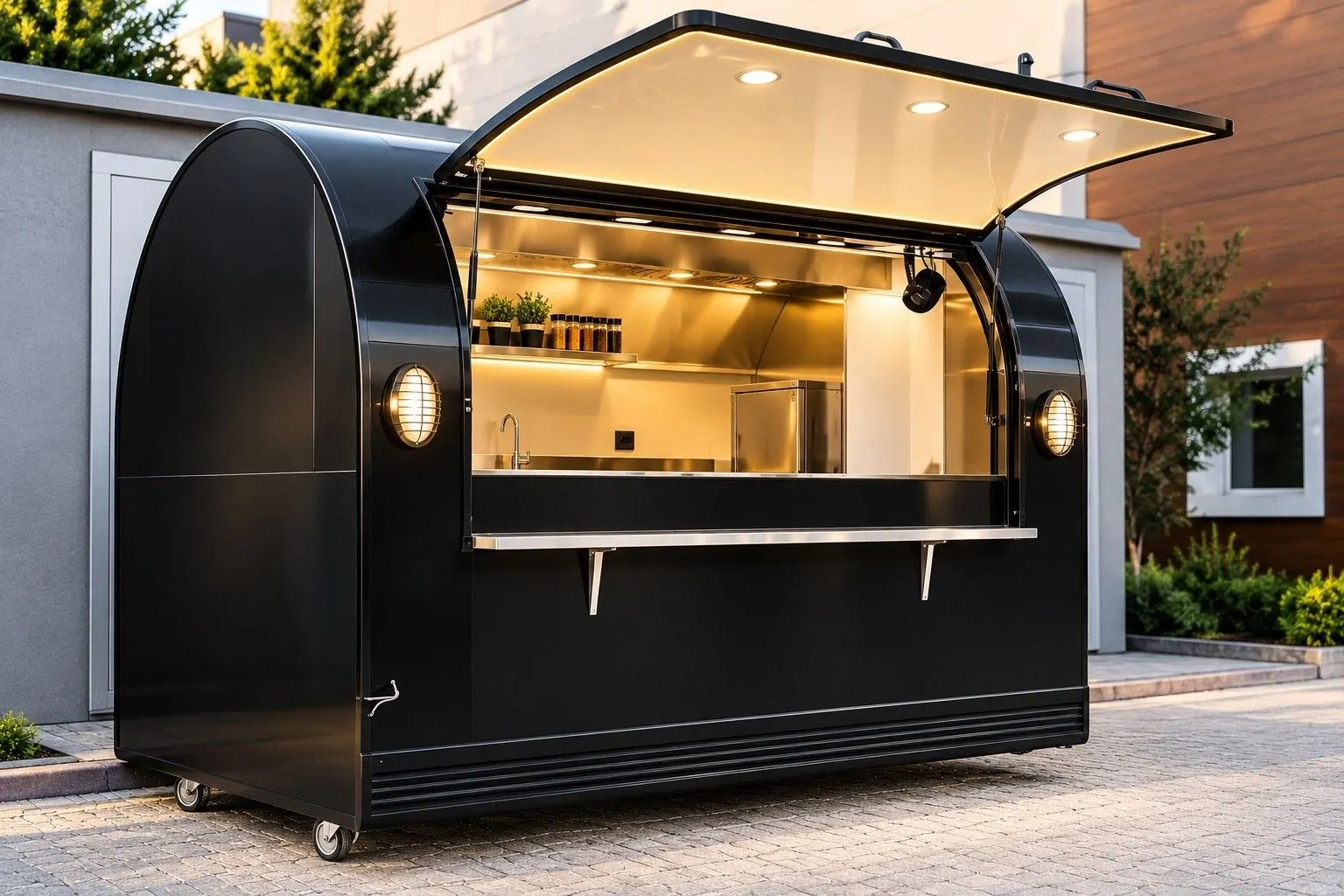
Our site does not show a crepe build. Our coffee and ice cream trailers are built as a single or tandem-axle trailer, a fixed kiosk or a small vehicle. La Gelateria is a rounded tandem-axle ice cream trailer whose serving window opens onto a counter with an ice cream display. On our food trucks page, Lokmana is a dessert van where dough, frying and syrup are all done on board. The same page lists generator, shore power or battery systems.
What to send for a quote
- the country, state or county where you will trade,
- your menu, with every filling and topping,
- the crepe makers and waffle irons you chose, with spec sheets and voltage,
- how your health department wants batter held,
- the supply you expect on site, or whether you need a generator,
- how many staff work inside and your busiest hour,
- your branding and the look you want.
Frequently asked questions
What is a crepe?
In the maker instructions we read, a crepe is a ladleful of batter poured onto a hot plate, spread with a spreader and turned with a spatula. Krampouz recommends about 200 to 230°C, and its wheat crepe recipe uses wheat flour, eggs, sugar and milk.
How do you start a crepe business?
Start with your health department, which can ask for plans listing your menu and every machine by model. Then choose plates in your country's voltage, do the power sum, and settle how batter is held and allergens shown.
Can one trailer make crepes and waffles?
Yes, if the power and the counter allow it. In our US example, one crepe maker, one waffle iron and a fridge run at 3,230 W. Each plate also needs the clearances its maker asks for.
Do I need a generator for a crepe trailer?
It depends on the supply at your site. Compare it with your running total and planning peak.
Send the list above through the quote form. You can see our trailers and kiosks on the mobile cafe page.
Related guides
- New vs Used Food Truck: What to Check Before You Buy
- Taco Trucks: Kitchen Line, Holding and Service Window Planning
- How Much Does a Food Truck Cost to Build? The Parts That Drive the Price
- Hot Dog Carts vs Hot Dog Trailers: What Changes for the Buyer
Sources
- FDA Food Code 2026 (PDF), sections 1-201.10, 2-103.11(O), 3-501.16, 3-501.19, 3-602.12 and Annex 3, 4-101.18, 4-301.11, 4-301.12, 5-202.12, 5-401.11, 6-304.11, 8-201.11, 8-201.12
- FDA, Food Allergies
- Food Standards Agency, Allergen guidance for food businesses
- Waring Commercial, WSC160X crepe maker instruction booklet
- Waring Commercial, WW180X spec sheet
- Sephra, Commercial Crêpe Maker
- Sephra, Commercial Belgian Waffle Baker
- Sephra, Gourmet Crêpe Mix
- Sephra, Belgian Waffle Mix
- Krampouz, Standard electric round crêpe maker
- Krampouz, Confort electric round crêpe maker
- Krampouz, Confort electric double crêpe maker
- Krampouz, Standard gas crêpe maker
- Krampouz, single 4x6 Brussels waffle maker
- Krampouz, double 4x6 Liège waffle maker
- Krampouz, electric crêpe maker manual AI0414
- Krampouz, waffle maker manual AI0208
- Krampouz, professional crêpe maker catalogue
- True Manufacturing, TUC-27-HC spec sheet
- Generac, What Size Generator Do I Need?
- Cummins, RV Generator Power Basics

By
Ozan Food Truck
This guide is based on the laws, regulations, official guidance and manufacturer documents linked in the text. It is general information, not legal or engineering advice. Rules differ by country, state and city, so confirm the details with your local authority before you build or buy.