
Planning
Food Truck and Food Trailer Sizes: How to Plan Length, Weight and Layout
There is no standard food truck size. What you can build is set by three things: the road limits where you will trade, the weight rating on the vehicle's plate, and the kitchen your menu and your health inspector call for. In the EU the width limit is 2.55 metres, which is also the UK limit for a towed trailer. On the US National Network it is 102 inches. Length and weight depend on the type of vehicle and on who tows or drives it.
By Ozan Food TruckPublished 10 min read
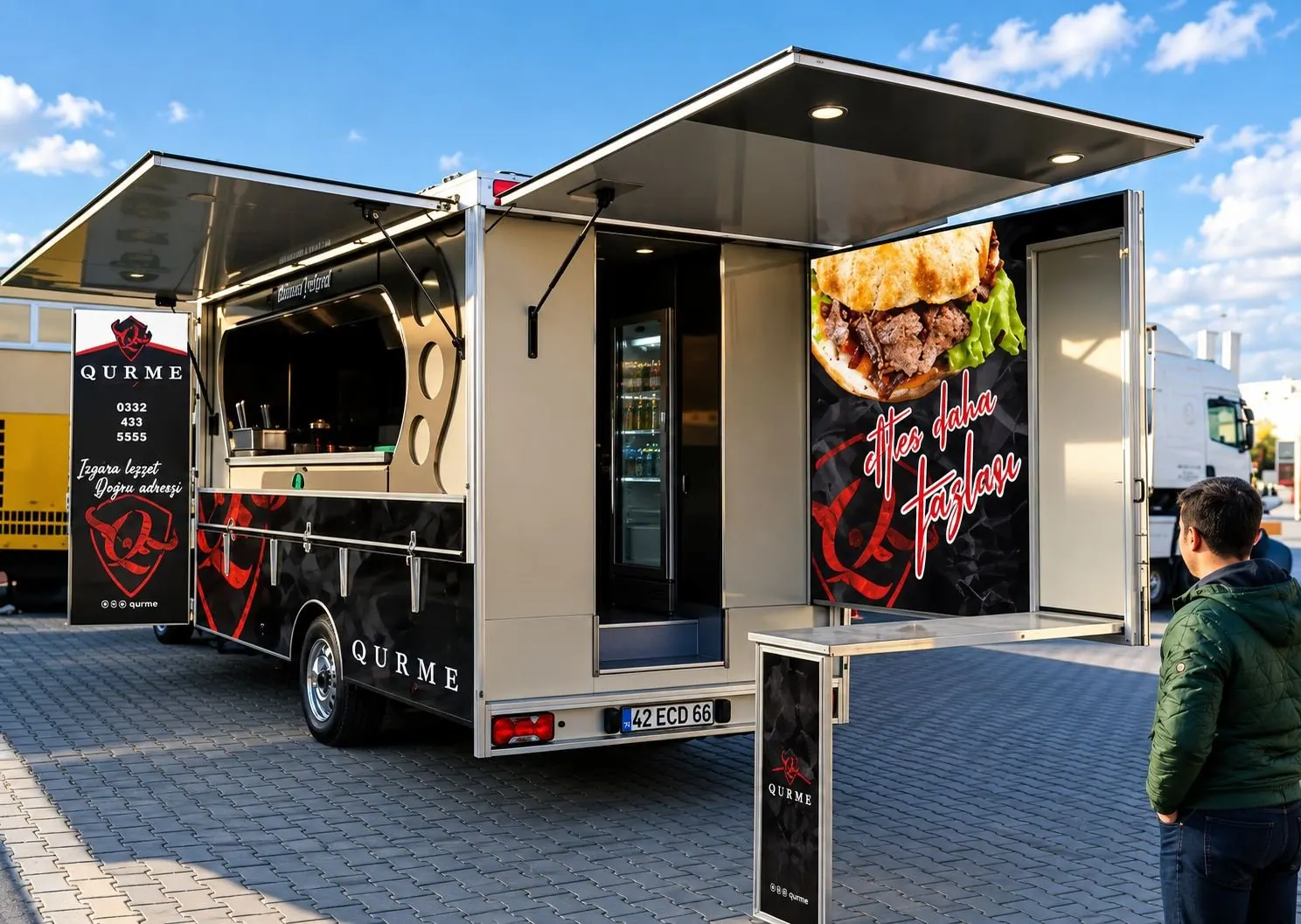
This guide sets out the legal limits region by region, explains the weight terms you will see on plates and labels, and shows which parts of the layout the hygiene rules fix before you choose a single appliance. Every number comes from a source listed at the end. Local rules can be stricter, so confirm with your licensing authority and health department before you order.
Checked on 28 September 2026.
Why there is no standard size
No law says how big a food truck should be. The law sets an outer limit, and your menu decides how much of it you use. The FDA's plan review matrix for mobile food establishments makes the same point: the requirements follow the menu and the operation, and the vehicles it covers run from push carts to catering vehicles that prepare food on board.
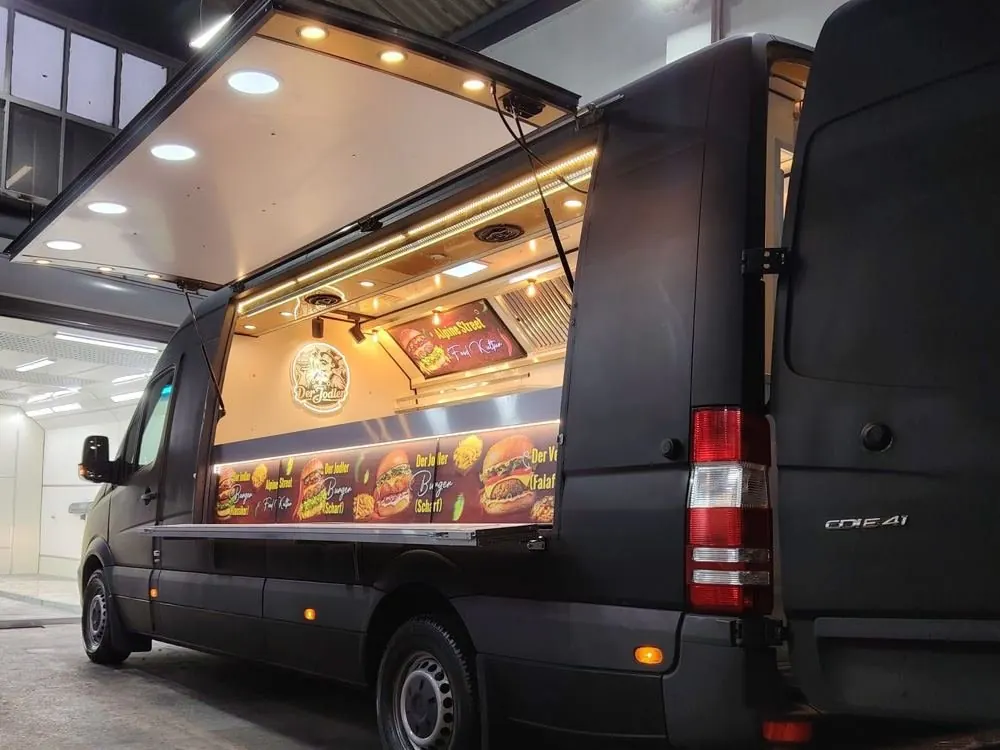
We see this in our own work. A food truck can be a box body on a chassis cab, a converted panel van or a towable trailer, and we pick one for where you trade and how often you move. So start with the menu and the site. The size comes out of those.
Length, width and height limits
| Where | Width | Length | Height | Source |
|---|---|---|---|---|
| EU, vehicle approval (goods vehicles up to 3.5 t, all trailers) | 2.55 m | 12.00 m (a drawbar trailer includes the drawbar) | 4.00 m | Reg. (EU) 2021/535, Annex XIII |
| EU, heavier trucks on the road (over 3.5 t) | 2.55 m | 12.00 m truck, 18.75 m road train | 4.00 m | Directive 96/53/EC, Annex I |
| UK, towed trailer | 2.55 m | 7 m if the towing vehicle is 3,500 kg MAM or less; otherwise 12 m trailer, 18 m combined | not on the page | GOV.UK towing limits |
| US, National Network | 102 in (2.6 m) | set by each state for straight trucks | no federal limit | 23 CFR 658, FHWA |
EU
Directive 96/53/EC sets the maximum dimensions for road use, but only for buses and their trailers, and for goods vehicles over 3.5 tonnes with trailers over 3.5 tonnes. Our reading: a food truck of 3.5 tonnes or less, and a food trailer of 3.5 tonnes or less, sit outside its scope. That does not free them from limits. The EU type-approval rules in Regulation 2021/535 apply the same 12.00 m length, 2.55 m width and 4.00 m height to goods vehicles up to 3.5 tonnes and to every trailer category (for a drawbar trailer the 12.00 m includes the drawbar), measured with the vehicle at its mass in running order.
Both texts allow 2.60 m for certain insulated bodies. The approval rule ties that to specific bodywork codes, so ask your approval authority before you design to it. For the vehicles it covers, the directive measures its limits "with no positive tolerances".
UK
GOV.UK sets the trailer width at 2.55 metres for any towing vehicle. If your towing vehicle has a maximum authorised mass (MAM) of 3,500 kg or less, the trailer cannot be longer than 7 metres. Above that, the limits are 12 metres for the trailer and 18 metres for the combination. The A-frame is not counted.
Note that the 7 metre rule is set by the towing vehicle, not the trailer. Decide what will pull the trailer before you fix its length.
US
Federal rules set width. No state may impose a width limit of more or less than 102 inches on a vehicle on the National Network, with an exception for Hawaii. Mirrors, turn signals and a few other devices are left out of the measurement. Other parts count unless a law or regulation excludes them. Part 658 is written around commercial motor vehicles, so ask your state whether your truck counts as one.
Length is different. The federal length rules cover truck tractor and semitrailer combinations. For a straight truck, FHWA's guide says "vehicle length regulation remains with the States". There is no federal height limit either, and FHWA's overview gives state standards from 13.6 to 14.6 feet. Check the figures with your state department of transportation before the body is drawn.
Weight: the number on the plate
Weight limits work through ratings, and the ratings are on the vehicle. Learn the terms first.
- MAM (UK): the weight of the vehicle or trailer including the maximum load it can carry safely. GOV.UK says it is normally shown on a plate or sticker.
- Maximum mass (EU): defined as the technically permissible maximum laden mass. It decides the vehicle category.
- Unladen weight (UK): the vehicle with its body and normal parts, without passengers or goods.
- GVWR (US): the manufacturer's value for the loaded weight of a single vehicle. GCWR is the same for a combination, and GAWR is the load-carrying capacity of one axle.
A US trailer's certification label must show the GVWR and a GAWR for each axle.
Our reading: what you can load is the rating minus the weight of the finished vehicle. Fresh water, waste water, gas bottles, stock and the people working inside all count against it. Ask the builder for a weighed figure of the finished vehicle, not a catalogue number. The axle ratings matter too. Heavy items such as tanks, fridges and a generator should sit where neither axle goes over its GAWR, so ask to see the axle loads on the drawing.
The weight thresholds to plan around
UK. A trailer that weighs over 750 kg when loaded needs a working brake system. If you passed your car test on or after 1 January 1997, you can tow a trailer up to 3,500 kg MAM, and the vehicle and trailer together must not exceed 7,000 kg MAM. The towing vehicle's gross train weight must not be exceeded either. A truck between 3,500 and 7,500 kg MAM falls in licence category C1.
EU. Under Directive 2006/126/EC, a category B licence covers a trailer up to 750 kg. A heavier trailer is allowed if the combination stays at or under 4,250 kg, with training or a test above 3,500 kg. The new driving licence directive, (EU) 2025/2205, keeps this rule, and Member States are to apply it from 26 November 2029. A food truck over 3,500 kg falls in category C1, up to 7,500 kg. Confirm the details with your national licensing authority.
US. Under 49 CFR 383.5, a straight vehicle used in commerce with a GVWR of 26,001 pounds or more is a commercial motor vehicle, and driving one needs a commercial driver's license. For a combination, the line is a GCWR of 26,001 pounds or more with a towed vehicle rated over 10,000 pounds. Whether your truck falls in is a question for your state licensing office, so ask before you pick a chassis.
The layout: what the hygiene rules fix first
Our reading: the hygiene rules claim wall and counter space before the cooking line does, so draw them in first.
EU. Regulation 852/2004, Annex II, Chapter III covers mobile sales vehicles. Where necessary, it asks for facilities to wash and dry hands, easy-to-clean food-contact surfaces, a way to clean equipment, drinking water, waste storage and temperature control. It also says food is to be placed so as to avoid contamination as far as reasonably practicable. It sets no sink counts or tank sizes. Those come from national or local guidance.
US. The FDA Food Code is a model that states and local regulators use to write their own rules, and adoption varies. Where it applies, it fixes several points on the plan:
- At least one handwashing sink, placed for convenient use in the food preparation, food dispensing and warewashing areas. It must stay accessible and may be used only for handwashing.
- A sink with at least three compartments for washing, rinsing and sanitising by hand, large enough to immerse the largest utensils. Alternatives need approval.
- Raw animal foods kept apart from ready-to-eat food during storage, preparation, holding and display.
- Toxic materials separated from food by spacing or partitioning, and not stored above food or clean equipment. Cleaners kept in the warewashing area have a narrow exception.
- Fixed equipment spaced for cleaning on the sides, behind and above, or sealed to the wall.
- A waste tank 15 percent larger than the fresh water tank.
The Food Code also asks for plans before construction. Where your health department requires it, they include the menu, the expected volume, the layout and each piece of equipment with its model number, location and dimensions. That list is a good order to plan in.
Plan the layout in this order
- Menu and volume. What you cook and how many portions an hour. This decides the equipment.
- Equipment list with dimensions. Every appliance, with its footprint and its power and gas needs.
- Fixed hygiene points. Handwash sink, warewashing sink, water and waste tanks, chemical storage.
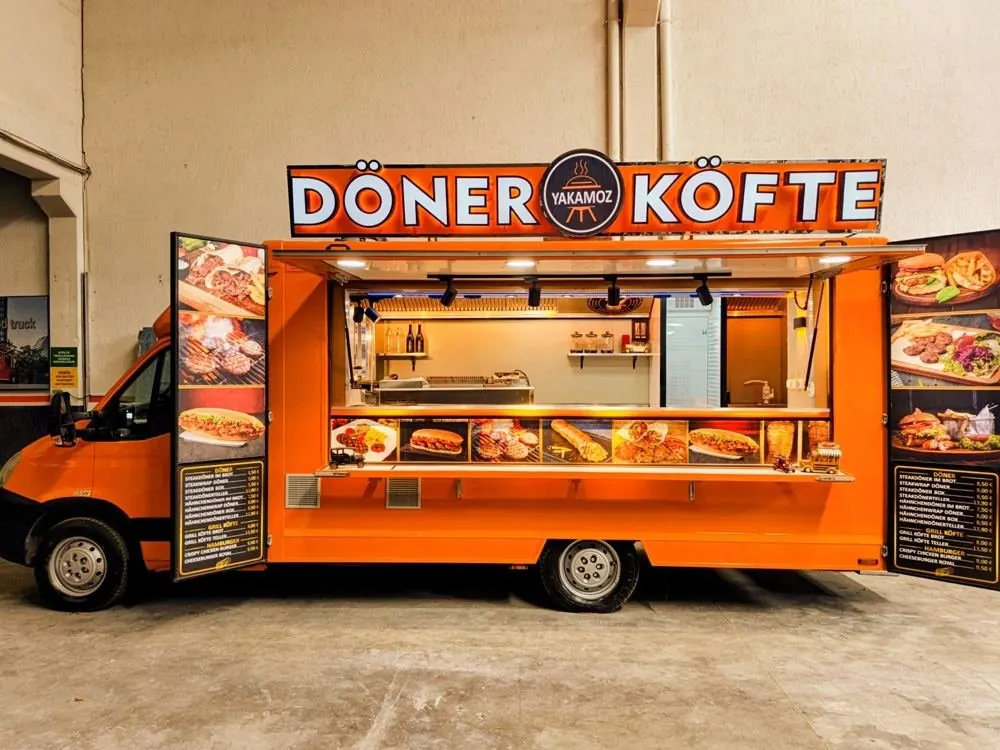
- The cooking line and the people. On our custom food trucks, the layout starts with what you cook and how many people work inside. Worktops, the cooking line, storage and refrigeration go where your team moves as little as possible.
- The serving side. Hatches and counters go where your queue forms. Some of our trucks open on both sides so two queues can be served at once.
- Weight and envelope check. Add up the loaded weight and the axle loads, then check the overall width with every hatch, light and step closed and in place.
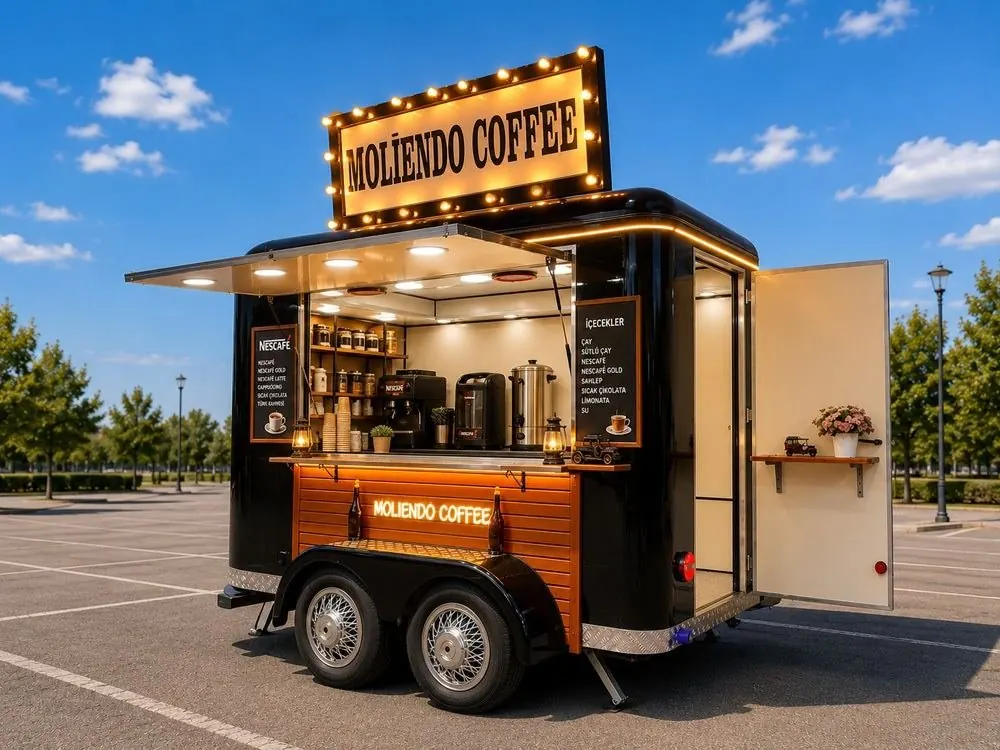
Smaller builds follow the same logic. For a coffee trailer, we choose a single or tandem-axle trailer, a kiosk or a small vehicle for where the cafe will stand. The espresso machine, grinder, fridge and sink are placed for one or two baristas.
Frequently asked questions
What is a good size for a food truck?
The smallest one that fits your menu, your staff and the fixed hygiene points, inside the legal limits where you trade. Those limits are 2.55 m wide in the EU and for UK trailers, and 102 inches on the US National Network. Length depends on the vehicle type and, in the US, on the state.
What is the best layout for a food truck?
One drawn from the menu outwards. Start with the equipment list, place the handwash sink, the warewashing sink and the tanks where your health department wants them, then fit the cooking line so the team moves as little as possible. Put the hatches where the queue forms.
What is the average weight of a food trailer?
We found no official average. Read the MAM or GVWR on the plate, and ask the builder for the weighed figure of the finished trailer. The difference between the two is what you can load.
Can I tow a 3,500 kg trailer?
In the UK, yes, if you passed your test on or after 1 January 1997, within your vehicle's towing limit and with the combination at 7,000 kg MAM or less. In the EU, a trailer that heavy needs category BE. In both places, check your own licence first.
If you have a menu and a site in mind, send them through the quote form. We reply with questions first, then drawings. You can also see what we have built on our custom food trucks page.
Related guides
- Food Truck Ideas That Start from the Kitchen: 12 Concepts and What Each Needs
- Food Trucks for Events and Festivals: Power, Water and Pitch Questions
- Small Food Trailers: What Fits Inside and What Does Not
- Starting a Food Truck Business: The Vehicle Decisions to Make First
Sources
- Council Directive 96/53/EC, consolidated text of 14 August 2019, Articles 1 to 3 and Annex I
- Commission Implementing Regulation (EU) 2021/535, Annex XIII (masses and dimensions)
- Regulation (EU) 2018/858, Article 4 and Annex I
- Directive 2006/126/EC on driving licences, Article 4
- Directive (EU) 2025/2205 on driving licences, Articles 4, 29 and 30
- GOV.UK, Towing weight and width limits
- GOV.UK, Trailer and towing equipment
- GOV.UK, Driving licence categories
- GOV.UK, Vehicle weights explained
- 23 CFR Part 658, sections 658.13, 658.15 and 658.16
- FHWA, Federal Size Regulations for Commercial Motor Vehicles (FHWA-HOP-04-022)
- FHWA, Commercial Vehicle Size and Weight Program
- 49 CFR 571.3, definitions
- 49 CFR Part 567, certification labels
- 49 CFR Part 383, sections 383.5 and 383.23
- Regulation (EC) No 852/2004, Annex II, Chapter III
- FDA Food Code 2026, sections 3-302.11, 4-301.12, 4-402.11, 5-203.11, 5-204.11, 5-205.11, 5-401.11, 7-201.11, 8-201.12 and Annex 7 Chart 4-D

By
Ozan Food Truck
This guide is based on the laws, regulations, official guidance and manufacturer documents linked in the text. It is general information, not legal or engineering advice. Rules differ by country, state and city, so confirm the details with your local authority before you build or buy.