
Planning
Small Food Trailers: What Fits Inside and What Does Not
A small food trailer is set by weight, not by length. Choose a menu whose equipment, sinks, water and stock stay under the weight line you plan to tow at: 750 kg loaded for an unbraked trailer in the UK, the 0.75-tonne ceiling of an EU O1 trailer, or the brake threshold your US state sets. The hygiene rules we read give no size exemption for sinks or tanks.
By Ozan Food TruckPublished 10 min read
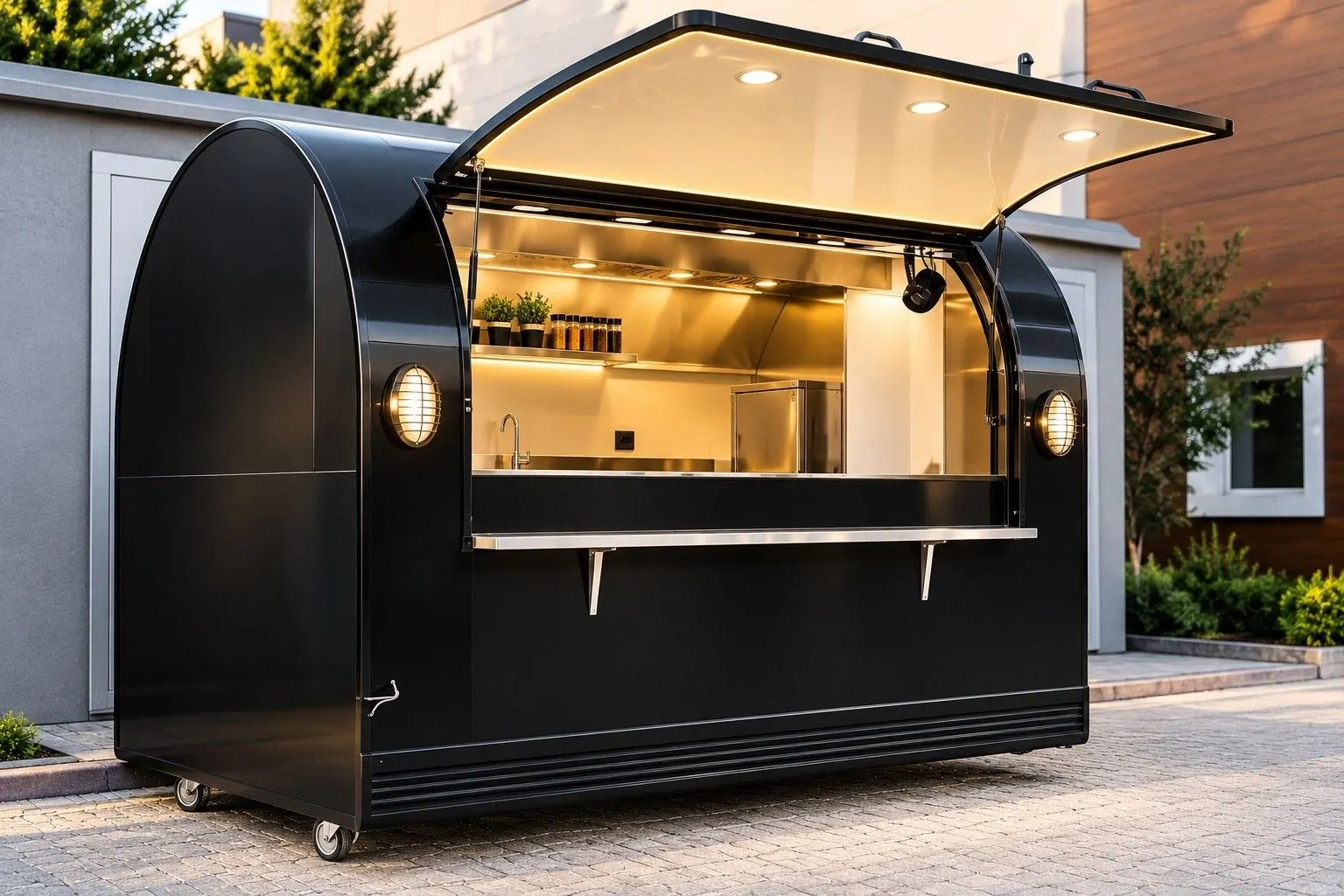
Below: the weight lines, towing with a car, the fixtures a small kitchen still needs, and the menus that makers' weights leave room for. Rules come from GOV.UK, EU law, the FDA Food Code and California law, and equipment figures from maker spec sheets.
Checked on 29 September 2026.
Pick the weight line first
None of the rules we read defines a "small" food trailer. They draw weight lines instead.
| Where | The line | What changes at it |
|---|---|---|
| UK | 750 kg loaded | Above it the trailer must have working brakes |
| EU | 0.75 t maximum mass | Up to it the trailer is category O1; above it, O2 up to 3.5 t |
| California (one state) | 3,000 lb gross weight | Trailers made and first registered after 1 January 1966 need brakes on at least two wheels |
The UK also asks for a breakaway cable or secondary coupling, brakes or not. California asks for a safety chain, cable or equal device on top of the drawbar. The 750 kg line is about 1,653 lb. Other US states set their own brake rules, so ask your state DMV. For an EU trailer, ask the national registration authority which brakes an O1 trailer needs.
Our reading: decide the line before the layout. "Loaded" means everything on board when you tow: kitchen, water, gas, stock. Ask the builder for the expected weight with full tanks, not just empty. The sizes and layout guide explains plates and ratings.
Towing a small trailer with a car
UK. DVSA's safety checks say a loaded trailer with no brakes must not weigh over 750 kg and should not weigh more than half the weight of the car. So a fully loaded 750 kg unbraked trailer should be towed by a car of 1,500 kg or more. For a braked trailer, the car and loaded trailer together must stay under the second weight on the car maker's plate. No train weight on the VIN plate means no towing, GOV.UK says.
A licence gained from 1 January 1997 lets you tow up to 3,500 kg MAM. Fit towing mirrors if the trailer is wider than the rear of the car. A car towing a trailer is limited to 50 mph on single carriageways and 60 mph on dual carriageways and motorways.
EU. A category B licence covers a car with a trailer up to 750 kg. A heavier trailer is allowed if the combination stays at or under 4,250 kg, with training or a test above 3,500 kg (code 96). The new directive keeps those figures for a petrol or diesel car. Confirm with your national licensing authority.
US. In California, a Class C licence may tow a single vehicle of 10,000 lb GVWR or less, and a passenger vehicle drawing another vehicle must not go over 55 mph. That is one state. The trailer's GVWR and each axle's rating are on its certification label.
What the hygiene rules still ask for at any size
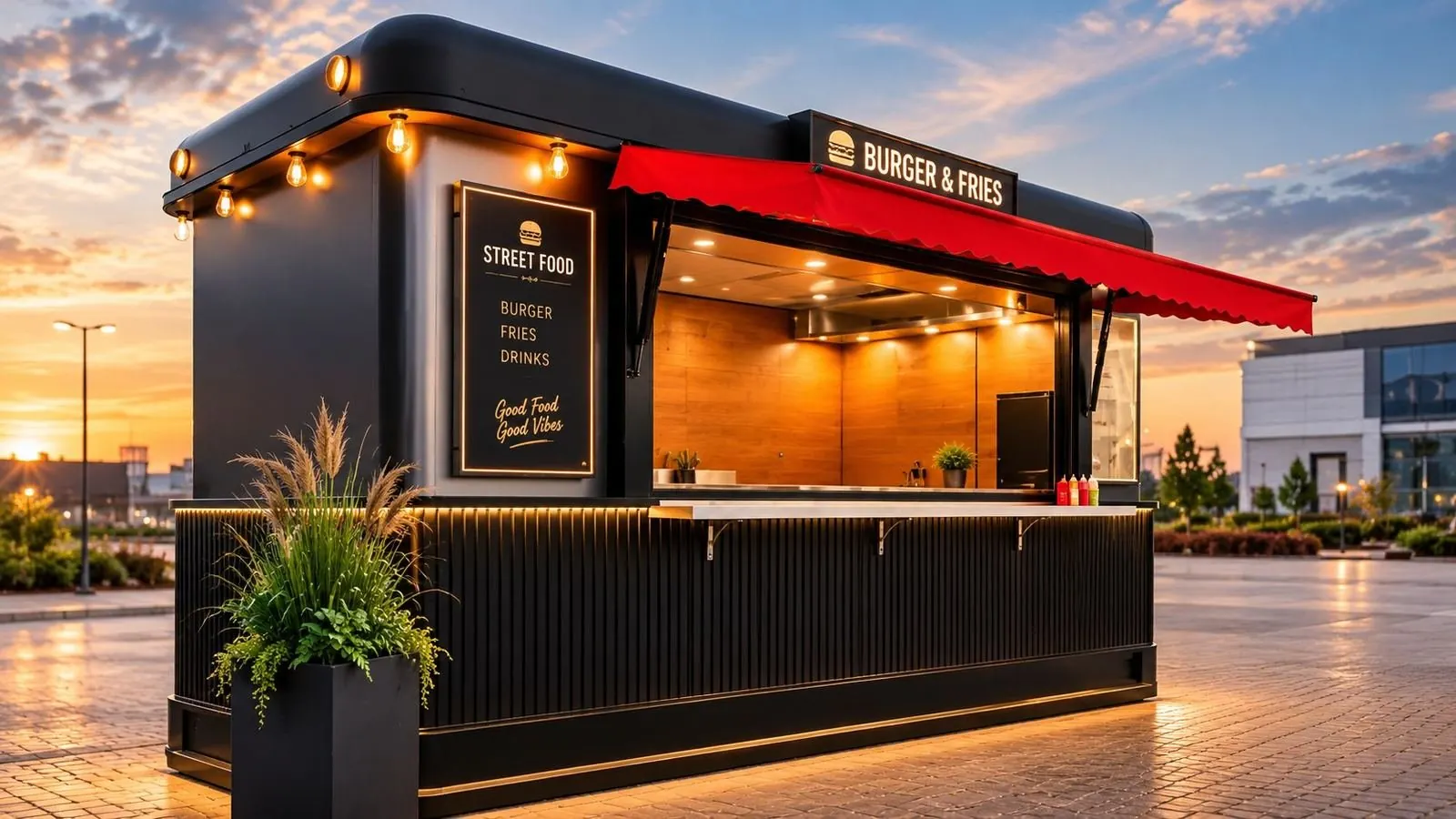
The FDA Food Code's mobile matrix bases the requirements on the menu and the operation, for everything from push carts to catering vehicles. It does not mention size. The Food Code is a model that state and local regulators adopt, so treat this as the national baseline. Your health department may ask for more.
Where it applies, a small trailer that prepares food needs:
- At least one handwashing sink, placed for use where food is prepared and served and where dishes are washed. It is for handwashing only and gives water of at least 85°F (29.4°C) through a mixing valve or combination faucet.
- A sink with at least three compartments for washing, rinsing and sanitising. Each compartment must take your largest pan or utensil. A two-compartment sink or other alternative needs approval, and a two-compartment sink is limited to batch washing.
- Drainboards or racks for dirty and clean items.
- A waste tank sized 15 percent larger than the fresh water tank, sloped to a drain of at least 1 inch with a shut-off valve. A 20-gallon fresh tank means a waste tank of at least 23 gallons.
- An enclosed fresh tank that drains completely, a water system sized for peak demand, and water under pressure to the fixtures.
Our reading: the pressure rule's exception names temporary food stands and supply interruptions, not mobile kitchens, so plan for a pump. The handwash sink can't be used for anything else, so it takes its own counter space.
In the EU and UK, Regulation 852/2004 covers "mobile sales vehicles". Where necessary, it asks for hand washing and drying, a way to clean utensils and equipment, hot and/or cold potable water, and waste storage. It sets no sink counts or tank sizes. UK guidance asks for enough washbasins for everyone working, with hot and cold running water, and separate sinks where necessary for food and equipment. Ask your local authority how it reads those words.
What fits: weights and sizes from the makers
One example model per menu, with the maker's figures. They are not what we fit and not a recommendation. Check the rating plate of the version you buy.
| Menu | Example appliance | Size (W x D) | Weight | Power as printed | Share of 750 kg |
|---|---|---|---|---|---|
| Hot dogs | Star Grill-Max, 20 hot dogs | 43.5 x 52.4 cm | 15.9 kg | 930 W, 7.75 A at 120 V | 2% |
| Coffee | Rancilio Classe 5 S, 1 group, tank | 410 x 539 mm | 37 kg | 1,450 W at 110 V; 1,800 W at 220-240 V | 5% |
| Crepes | Krampouz electric, 40 cm plate | 40 cm plate | 17 kg | 3,000 W | 2% |
| Burgers, fries | Lincat GS6/T griddle + LDF fryer | 600 x 620 mm + 270 x 417 mm | 39 kg + 8 kg | 4,000 W + 3,000 W | 6% |
| Tacos | Lincat BM6W bain marie (with a griddle) | 600 x 600 mm | 14 kg | 2,000 W | 2% |
| Juice | Zumex Essential Pro | 470 x 500 mm | 45.5 kg | 300 W | 6% |
| Pizza | Lincat PO430, one deck | 966 x 925 mm | 97 kg | 4.2 kW, 18.3 A single phase | 13% |
| Pizza | Lincat PO430-2, two decks | 966 x 925 mm | 150 kg | 8.4 kW, 36.6 A single phase | 20% |
| Soft serve | Taylor C709 | 464 x 820 mm | 187.8 kg | 25 A max fuse, 208-230 V single phase | 25% |
| BBQ | Southern Pride MLR-150 smoker | 997 x 1,464 mm | 298 kg | 19 kW gas burner; 120 V, 15 A | 40% |
The last column is our arithmetic: one appliance's share of a 750 kg loaded limit.
Our reading: menus built on light counter-top appliances fit a small trailer best. The examples for hot dogs, espresso, crepes, juice and burgers each weigh under 50 kg. A line of griddle, fryer and bain marie still needs 1,470 mm of counter before the sinks go in. The tank version of the Rancilio needs no fixed water connection, which suits a trailer with no hook-up.
Heavy items push a trailer toward brakes and a bigger build. The smoker alone takes 40% of 750 kg. Taylor asks for 152 mm of air clearance on both sides of the air-cooled C709, so it needs about 768 mm of width, less with the optional discharge chute. The two-deck oven draws 36.6 A on a single phase. None of this rules these menus out. They just use up a small trailer's budget fast.
If your fryer or griddle needs a hood, the Food Code says it must keep grease and condensation off walls and ceilings. In Austin, Texas, vendors permitted after 1 May 2022 with appliances that give off grease-laden vapour need fire suppression. Coffee and ice cream vendors there with no propane and no cooking need no fire permit. That is one city, so ask your health and fire authorities what your menu needs. Our food truck ideas go menu by menu.
Small trailer, kiosk or cart
Our reading: if the pitch never changes, a kiosk may suit you better. Under the Food Code, "mobile" means something that moves as part of its routine operation, so a kiosk that stays put may be treated as fixed premises, and in England it can raise planning questions. Our food kiosk guide covers both.
Our compact kiosks come with "a lift-up hatch or a full-width awning, lit inside and finished in black". They "suit fixed spots such as parks, terraces and shopping centre entrances".
In California, a cart run as a compact mobile food operation may only do limited food preparation. Made-to-order drinks without frozen milk products are within it. The coffee cart guide sets out when a cart stops being enough.
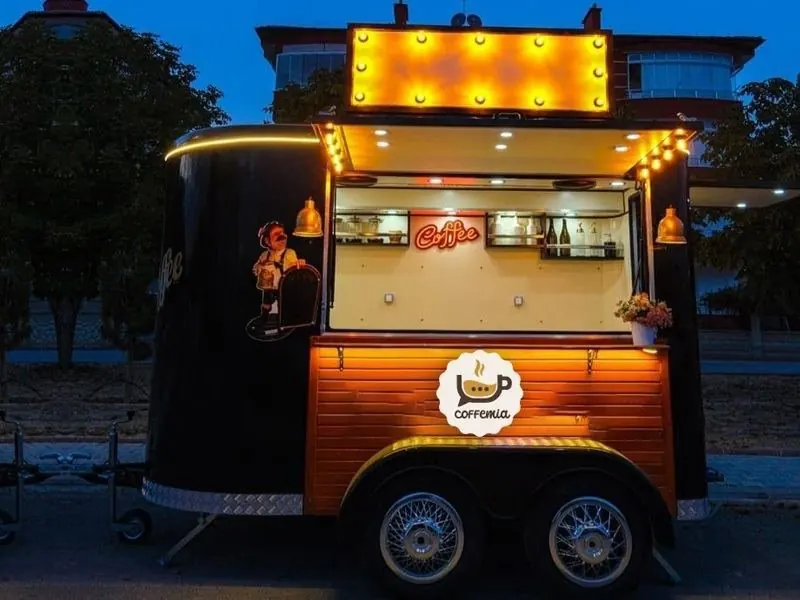
Our reading: a small trailer sits between the two. A car can tow it every day, and it can carry its own tanks and sinks. For coffee, our mobile cafes come as "a single or tandem-axle trailer, a fixed kiosk or a small vehicle, chosen for where the cafe will stand". Coffomus is one of them: a coffee trailer "with a rounded body, wooden panels and a lift-up awning lined with warm lights".
What to tell the builder for a quote
- Your menu and the busiest hour you expect.
- The weight line you want to stay under: 750 kg, O1, or your state's brake threshold.
- The car you will tow with, its towing limit, tow ball and plug.
- Your appliance list with makers and models, so weights and circuits can be added up.
- The sinks and tank sizes your health department expects.
- Power: generator, shore power or batteries, and the supply voltage.
- Whether the trailer moves daily or stays on one pitch.
- The country where it will be registered and towed.
The buying checklist covers brakes, documents and the delivery inspection.
Frequently asked questions
How big is a 750 kg trailer?
750 kg is a weight limit, not a size. In the UK trailer width is capped at 2.55 m, and length at 7 m behind a vehicle of 3,500 kg or less, without the A-frame. What fits under 750 kg depends on the build and the load.
What is the average weight of a food trailer?
We found no official average. Read the MAM or GVWR on the trailer's plate or label, and ask the builder for the delivered weight.
Can I tow a small food trailer with a car?
It depends on the car and the loaded weight. In the UK an unbraked trailer must not weigh over 750 kg loaded and should not weigh more than half the car. In the EU a B licence covers a trailer up to 750 kg. In the US, check your state's licence and brake rules.
Does a small food trailer still need sinks?
If you prepare food on it, the Food Code asks for a handwashing sink and a three-compartment sink unless an alternative is approved. EU and UK rules ask for handwashing and equipment cleaning where necessary. Your health department decides.
Send your menu and your weight line through the quote form. We reply with questions first, then drawings and a quote. The food trucks and trailers page shows the bases we build on, towable trailers included.
Related guides
- Food Trucks for Events and Festivals: Power, Water and Pitch Questions
- Starting a Food Truck Business: The Vehicle Decisions to Make First
- Ordering Food Trucks for a Franchise or Brand: How to Keep Every Truck the Same
- How a Food Truck Is Built: From the First Drawing to Delivery
Sources
- FDA Food Code 2026 (1-201.10, 4-301.12, 4-301.13, 4-301.14, 5-103.11, 5-103.12, 5-104.12, 5-202.12, 5-203.11, 5-204.11, 5-205.11, 5-302.11, 5-401.11, 8-201.12, Annex 7 Chart 4-D)
- Regulation (EC) No 852/2004, Annex II Chapter III
- Regulation (EU) 2018/858, Article 4
- Directive 2006/126/EC on driving licences
- Directive (EU) 2025/2205 on driving licences
- GOV.UK, Towing with a car
- GOV.UK (DVSA), Tow a trailer or caravan with a car: safety checks
- GOV.UK, Speed limits
- GOV.UK, Starting a food business
- California Vehicle Code 26302
- California Vehicle Code 29004
- California Vehicle Code 22406
- California DMV, Driver's Licenses
- California Health and Safety Code 113818 and 114368.2
- 49 CFR 567 (certification label)
- City of Austin Fire Department, Mobile Food Vending Fire Inspections
- Star, Grill-Max roller grill spec sheet
- Rancilio, Classe 5 S
- Krampouz, Standard electric round crepe maker
- Lincat, Silverlink GS6/T griddle
- Lincat, Lynx LDF fryer
- Lincat, Silverlink BM6W bain marie
- Lincat, PO430 pizza oven
- Lincat, PO430-2 pizza oven
- Zumex, Essential Pro
- Taylor, C709 spec sheet
- Southern Pride, MLR-150

By
Ozan Food Truck
This guide is based on the laws, regulations, official guidance and manufacturer documents linked in the text. It is general information, not legal or engineering advice. Rules differ by country, state and city, so confirm the details with your local authority before you build or buy.