
Planning
Ordering Food Trucks for a Franchise or Brand: How to Keep Every Truck the Same
To keep a franchise fleet of food trucks the same, fix one master drawing and specification before the first truck is built, and put the same equipment models and the same graphics materials in it. Then treat every truck as its own vehicle, because the rules deal with vehicles one at a time. Each one has its own papers and its own permit, so each one needs its own acceptance check.
By Ozan Food TruckPublished 10 min read
This guide is for brands, chains and franchisors ordering several trucks or trailers, at once or in batches. For the kitchen we use the FDA Food Code, the model US state and local regulators use for their own rules. Vehicle papers follow US, UK and EU rules, and wraps follow the film makers' data sheets. Where your authority decides, we say who to ask.
Checked on 29 September 2026.
What has to match, and what stays with each truck
| Layer | Fix once, for the whole fleet | Stays with each truck |
|---|---|---|
| Layout and body | Master drawing, dimensions, materials, finishes | Its own inspection against that drawing |
| Kitchen | Equipment makers and model numbers | Its own food permit |
| Graphics | Artwork files, film, laminate, ink, printer | Film lot and install record |
| Vehicle | Base vehicle or trailer type | VIN, label, approval, registration |
Start from one approved project
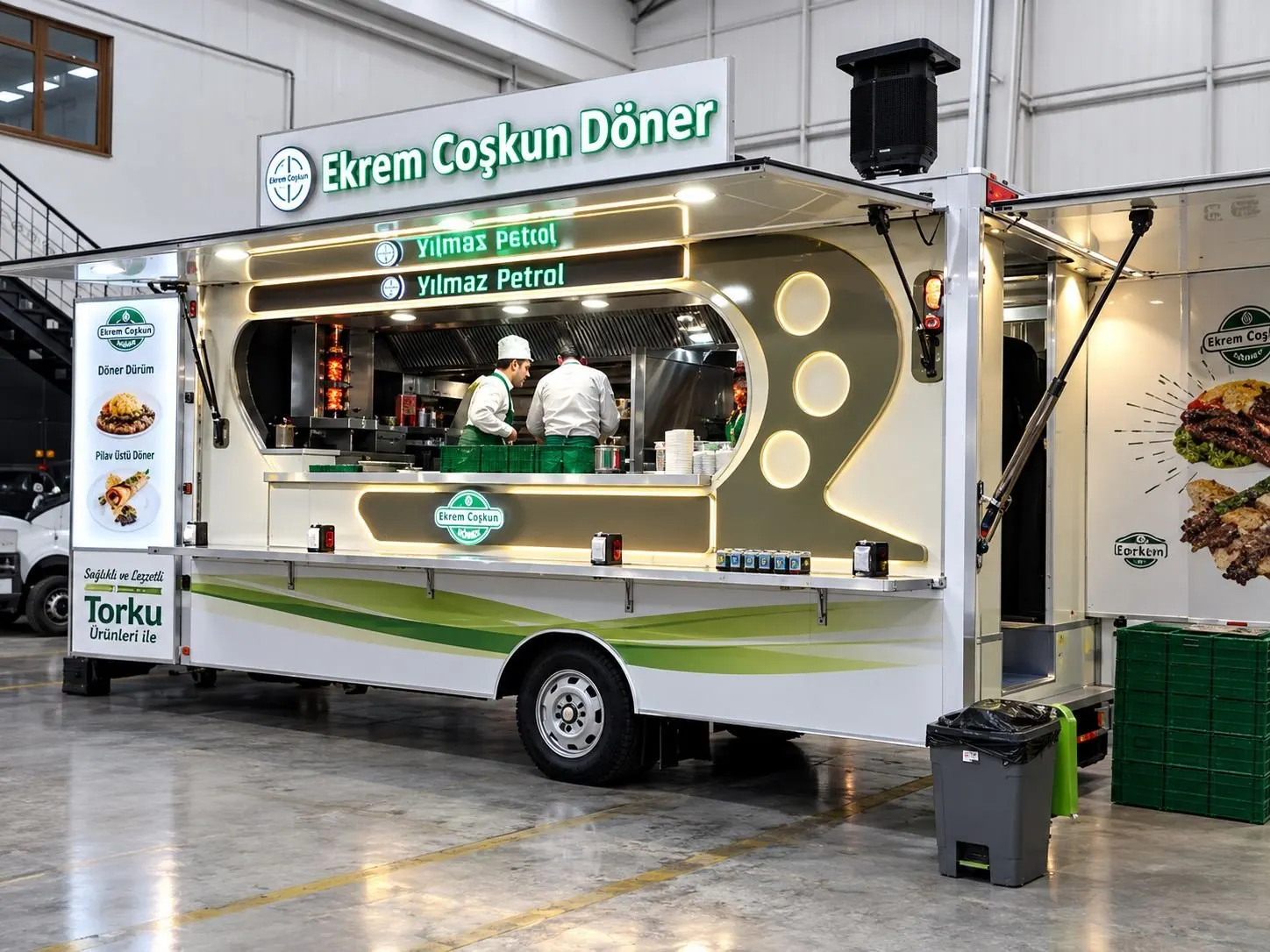
Our About us page describes how we handle it: "Alongside single builds, the company carries out series production of food trucks and food trailers for restaurant chains and franchise brands, with every vehicle built to the same dimensions, equipment and appearance as the first approved project." One of our custom food trucks, the Ekrem Coşkun Döner truck, is "an express restaurant truck for a döner franchise".
The Food Code already gives the master specification its headings. Plans for review can include, as your regulator requires:
- the intended menu and the expected volume of food,
- the layout, mechanical schematics, construction materials and finish schedules,
- equipment types, makers, model numbers, locations, dimensions, performance capacities and installation specifications.
Our reading: write the fleet's master spec under those same headings. Then one document serves your builder, your franchisees and each health department.
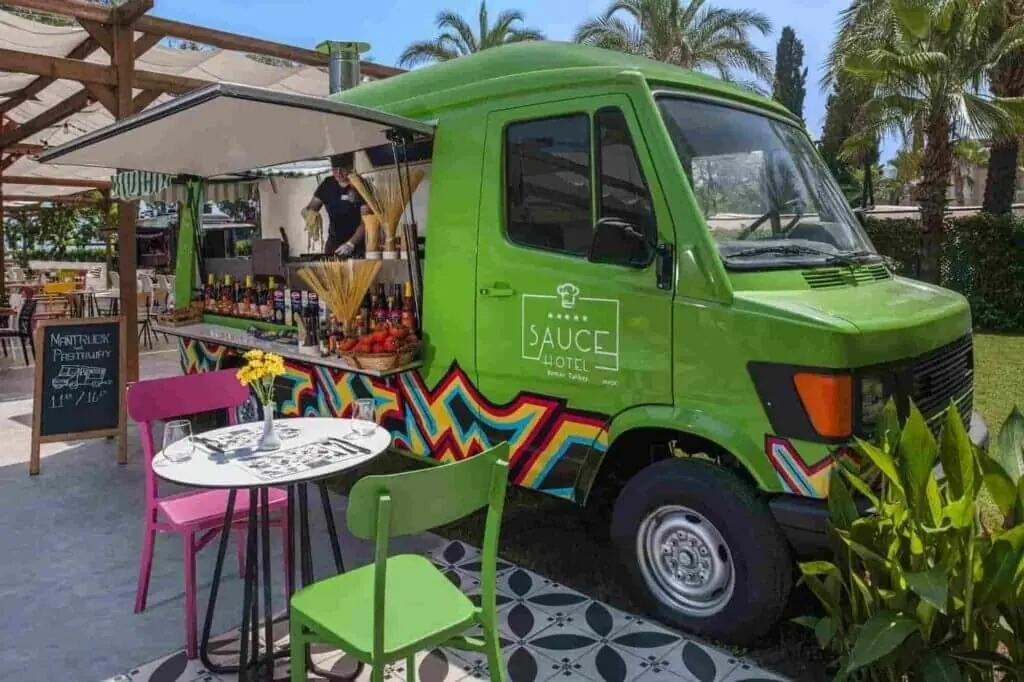
Decide early what is allowed to differ. A set we built for Sauce Hotel is a mixed brief: "Each truck carries the hotel brand, a lit serving side and a kitchen fitted for its own menu." Shared look, different kitchens. A franchise with one menu may want the kitchen fixed as well. Write down which you want before the drawings go out.
Keep one change log. The health department's preoperational inspection checks that the truck is "constructed and equipped in accordance with the APPROVED plans and APPROVED modifications of those plans". Our reading: a change made on the sixth truck but not on the master drawing is a deviation for that truck. Put the change on the master and send it back for approval.
Same equipment models, repeatable plan review
Where your jurisdiction follows the Food Code, plans go to the regulator for review and approval before construction starts. The list of what goes in them names "manufacturers, model numbers" (8-201.12). Our reading: if every truck carries the same fryer, fridge and hood, the equipment pages of every plan set are the same pages.
That helps, but it does not replace the review. A mobile food establishment is a food establishment in its own right. Nobody may operate one without a valid permit. And "A PERMIT may not be transferred ... from one FOOD ESTABLISHMENT to another" (8-304.20). The permit is issued after the plans are approved and an inspection shows the truck was built to them.
Our reading: each truck gets its own permit and its own inspection. Whether a department will accept one approved plan set for several identical trucks is its decision, and the Food Code text we read does not say. Ask before you order.
A fleet that trades across several counties or states may face more than one code edition. FDA's 2024 report found that 11 state agencies in 7 states had adopted the 2022 edition, and oversight "is typically handled at the state and local levels". Ask each health department which edition it uses and what it wants on the drawings.
Equipment certified for sanitation by an ANSI-accredited program is deemed to meet the Food Code's equipment materials and design rules (4-205.10). Our builder guide lists more questions for the builder.
Brand graphics that match from the first truck to the last
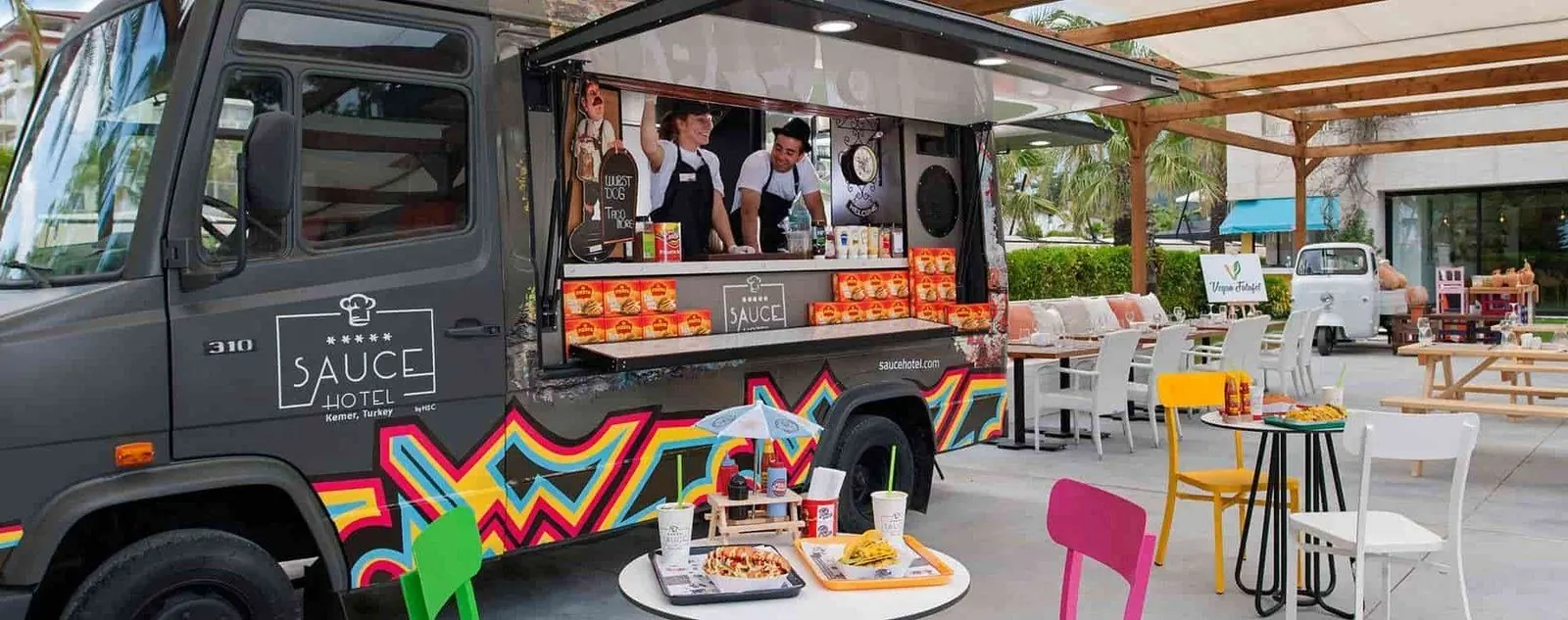
On our builds, "Paint, printed wrap, illuminated signage and LED lighting are designed together with the truck, so the brand reads from across the street and after dark." For a fleet, the question is whether truck twelve will look like truck one.
Film lots matter. Avery Dennison's SW900 data sheet warns: "Some slight color shift may occur between rolls or lots." If several rolls are needed, use rolls from one production lot. For metallic and pearlescent films it asks for one roll per vehicle where possible.
Printed wraps depend on the whole build-up. Under Avery's ICS guarantee the finished graphic is warranted for the stated durability of its least durable component, such as the ink. 3M's warranty bulletin says coverage applies only when the film, ink and printer are the ones in its warranty matrices, and "The substitution of non-approved products invalidates warranty coverage."
Our reading: name the film, laminate, ink and printer in the master spec, not just the artwork file. A later batch printed with a different combination can lose that warranty basis, and film from another lot can shift slightly in colour.
Keep records per truck. Avery's claim notices must include the lot numbers of the films, the installation date and location, and the installer's name. Our wrap guide covers durability by face and angle.
Papers and approvals: one vehicle at a time
The vehicle rules work truck by truck.
United States. Each vehicle has its own 17-character VIN (49 CFR 565.13). The manufacturer must "affix to each vehicle a label" (567.4) giving the month and year of manufacture, the weight ratings (GVWR and GAWR) and the VIN. When a body goes on a chassis, the final-stage manufacturer labels each vehicle. If the trucks are imported, the importer files a declaration when each vehicle is offered for import. Registration is a separate step with your state DMV.
Great Britain. GOV.UK lists individual vehicle approval (IVA) for "a single vehicle or small number of vehicles", trailers included. It also describes model reports: "One way of proving your vehicle is compliant is by showing it's the same specification as another vehicle (a 'master vehicle') that's been proved compliant." Manufacturers can also get type approval, which is "approval for a type of vehicle, rather than each individual vehicle". Our reading: for identical trucks, ask DVSA whether a model report can support the later approvals, and ask VCA about type approval.
European Union. For a type-approved vehicle, the manufacturer issues a certificate of conformity for each vehicle. It goes with the vehicle on paper, or from 5 July 2026 it can be made available as electronic data instead. Regulation 2018/858 also has EU and national type-approval for vehicles produced in small series, within annual limits. A national small series approval is valid in the member state that granted it. Other member states can be asked to accept it, and each decides. Individual approval is another route. Ask your national approval authority which applies.
On our side, "the technical and legal requirements of the destination country are assessed at the design stage". The approval itself comes from your authority, not from us. For import steps, see our guide to buying from overseas.
Acceptance checks for every truck
Where the Food Code applies, the health inspection compares each truck with the approved plans. So check each one against the master spec, not against the truck before it. A fault copied from truck three is still a fault on truck four.
Our process ends: "once all checks are complete the food truck or trailer is delivered on the committed date." Your acceptance list can follow the rules above:
- Dimensions, layout and hatch positions against the approved drawing.
- Every appliance's maker and model number against the equipment list.
- Where the Food Code applies, a waste tank 15 percent larger than the fresh-water tank.
- In the US, the VIN and the certification label, with the build month and year and the weight ratings.
- Graphics against the artwork, with the film lot and installer recorded.
- The vehicle papers your approval route needs.
In the UK, the Sale of Goods Act gives a buyer, on request, "a reasonable opportunity of examining the goods" when the seller tenders delivery. Our reading: that helps only where UK law governs the contract. Agree in writing where and when each truck is checked, and against which document.
Spare parts for a fleet
The Food Code asks that equipment be kept in good repair. Doors, seals, hinges, fasteners and kick plates must be kept "intact, tight, and adjusted in accordance with manufacturer's specifications" (4-501.11).
Our reading: the same models on every truck mean one spare-parts list and one set of maker's manuals for the whole fleet. Start with the parts the rule names, and ask each equipment maker and your builder which of them they can supply.
Watch replacements. When equipment is replaced in the normal course of operation, the new piece must comply with the Code (8-304.11), and the permit holder must keep to the approved plans. Our reading: swapping in a different model changes what was approved. Ask the health department first.
The franchise side (US)
If you sell franchises in the US, the FTC Franchise Rule (16 CFR Parts 436 and 437) sets duties for franchisors. The FTC summarises it this way: "The Rule requires franchisors to provide all potential franchisees with a disclosure document containing 23 specific items of information about the offered franchise, its officers, and other franchisees."
The same FTC page lists notices on exemptions from the rule. Whether it applies to you, and which truck details belong in the document, are questions for a franchise lawyer. Outside the US, ask a franchise lawyer in that country.
What to send for a quote
- How many trucks or trailers, and in what batches.
- Each destination country, and the states or counties where they will trade.
- The menu.
- Your master drawing, or a reference truck to copy.
- The equipment list with makers and model numbers.
- Which parts must be identical and which may differ.
- Brand files, colour references and any film or printer you require.
- The approval route you expect in each country.
- Your acceptance checklist and where the checks happen.
- The spare parts you want delivered with the fleet.
Frequently asked questions
How much does a food truck franchise cost?
We give no prices here. For the trucks, the price follows the scope: the vehicle type and body size, how many are built from the same design, the equipment, the power and water systems, and the branding and delivery. For the franchise itself, the FTC Franchise Rule requires franchisors to give potential franchisees a disclosure document with 23 items. Read it with a franchise lawyer.
Does each truck in a fleet need its own permit?
Where the Food Code applies, yes. Each mobile food establishment needs a valid permit, and permits do not transfer between establishments. Ask your health department how it handles identical trucks.
Can one approval cover several identical trucks?
In the US the manufacturer certifies each vehicle itself, with its own label and VIN. In Great Britain IVA approves vehicles individually, and a model report is one way to show a vehicle matches a master vehicle already proved compliant. EU type-approval covers a type, and each vehicle then gets its own certificate of conformity.
Send your truck count, destinations and master drawing through the quote form. We reply with questions first, then drawings and a quote. You can see recent builds, including the franchise truck, on our custom food trucks page.
Related guides
- Food Truck and Food Trailer Sizes: How to Plan Length, Weight and Layout
- Food Truck Ideas That Start from the Kitchen: 12 Concepts and What Each Needs
- Food Trucks for Events and Festivals: Power, Water and Pitch Questions
- Small Food Trailers: What Fits Inside and What Does Not
Sources
- FDA Food Code 2026 (1-201.10, 4-205.10, 4-501.11, 5-401.11, 8-201.11, 8-201.12, 8-203.10, 8-301.11, 8-303.10, 8-304.11, 8-304.20)
- FDA, FDA Food Code
- FDA, Adoption of the FDA Food Code
- FTC, Franchise Rule (16 CFR Parts 436 and 437)
- 49 CFR Part 565, Vehicle Identification Number requirements
- 49 CFR Part 567, Certification
- 49 CFR Part 591, Importation of vehicles
- 49 U.S.C. 30115, Certification of compliance
- CBP, Importing a Motor Vehicle
- GOV.UK, Vehicle approval
- GOV.UK, Individual vehicle approval
- Regulation (EU) 2018/858 (Articles 36, 41 to 44)
- Sale of Goods Act 1979, section 34
- Avery Dennison, SW900 Supreme Wrapping Film, Product Data Sheet (Rev. 20, 03/10/26)
- Avery Dennison, ICS Performance Guarantee Durability Chart, HP Latex (chart 1)
- Avery Dennison, ICS Performance Guarantee terms and conditions
- 3M, Graphics Products Warranty Bulletin (Rev. I, December 2024)

By
Ozan Food Truck
This guide is based on the laws, regulations, official guidance and manufacturer documents linked in the text. It is general information, not legal or engineering advice. Rules differ by country, state and city, so confirm the details with your local authority before you build or buy.