
Planning
Food Trucks for Events and Festivals: Power, Water and Pitch Questions
A food truck for events may have to trade where there is no drain and no power. So before you order one, decide how it will be permitted at each event, whether it runs on site power or its own generator, and how much fresh and waste water it carries between services.
By Ozan Food TruckPublished 10 min read
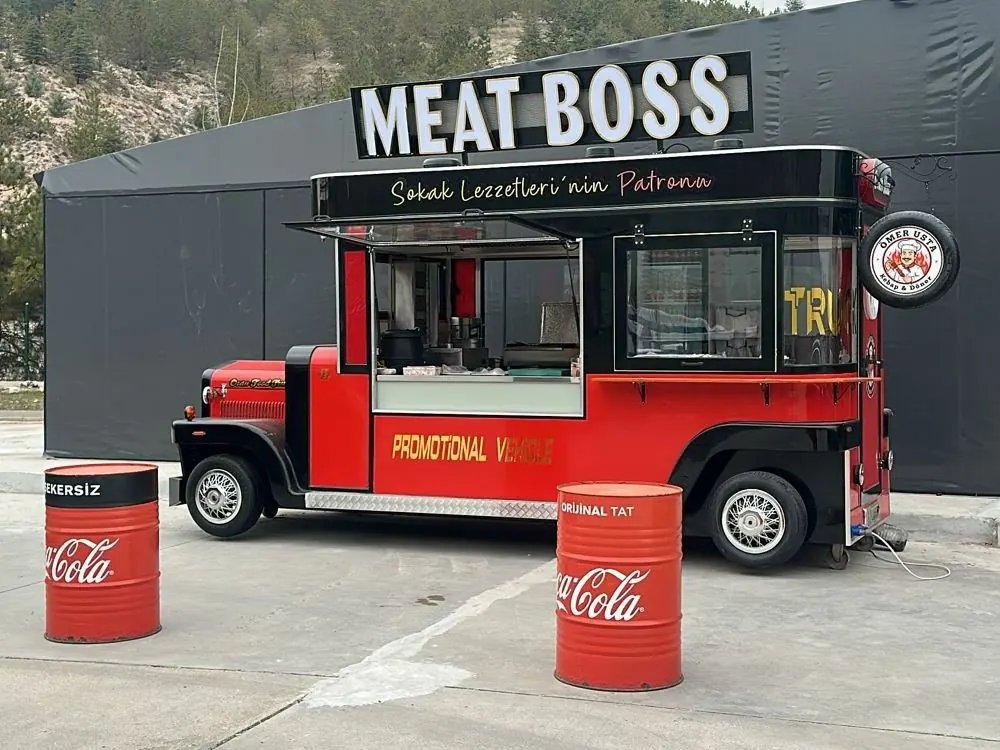
This guide is for caterers and festival traders who will trade mainly at events. It uses the FDA Food Code, official examples from New York City and Oregon, and HSE's event safety guidance for the UK. Treat every list here as a baseline. Your health department, fire authority, council or event organiser may ask for more.
Checked on 29 September 2026.
Temporary event permit or your own mobile permit
The FDA Food Code, a model offered to states and local governments for adoption, defines a temporary food establishment as one that "operates for a period of no more than 14 consecutive days in conjunction with a single event or celebration." A mobile food establishment is one that "can change location and moves as part of its routine operation." What applies to you depends on where you trade.
Under the model code, you need a permit before you operate, and the application states whether you are "mobile or stationary and temporary or permanent." It asks for applications at least 30 calendar days before opening. Local lead times differ. Ask early.
The two local examples show how a truck's own permit can carry over to an event:
- New York City. The Health Department says a vendor with a mobile food vending permit "may be able to use that permit to operate at a special event." Otherwise you apply for a Temporary Food Service Establishment permit, renewed each year. You need a permit on private land too.
- Oregon. A licensed food truck or cart may trade at fairs, festivals and concerts as a single-event temporary restaurant. Tables outside the truck may hold only non-potentially hazardous foods, dispensed drinks, condiments and napkins, and no preparation or cooking. Equipment or work outside the truck beyond that needs a single-event temporary restaurant licence from the county where the event takes place.
Our reading: in both examples, the more of the kitchen work you keep inside the vehicle, the more your own permit covers. The Food Code points the same way. It tells inspectors to check temporary food establishments with "improvised rather than permanent facilities" for handwashing, warewashing or waste periodically through the permit period. Plan the build so the menu never needs a prep table outside.
In the UK, food business registration and street trading are covered in our UK food truck and trailer guide. One event-specific point from there: councils in Northern Ireland may issue temporary street trading licences of up to 7 days, "normally only given for special events or festivals."
What event organisers are asked to check
In New York City, organisers must notify the Health Department 30 days before the event and provide "a list of participating food vendors", with each vendor's permit number. They must also "arrange for daily storage and disposal of waste water" and provide handwashing sinks with hot and cold running water. Our reading: expect a request for your permit number weeks ahead, and ask where your grey water goes.
In the UK, HSE tells organisers to ask contractors to show they understand the hazards of their work, to give evidence of a trained workforce, to confirm they have enough resources, and to show previous safe work. Organisers then plan the programme "taking into account contractor risk assessments." Our reading: if an organiser treats you as a contractor, have a written risk assessment for the truck, the gas and the generator ready to send.
For the UK vehicle side of an event trailer, and how event trading differs from a street pitch, see our catering trailer guide.
The pitch: space around the truck
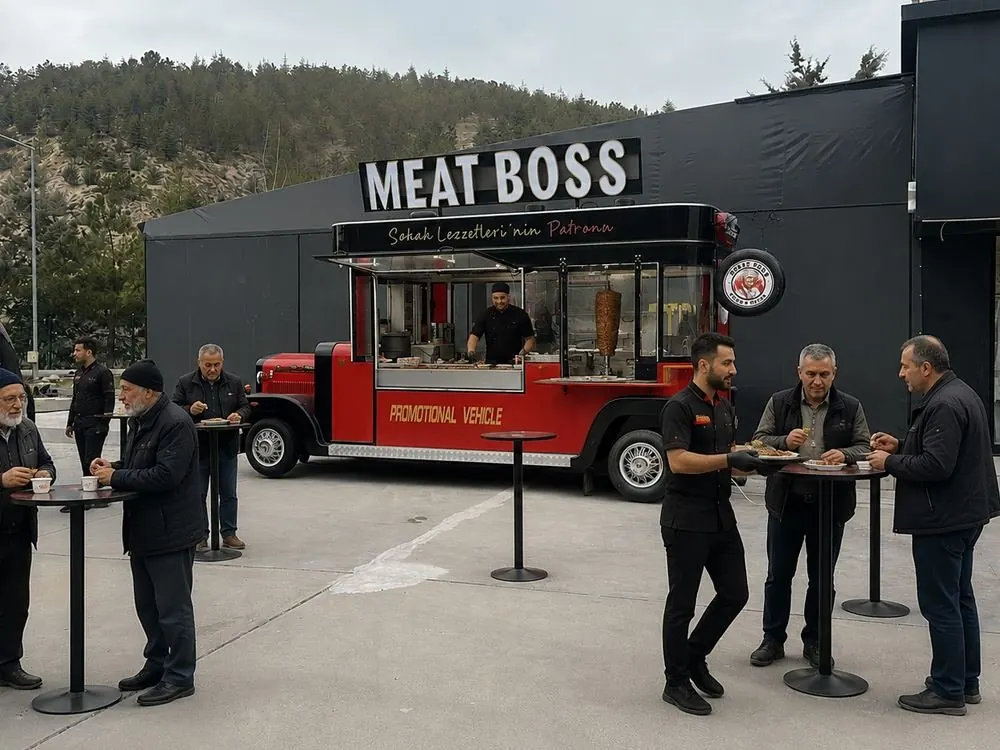
Fire rules shape the pitch too. In Oregon, the State Fire Marshal publishes a checklist for food trucks, based on the 2022 Oregon Fire Code. It asks for:
- an operational permit;
- a truck that does not block fire lanes, fire access roads or hydrants;
- at least five feet from buildings, combustible materials, vehicles and other cooking operations;
- two exits, and a serving window sized for escape;
- LP gas limited to 200 pounds in total, securely mounted, inspected every year, with a listed LP gas alarm;
- a generator that is not refuelled while running or used in an enclosed area.
Oregon's health authority says it does not enforce these fire rules and sends questions to the local fire marshal. Our reading: at an event you may answer to two regulators.
For UK events, HSE says: "Use of LPG at an event is an example of a process fire safety risk."
Our reading: give the organiser your full footprint with the hatches and any awning open, and mark where the gas cylinders and the generator sit. Then ask what spacing the local fire authority applies. Five feet is Oregon's figure. It is not a national one.
Site power or a generator
HSE's guidance tells UK organisers to plan the mains supply, a timetable of power needs, generators, earthing and "power supplies for catering equipment." It also lists "special power supplies for some equipment, eg non-UK equipment." Our reading: if your truck is built abroad, raise its voltage and plugs with the organiser early.
A hook-up is only useful if it covers your load. Cummins gives the ceiling for two common RV shore cords: 3,600 watts on a 30-amp cord at 120 V, and 12,000 watts on a 50-amp cord at 240 V. Ask each organiser for the voltage, the amps and the connector at your pitch. Then compare that with your peak load, which Generac works out as the running watts plus the largest starting surge. Our guide to sizing a food truck generator works through it.
The US Consumer Product Safety Commission says to use portable generators outside only, at least 20 feet from homes, with the exhaust facing away. That figure is written for homes. HSE tells UK organisers to keep generator enclosures "segregated from public areas" where possible, and Oregon's checklist wants built-in generators installed to their listing and the maker's instructions.
Our reading: a truck that trades mainly at events should be able to take site power and to run without it. Specify a hook-up inlet and a generator plan together, so a site with no power doesn't cost you the day.
Water and waste when there is no drain
Where the pitch has no drain, the truck carries its water in and its waste out.
The Food Code lists the ways water can reach a mobile or temporary operation: bottled water, closed portable containers, "an enclosed vehicular water tank", a storage tank on the premises, or a hose from an approved source. Water must reach fixtures under pressure, except bottled water or portable containers at a temporary food establishment. Our reading: a truck's own tank is not in that exception, so it needs a pump. Oregon says so directly: sinks need at least 20 PSI or a continuous flow, and "gravity fed is not allowed."
For waste, the Food Code's rule is the 15% rule. The sewage holding tank must be "sized 15 percent larger in capacity than the water supply tank" and sloped to a drain at least 1 inch wide, with a shut-off valve. Where that rule applies, a 40-gallon fresh tank needs a waste tank of at least 46 gallons. Waste leaves the truck at an approved servicing area or by a sewage transport vehicle.
Oregon adds detail that matters on a festival field:
- Fresh tanks must hold at least 5 gallons for handwashing and, if you wash dishes on board, at least 30 for dishwashing, plus what food preparation and cleaning need.
- The tanks stay on the truck even where water and sewer are available.
- You may connect to the public water system only if you can also connect to the sewer.
- Large waste tanks on the ground have "never been allowed in rule."
- If you produce only grey water, you may hand-carry it in containers of up to 20 gallons to a place the inspector approves, emptied daily.
- A second onboard waste tank is one of the disposal routes listed.
Our reading: at a multi-day event with no drain, the waste tank decides how long you can trade before you empty it. Size the fresh tank for your busiest day first. Then let the waste tank follow the 15% rule, and ask the organiser whether a pump-out service or a disposal point is on site. In the EU and UK, Regulation 852/2004 asks, where necessary, for "an adequate supply of hot and/or cold potable water" but sets no tank sizes. Ask your local authority.
What to send the builder for a quote
- How you will trade: mostly events, or events plus a regular pitch, and in which country.
- Your menu, the portions per hour at peak, and how many days in a row you trade at one site.
- Which permit you expect to use at events, so the work can stay inside the truck.
- Power: the hook-ups your events usually offer (voltage, amps, connector) and whether you also want a built-in generator, a portable one or batteries.
- Your equipment list with the makers' spec sheets, so the peak load can be worked out.
- Fresh and waste tank sizes, with the waste tank at least 15% larger, and a pump.
- Gas or electric cooking, the cylinder sizes, and where the cylinders are stored.
- Hatch and awning layout, one serving side or two, and the footprint with everything open.
- Fire items your local fire authority asks for, such as extinguishers and a gas alarm.
What we build
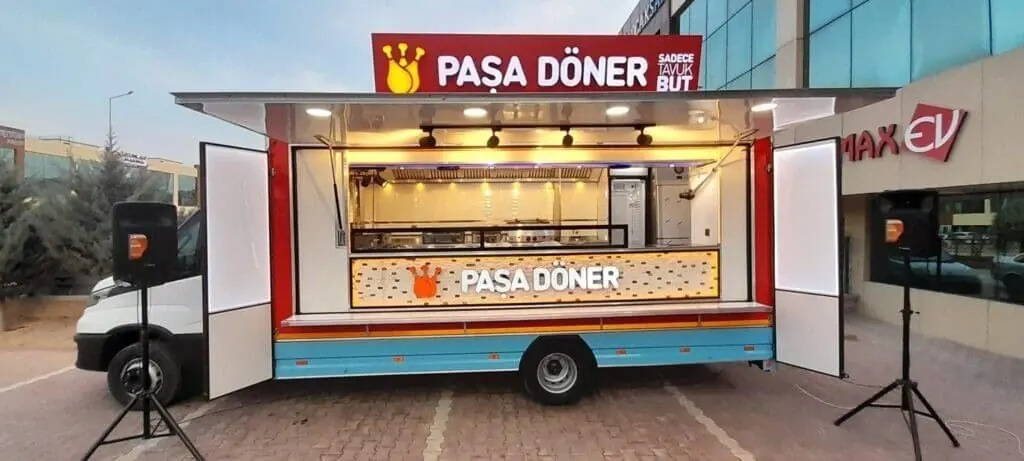
Catering trailers and mobile kitchens for events are part of our range. The custom food trucks page shows two event builds: a Hard Rock Cafe truck with a lit serving side for festivals and city events, and the Ocak Başı grill truck that cooks kebab at weddings, festivals and corporate events. It also shows the Paşa Döner truck, which opens on both sides so two queues can be served at once. Power can be a generator, shore power or batteries, and the power system and tank sizes are reflected in the quote. For export, each build is engineered to the electrical and gas standards of the destination country. Permits come from the authorities where you trade.
Frequently asked questions
Do I need a separate permit for every event?
It depends on the jurisdiction. In New York City a mobile food vending permit may cover a special event, and in Oregon a licensed truck may trade as a single-event temporary restaurant if preparation, cooking and potentially hazardous food stay inside it. Elsewhere, ask the local health department before each new event area.
Can a food truck plug into power at an event?
Only if the organiser provides a hook-up, and only up to what it carries. By Cummins' figures, a 30-amp RV cord at 120 V carries 3,600 watts at most. Ask for the voltage, amps and connector, and plan a generator for sites with no power.
Where does the waste water go at a festival?
Into the truck's waste tank, which under the Food Code is 15% larger than the fresh tank. It is emptied at an approved servicing area or by a sewage transport vehicle. In New York City the organiser must arrange daily disposal of waste water, so ask how it works at your event.
Tell us how and where you trade through the quote form, or see the vehicle types on our food trucks and trailers page. We reply with questions first, then drawings and a quote.
Related guides
- Food Truck and Food Trailer Sizes: How to Plan Length, Weight and Layout
- Food Truck Ideas That Start from the Kitchen: 12 Concepts and What Each Needs
- Small Food Trailers: What Fits Inside and What Does Not
- Starting a Food Truck Business: The Vehicle Decisions to Make First
Sources
- FDA Food Code 2026 (1-201.10, 5-103.11, 5-103.12, 5-104.12, 5-401.11, 5-402.14, 8-301.11, 8-302.11, 8-302.14, 8-401.10)
- NYC Health, Food Vending at Temporary Events
- Oregon Health Authority, mobile food information page
- Oregon Health Authority, mobile food operation guide
- Oregon Health Authority, Food Code Fact Sheet #35, Wastewater Disposal
- Oregon State Fire Marshal, mobile food fire safety checklist
- HSE, Event safety: Electrical safety
- HSE, Event safety: Fire safety
- HSE, Event safety: Getting started
- HSE, Event safety: Managing an event
- GOV.UK, Street trading licence (Northern Ireland)
- Cummins, RV Generator Power Basics
- US Consumer Product Safety Commission, Carbon Monoxide Information Center
- Regulation (EC) No 852/2004, Annex II, Chapter III

By
Ozan Food Truck
This guide is based on the laws, regulations, official guidance and manufacturer documents linked in the text. It is general information, not legal or engineering advice. Rules differ by country, state and city, so confirm the details with your local authority before you build or buy.