
Buying guide
Catering Trailers: What UK and EU Buyers Should Check
A catering trailer is a road trailer and a small food premises at the same time. Before you compare catering trailers for sale, fix its loaded weight, because that one figure decides the brakes, the licence you need to tow it and, in the EU, its trailer category. Then match the layout to how you trade: long days on an event site, or a pitch on the street.
By Ozan Food TruckPublished 10 min read
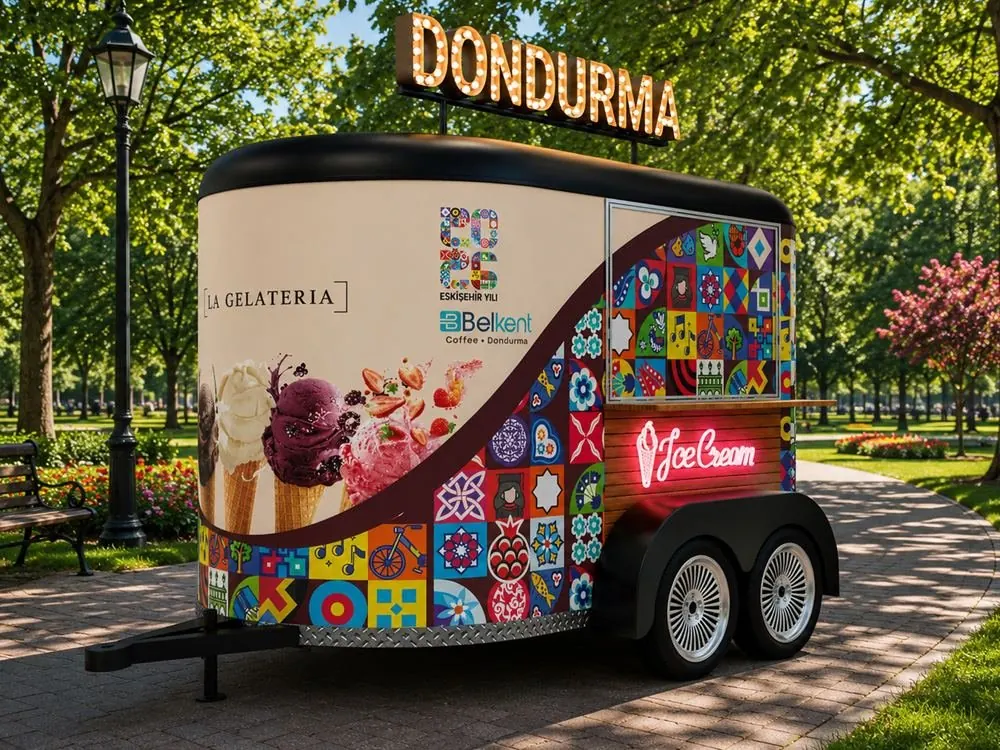
This guide covers the trailer itself, for buyers in Great Britain and the EU, using GOV.UK, DVSA, HSE and EU law. Treat each list as the national baseline. Your approval authority, council or event organiser may ask for more.
Checked on 29 September 2026.
The UK paperwork, in two lines
A newly built or imported trailer needs vehicle approval, and for a single one GOV.UK points to DVSA's Individual Vehicle Approval scheme. In England, Wales and Northern Ireland you register the food business with your council at least 28 days before trading, and our UK food truck and trailer guide covers that, plus street trading consent.
Start with the weight
Everything on the road side follows from one figure. The maximum authorised mass (MAM), as GOV.UK defines it, is the weight of the trailer including the maximum load it can carry safely on the road, and it is normally shown on a plate or sticker. In a catering trailer, that load includes the kitchen and fridges as well as water, gas cylinders and stock.
In Great Britain, three thresholds matter:
- Up to 750 kg loaded, a trailer may run without brakes. DVSA adds that an unbraked trailer should not weigh more than half the car.
- Over 750 kg loaded, it must have a working brake system. The car and loaded trailer together must then stay within the second weight on the car's plate.
- With a licence gained on or after 1 January 1997, you can tow a trailer of up to 3,500 kg MAM, with a combined MAM of up to 7,000 kg.
In the EU the maximum mass sets the category. O1 covers trailers up to 0.75 tonnes, and O2 covers trailers over 0.75 and up to 3.5 tonnes. Under the EU driving licence rules, a category B licence tows an O1 trailer, or an O2 trailer if car and trailer stay within 4,250 kg together. Above 3,500 kg combined, member states require training or a test (code 96). Category BE covers a B car with an O1 or O2 trailer. Directive (EU) 2025/2205 replaces the current directive from 26 November 2029 and keeps these figures for a petrol or diesel car. Confirm with your national licensing authority.
Our reading: ask the builder for two figures in writing. One is the MAM on the plate. The other is the expected weight as delivered, with empty tanks. The gap between them is what you can load, and water, gas and stock all count against it.
Chassis and axles
DVSA's pre-tow check asks that the trailer is not overloaded and that the load is spread evenly and secured. Tyres must be inflated to the maker's figure for the load, with at least 1.6 mm of tread, and mudguards must be fitted.
Our reading: where the builder places the fridges, the water tanks and the gas locker decides how the weight sits on the axles and the coupling. Ask for a layout drawing that shows them, not only the serving side.
Brakes
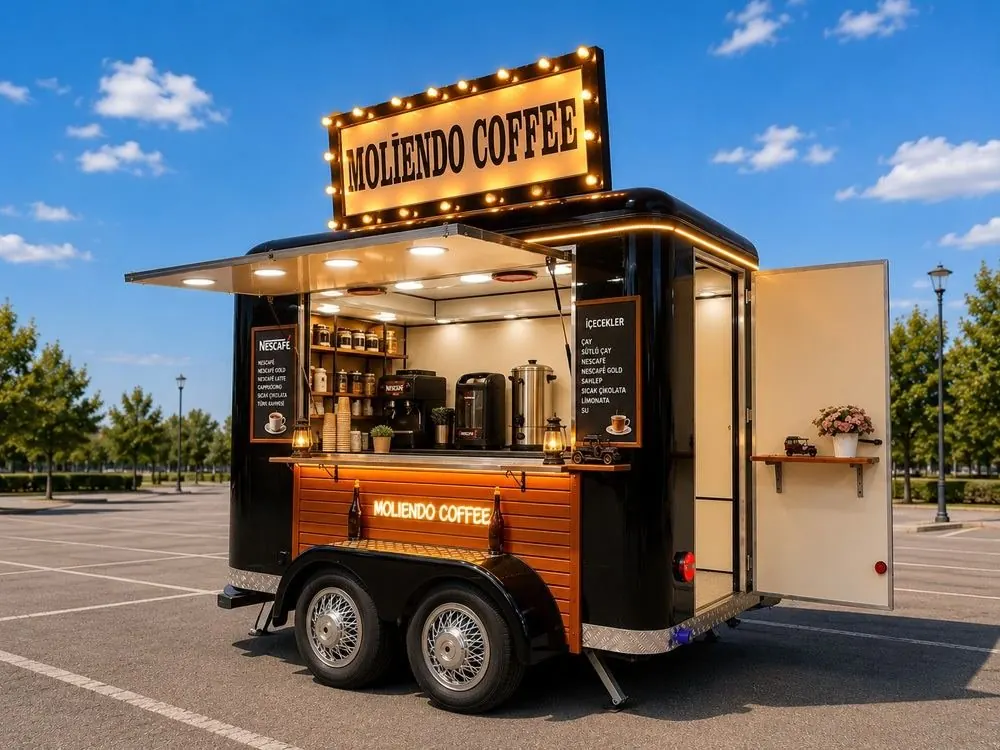
GOV.UK makes brakes optional below 750 kg loaded and compulsory above it. Either way you need a breakaway cable or a secondary coupling. It engages the trailer's brakes, if fitted, or stops the trailer if it comes off the car. The cable needs enough slack not to brake on its own, and it must not drag on the road.
A 2011 DVSA sheet on American trailers sets out what European rules expect of a braked caravan or trailer:
- every wheel brakes;
- a parking brake holds the trailer on an 18% slope, locked by a purely mechanical device;
- the trailer stops automatically if the coupling separates while moving;
- an overrun (inertia) brake lets you reverse without a sustained drag above 8% of the trailer's maximum mass.
The sheet links the UK rules to UN Regulation 13 on braking. It is old. Confirm the current rules with DVSA. On the EU side, the list of type-approval requirements in Regulation 2018/858, as updated in 2019, applies UN Regulation 13 to both O1 and O2 trailers.
Coupling and plug
UN Regulation 55 covers mechanical couplings, and the EU list applies it to both light trailer categories too. DVSA notes that the European and UK tow ball is 50 mm, while an American ball is usually 2 inches. If your car was first used on or after 1 August 1998, its tow bar has to be type-approved.
Before each trip, DVSA says to check the coupling height and the 7 or 13 core cable and plug. Our reading: both depend on your car. Tell the builder your tow vehicle and its socket before the drawbar is made, so the coupling height and the plug match.
Lights and length
In Great Britain, Table VI of the Road Vehicles Lighting Regulations 1989 lists the lamps and reflectors a trailer drawn by a motor vehicle must carry. Width and length decide part of the list:
| Lamp or reflector | Required on a modern trailer (GB) |
|---|---|
| Rear position lamps, stop lamps, direction indicators, rear and front retro reflectors | No size exception |
| Rear registration plate lamp | Whenever a rear plate is required |
| Rear fog lamp | Wider than 1,300 mm |
| Front position lamps | Wider than 1,600 mm |
| End-outline marker lamps | Wider than 2,100 mm |
| Side retro reflectors | Longer than 5 m, drawbar excluded |
| Side marker lamps | Longer than 6 m, drawbar excluded |
| Rear marking | Not required at 3,500 kg maximum gross weight or less |
Their schedules set how each lamp is fitted, and there are further exceptions we have not listed. Ask the builder to fit and wire the lights to these regulations, and check anything unusual with DVSA. For EU type-approval, UN Regulation 48 on the installation of lighting applies to O1 and O2 trailers.
The maximum trailer width in Great Britain is 2.55 m. Behind a tow vehicle of 3,500 kg MAM or less, the trailer can be no longer than 7 m, and the A-frame doesn't count. The 2011 DVSA sheet adds one detail for caravans: a box on the drawbar that holds gas cylinders counts in the overall length. Our reading: treat a gas locker on a catering trailer's A-frame the same way, and ask for a quoted length that includes it. Our sizes and layout guide covers the EU approval limits.
For continental buyers
If a builder holds EU type-approval for a model, each trailer comes with a certificate of conformity, on paper or, from 5 July 2026, as electronic data. If not, one route is individual approval. The owner, the manufacturer or the importer can apply, and a national individual approval is valid only in the member state that grants it. For a national approval, the authority accepts type-approved components. Our reading: ask for the approval marks and certificates of the lights, coupling, axles and brakes fitted.
EU law makes periodic roadworthiness tests compulsory for trailers over 3.5 tonnes. For O1 and O2 trailers, each member state may set its own rules, so ask your registration or testing authority.
The hygiene rules sit in Regulation 852/2004, Annex II, Chapter III, which names "mobile sales vehicles". Where necessary, you need facilities to wash and dry hands, food-contact surfaces that are smooth, washable and corrosion-resistant, and "an adequate supply of hot and/or cold potable water". It also asks for ways to clean equipment, store and dispose of waste, and control food temperatures. It sets no sink counts or tank sizes. Those come from national guidance and your local authority, and each establishment has to be registered with the competent authority.
Event caterer or street trader

At events, HSE tells organisers to plan the mains supply, generators, earthing and power for catering equipment, and special supplies for non-UK equipment. It treats LPG at an event as a process fire risk. Work vehicles should finish their tasks in public areas before the audience is admitted. Our reading: once the gates open, you may not be able to restock by vehicle. Size fridges and tanks for the whole session, and ask each organiser which power, water and waste points traders get. For long peak queues, consider a longer hatch or a second serving side. Our Paşa Döner truck opens on both sides so two queues can be served at once, and you can ask for a trailer drawn the same way.
On the street, the council decides. A consent in England and Wales covers trading from a vehicle only if the council includes that permission, and the council can grant fewer days than you ask for. Our reading: a pitch may come with no power or water. Ask the council before you choose between a generator, batteries and shore power, and get the pitch size before the body length is fixed.
What to send the builder for a quote
- How you will trade: events, a street pitch or both, and in which countries.
- Your menu and the busiest hour you expect.
- The tow vehicle: its MAM, gross train weight, tow ball and 7 or 13 core socket.
- For the UK, the date you passed your test. For the EU, the licence categories you hold.
- A target MAM, braked or unbraked, and for the EU the category, O1 or O2.
- The maximum length and width, with the gas locker included.
- Lighting to the GB regulations or to UN Regulation 48, and the approval certificates for fitted parts.
- Power: site hook-up, generator or batteries.
- A washbasin with hot and cold water, sinks for equipment and food, and the tank sizes you want.
- Gas or electric cooking. In Great Britain, gas installation and repair work must be done by someone Gas Safe-registered. Our burger van guide covers LPG and extraction.
- The documents you need at delivery: a plate with the masses, the VIN or chassis number, an invoice and the approval documents.
What we build
Ozan Food Truck builds towable food trailers in its own factory in Konya, Turkey, and catering trailers and mobile kitchens for events are part of the range. For export projects, each build is engineered to the electrical and gas standards of the destination country. Approval itself comes from the authority where you register the trailer. Our food trucks and trailers page shows the vehicle types.
Frequently asked questions
Do you need a licence to sell food from a trailer?
In England, Wales and Northern Ireland you register the food business with your council at least 28 days before trading. Where the council has designated the street, you also need a street trading licence or consent. In the EU, each establishment is registered with the competent authority. Check the local steps with your council or food authority.
What do I need to run a catering trailer?
A trailer with its MAM on a plate and any approval your country requires, and a tow vehicle and licence that cover that weight. Brakes above 750 kg loaded in Great Britain, and a breakaway cable or secondary coupling in every case. A food business registration, Gas Safe-registered gas work in Great Britain, and a pitch the council or event organiser has agreed.
Do I need planning permission for a catering trailer?
We did not check planning law for this guide. Ask your council's planning team before you commit to a fixed pitch.
Send your trading plan, tow vehicle and menu through the quote form, or see the coffee and ice cream trailers we build. We reply with questions first, then drawings and a quote.
Related guides
- New vs Used Food Truck: What to Check Before You Buy
- Taco Trucks: Kitchen Line, Holding and Service Window Planning
- How Much Does a Food Truck Cost to Build? The Parts That Drive the Price
- Hot Dog Carts vs Hot Dog Trailers: What Changes for the Buyer
Sources
- GOV.UK, Towing with a car
- DVSA, Tow a trailer or caravan with a car: safety checks
- DVSA, American caravans and trailers: brakes and couplings (2011)
- GOV.UK, Driving licence categories
- GOV.UK, Vehicle weights explained
- GOV.UK, Vehicle approval
- The Road Vehicles Lighting Regulations 1989, regulation 18 and Schedule 1
- Regulation (EU) 2018/858, Article 4, Articles 36 and 44 to 46, Annex II
- Regulation (EU) 2019/2144, Annex I and Annex III
- Directive 2006/126/EC on driving licences
- Directive (EU) 2025/2205 on driving licences
- Directive 2014/45/EU on periodic roadworthiness tests, Article 2
- Regulation (EC) No 852/2004, Article 6 and Annex II, Chapter III
- Food Standards Agency, Food business registration
- Food Standards Agency, Starting a food business
- Local Government (Miscellaneous Provisions) Act 1982, Schedule 4
- GOV.UK, Street trading licence
- HSE, Catering Information Sheet 23, Gas safety in catering and hospitality
- HSE, Event safety: electrical safety
- HSE, Event safety: fire safety
- HSE, Event safety: transport

By
Ozan Food Truck
This guide is based on the laws, regulations, official guidance and manufacturer documents linked in the text. It is general information, not legal or engineering advice. Rules differ by country, state and city, so confirm the details with your local authority before you build or buy.