
Buying guide
Buying a Burger Van or Burger Food Truck: Griddle, Extraction and Gas
Before you compare burger vans for sale, settle four things: gas or electric cooking, the extraction over the griddle and fryer, who installs and checks the LPG, and how raw meat is kept apart in the fridge. The first two also set how much power and ceiling height the van needs.
By Ozan Food TruckPublished 10 min read
This guide is for buyers ordering a burger van or truck for the UK or the US. It draws on HSE and Home Office guidance, GOV.UK food hygiene pages, the FDA Food Code and Lincat's own manuals. Council registration is in our UK food truck guide.
Checked on 29 September 2026.
What makes a burger van different
Search results for "burger van for sale" mix converted vans with towed burger trailers. On our food truck page the base is "a box body on a chassis cab, a converted panel van or a towable trailer". The kitchen questions below are the same for all three.
The difference is in the kitchen: a griddle and a fryer, with grease in the air and a tank of hot oil. In the UK there is usually LPG as well. HSE's gas guidance says burger vans "usually use LPG supplied in cylinders".
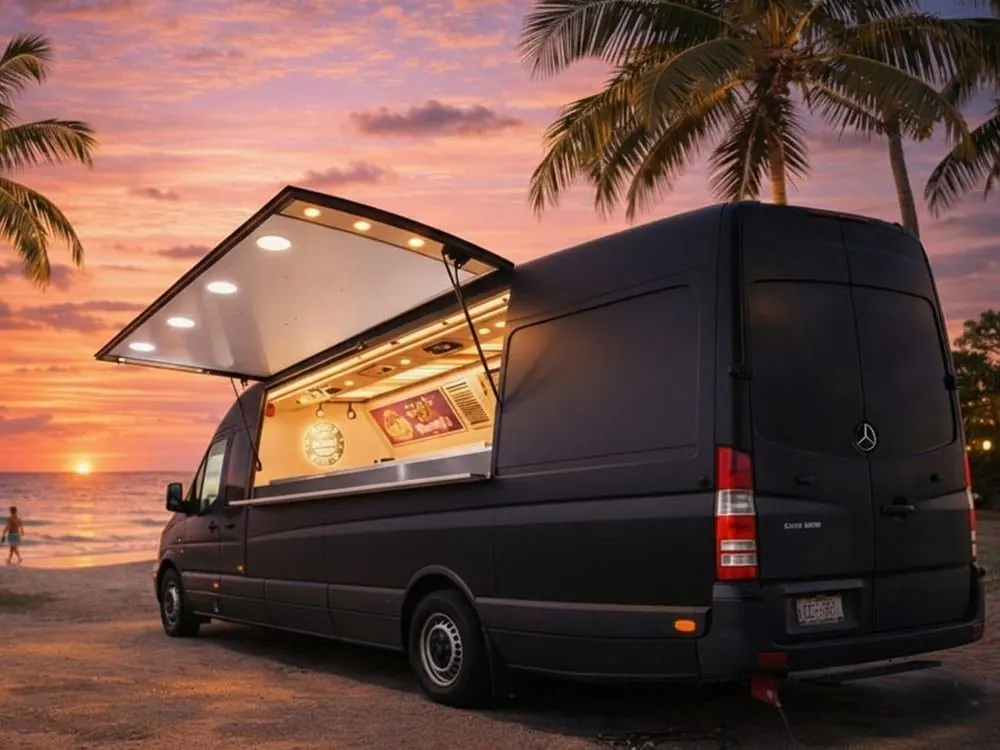
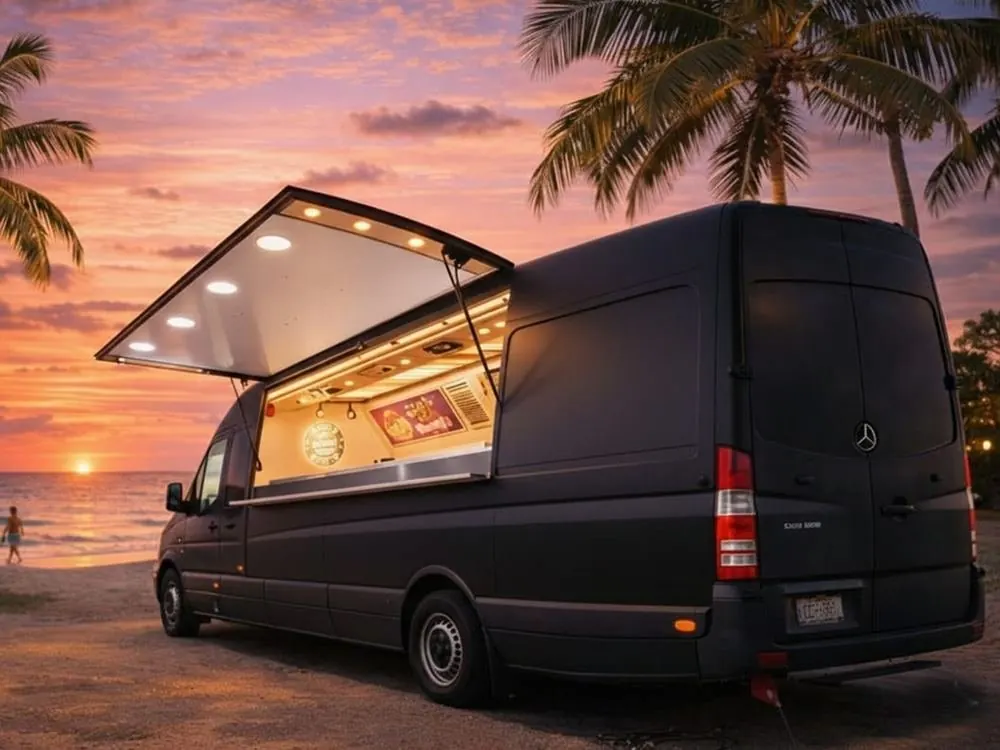
One of our builds, Alpine Street Food, is "a panel van turned into a burger and falafel kitchen", with fryers, a griddle and extraction behind a full-length lift-up hatch.
Gas or electric: the first decision
Lincat's product pages show what is at stake. These are the maker's printed values, as examples only.
| Appliance (Lincat model) | Energy | Rating as printed | Other maker values |
|---|---|---|---|
| Griddle, 450 mm (GS4/P) | Propane | 5.5 kW | 12 mm steel plate, 412 x 405 mm cooking area, flame failure device, 35 kg |
| Griddle, twin zone, 600 mm (GS6/T) | Electric | 4.0 kW, 17.4 A single phase | 562 x 405 mm plate, 50 to 250°C, removable front drainer drawer, 39 kg |
| Fryer, 1 basket, 300 mm (J5/P) | Propane | 12 kW in the manual, 11.3 kW on the spec sheet | 12-litre tank, 22.5 kg of chilled chips an hour, 43 kg |
| Fryer, 1 basket (DF39) | Electric | 9.0 kW, 39 A single phase or 13 A per line on three phase | |
| Fryer, 1 basket (LDF) | Electric | 3.0 kW, 230 V single phase |
On single phase, the electric griddle and the larger electric fryer above draw 17.4 A and 39 A. Our reading: an all-electric burger line needs a generator or site supply sized for that load, so check the power before you choose it. Our generator sizing guide shows how to add up the rating plates. Lincat's gas griddle and fryer take their heat from propane instead, which brings in the gas rules below.
Note the J5/P row: Lincat's own documents give the same fryer two figures. Design around the rating plate of the appliance you receive.
Extraction and grease
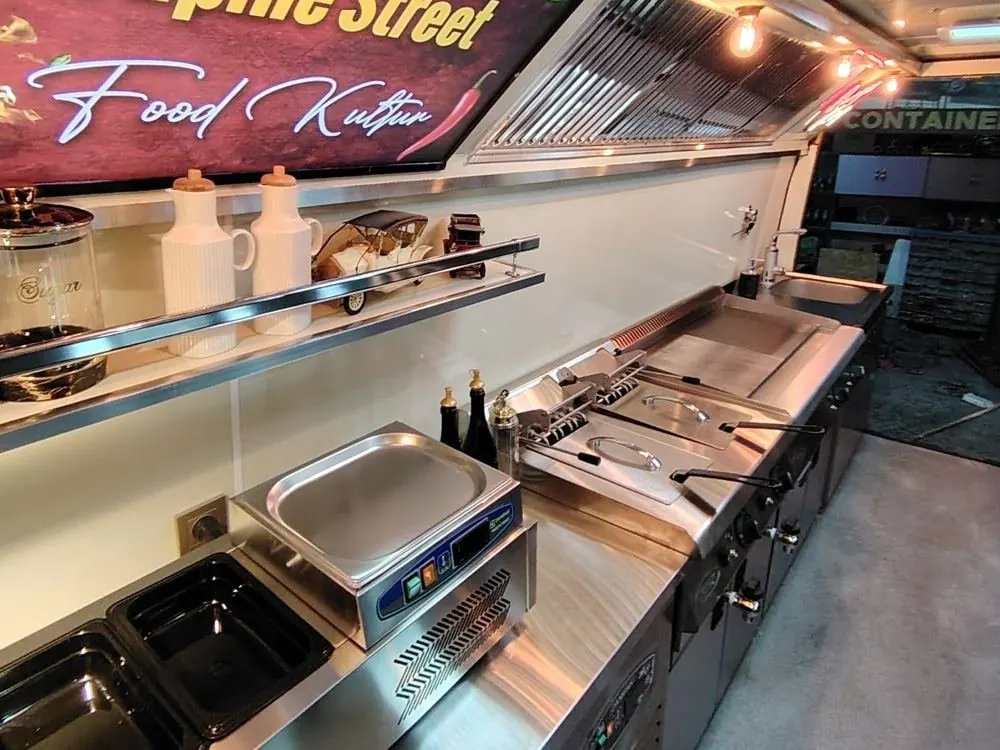
HSE's Catering Information Sheet 10 is written for catering kitchens, but its checklist makes a good brief for a van:
- a canopy hood for every appliance that makes fumes and heat, as close to the source as the work allows
- canopy and ductwork in non-combustible material, with access for cleaning
- grease filters that are easy to remove
- an extraction rate worked out "from the information supplied with the appliances"
- enough air for complete combustion at gas appliances, so carbon monoxide can't build up
Lincat's gas griddle manual adds the maker's side. Site the griddle "beneath an extraction canopy", don't connect it directly to a flue or extraction duct, and keep nearby walls non-combustible and at least 50 mm from the sides and rear of the flue. It also asks for 750 mm clear between the top of the flue and a non-combustible ceiling. Our reading: check that figure against the internal height of the van before you pick the base vehicle.
Grease is where fires start. HSE lists flame-grilling among the causes of duct fires above gas appliances, when a flame reaches built-up grease and fat. The Home Office guide for outdoor events names burning cooking oil, crumbs and duct grease as the main causes of fire in event catering. Lincat says the griddle's fat drawer must be emptied and cleaned before use, and may need emptying often in heavy use.
HSE says the installer should fit an interlock, so the gas to the appliances shuts off if the mechanical ventilation fails. A manual bypass is not permitted.
For a US truck, the Food Code asks for hoods that keep grease and condensation off food, walls and ceilings. Fire requirements differ from one jurisdiction to another. Austin, Texas, for one, asks new permit holders for an automatic hood fire suppression system and a Class K extinguisher. Ask your own fire authority before the hood is ordered.
LPG in the UK: who may do what
HSE's gas sheet, CAIS23, sets out the basics:
- Gas work on catering equipment, mobile catering included, falls under the Gas Safety (Installation and Use) Regulations 1998, and "the company or individual must be Gas Safe-registered".
- A vehicle with LPG appliances must be adequately ventilated, and pilot lights should not be lit while it is moving.
- A competent person who is not registered may change an LPG cylinder or hose. New installation and commissioning is for a Gas Safe-registered person.
- Annual inspection is "a reasonable minimum frequency".
- Flame supervision devices stop gas reaching the burner if the flame goes out. New equipment has them, and second-hand equipment with open or enclosed burners should be fitted with them.
- Domestic carbon monoxide alarms are not normally suitable for a catering kitchen.
The makers add detail. Lincat's griddle manual asks for an isolating cock close to the appliance, warns that "black domestic hoses are not suitable", and sets a propane supply of 37 mbar, adjusted to 25 mbar. The J5 fryer has a pilot flame. Our reading: make the gas shutdown before driving part of the handover.
Our factory does the gas and electrical installation in-house, and for export "each build is engineered to the electrical and gas standards of the destination country". Our reading: unless your builder is itself Gas Safe-registered, plan for a UK Gas Safe engineer to check or commission the installation before you trade. HSE says you can ask to see the engineer's Gas Safe ID card and verify it with Gas Safe Register.
Fire extinguisher and fire blanket
Lincat's fryer manual is direct: "Install a suitable fire extinguisher and fire blanket within reach of the appliance." It does not name a type.
The Home Office guide for open-air events explains the types. Class F covers fires in cooking oils such as deep-fat fryers, and a Class F extinguisher is "particularly suitable for commercial catering establishments with deep-fat fryers". Foam is not suitable for deep-fat fryers or electrical equipment. Water is for Class A fires only. Powder is "not generally suitable for confined spaces".
A light-duty fire blanket is meant for small fires in containers of cooking oil or fat. Keep it near the hazard, where you can reach it safely. Check extinguishers monthly, the guide says, and have them maintained yearly by a competent person.
Which fire law covers the van itself is less clear. The Fire Safety Order for England and Wales does not apply to a vehicle taxed under the Vehicle Excise and Registration Act, or to a trailer used as a means of transport. So ask your local fire and rescue service, and the organiser of each event or market, what they expect you to carry.
Cooking temperatures and cold storage
GOV.UK lists "products made from minced meat, such as burgers" among foods that must be cooked all the way through, with no pink meat. Its standard advice is a core temperature of 70°C for 2 minutes. Under the FDA Food Code, a ground-beef patty counts as non-intact meat: 68°C (155°F) for 17 seconds. GOV.UK suggests checking with a clean thermometer probe in the centre.
On the cold side:
| Cold holding | Source | |
|---|---|---|
| UK | 8°C or below (legal in England, Wales and Northern Ireland). Set the fridge to 5°C or below | GOV.UK food hygiene guide |
| US | 5°C (41°F) or less | FDA Food Code 3-501.16 |
GOV.UK also asks for separate fridges for raw and ready-to-eat food if possible, or raw food stored below ready-to-eat food in the same fridge. Raw meat stays away from salad and cheese, with its own boards and utensils.
Our reading: a burger menu puts raw patties next to salad and cheese, so decide early between two fridges and one with a strict raw-below layout. The wider equipment list is in our food truck equipment guide.
The serving hatch
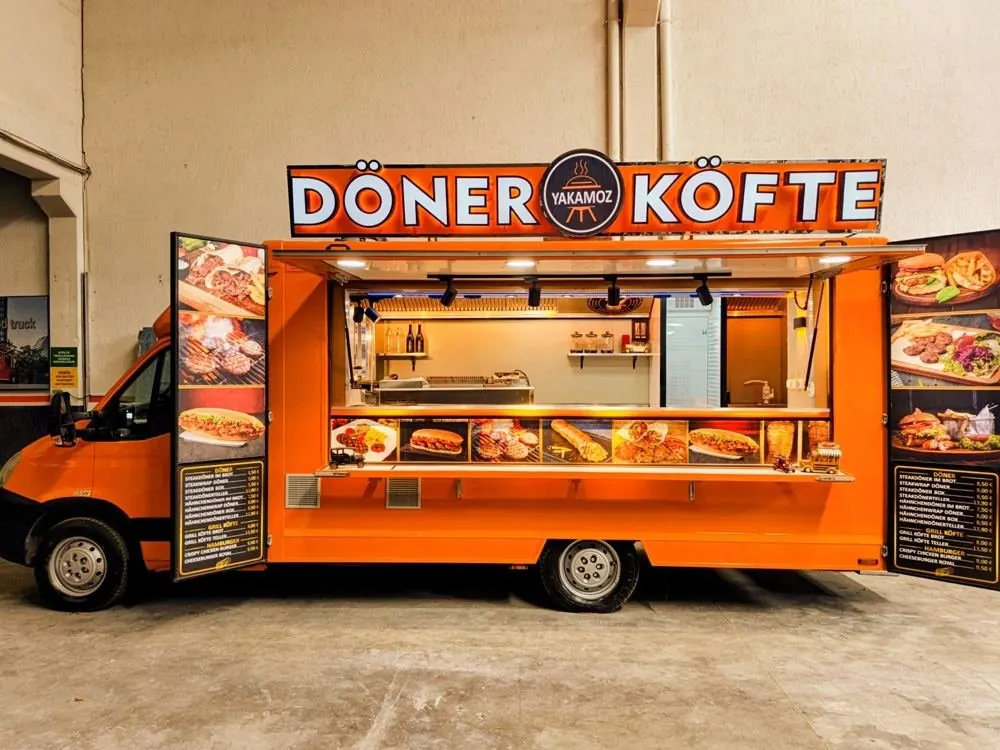
On our trucks the serving side is "lift-up hatches on gas struts, counters and menu panels placed for the way your customers queue". The Yakamoz Döner Köfte truck, laid out for döner, köfte and burgers, has a full-length hatch.
Regulation 852/2004, in its UK version, asks that mobile sales vehicles be designed and built, so far as is reasonably practicable, to avoid contamination, "in particular by animals and pests". The Food Code says openings kept open must be protected with screens, air curtains or other effective means, unless pests are absent. Our reading: a hatch that stays open all service may need a screen or an air curtain. Ask your health department before it is built.
Registration, in one line
In the UK you must register with the local authority "wherever you trade from, including your home, a van or a stall". Street trading and pitches are covered in the UK guide.
What to tell the builder for a quote
HSE asks caterers to give the ventilation designer the menu, the number of meals, the staff count and the equipment. Start your quote request from the same list:
- Your menu, and how many meals you expect to serve at the busiest hour.
- How many people will work inside.
- Gas or electric for the griddle and fryer, or the models you want, with spec sheets.
- The power source: generator, site hook-up or batteries.
- The base: panel van, box body on a chassis cab, or trailer.
- The country, and the pitches or events you will trade at.
- Fridge and freezer needs, with raw and ready-to-eat storage planned.
- Hatch length, which side it opens on, and the counter you want.
- Who will commission the gas system in the country of use.
Frequently asked questions
How much does it cost to have a burger van?
We don't publish prices, because every build is quoted to its scope. The drivers on our food truck page are the vehicle and body size, the kitchen equipment, the power and water systems, and branding and delivery. For a burger van, choosing gas or electric cooking changes what the power system has to carry.
Can you make money from a burger van?
No official source we read gives earnings figures, so we won't guess. What the build does decide is output. Lincat, for example, rates its J5/P fryer at 22.5 kg of chilled chips an hour. Size the griddle, fryer and extraction for the number of meals you plan to serve.
What do I need to run a burger van?
In the UK: registration with your local authority, gas installation work by a Gas Safe-registered business, and adequate ventilation. The fryer maker and the Home Office guide also point to an extinguisher and fire blanket suited to cooking oil. Check with your council and your fire and rescue service for local rules. The UK guide covers the council side.
Is a used burger van worth buying?
Check the gas side first. HSE says second-hand equipment with open or enclosed burners should be fitted with flame supervision devices, and gas work needs a Gas Safe-registered engineer. Our new vs used guide has a fuller checklist.
If you want a burger kitchen drawn around your menu, send the list above through the quote form. We reply with questions first, then drawings and a quote. You can see our other builds on the food trucks and trailers page.
Related guides
- Taco Trucks: Kitchen Line, Holding and Service Window Planning
- How Much Does a Food Truck Cost to Build? The Parts That Drive the Price
- Hot Dog Carts vs Hot Dog Trailers: What Changes for the Buyer
- How to Choose a Food Truck or Food Trailer Builder: What to Check Before You Order
Sources
- HSE, Catering Information Sheet 23, Gas safety in catering and hospitality
- HSE, Catering Information Sheet 10, Ventilation in catering kitchens
- Home Office, Fire safety risk assessment: open-air events and venues
- The Regulatory Reform (Fire Safety) Order 2005, article 6
- GOV.UK, Food hygiene for businesses
- GOV.UK (Food Standards Agency), Running a food business
- Regulation (EC) No 852/2004, Annex II (UK version)
- FDA Food Code 2026 (sections 3-401.11, 3-501.16, 4-204.11, 4-301.14, 6-202.15)
- City of Austin Fire Department, Mobile Food Vending Fire Inspections
- Lincat, Silverlink 600 propane griddle GS4/P
- Lincat, Silverlink 600 gas griddles manual
- Lincat, Silverlink 600 electric griddle GS6/T
- Lincat, Silverlink 600 propane fryer J5/P
- Lincat, J5/P spec sheet
- Lincat, Silverlink 600 free-standing gas fryers manual
- Lincat, Silverlink 600 electric fryer DF39
- Lincat, Lynx 400 electric fryer LDF

By
Ozan Food Truck
This guide is based on the laws, regulations, official guidance and manufacturer documents linked in the text. It is general information, not legal or engineering advice. Rules differ by country, state and city, so confirm the details with your local authority before you build or buy.