
Coffee trailers
Coffee Carts: What You Can Serve from a Cart and When You Need a Trailer
A coffee cart can serve drinks made to order from a compact espresso machine, where your local health code allows an open cart to do so. Once your menu, your machine or the water rules ask for more than a cart can carry, look at an enclosed trailer or a kiosk.
By Ozan Food TruckPublished 10 min read
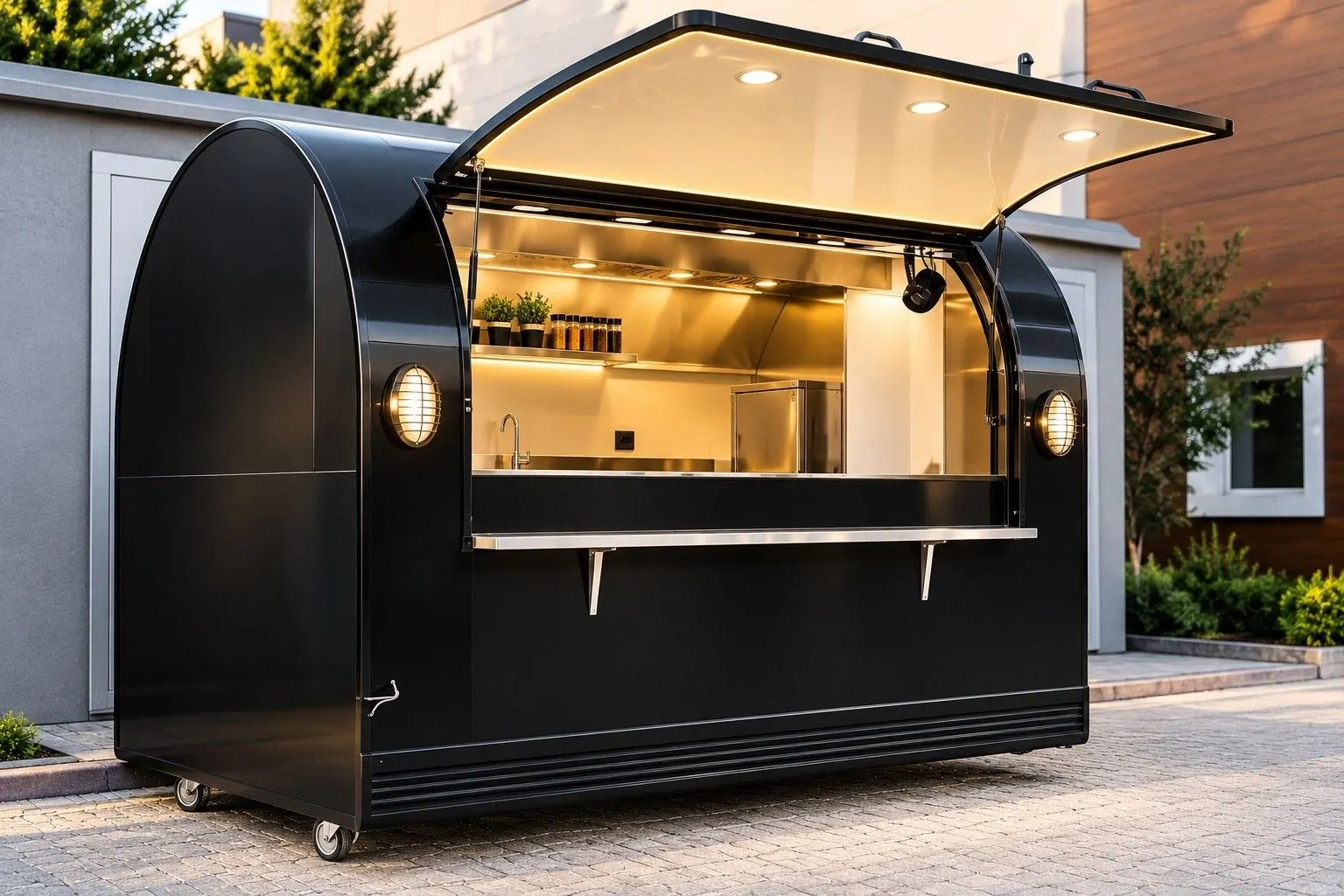
We compare the two on the menu, machine power, water and the pitch. The rule examples come from official pages in California, Oregon and England and Wales. The full equipment list is in our guide to coffee trailer equipment and power, and the order of permit decisions is in starting a coffee trailer.
Checked on 29 September 2026.
Cart or trailer: the short version
| Question | A cart can work when | Look at a trailer or kiosk when |
|---|---|---|
| Menu | Drinks made to order, within the local cart class | You want prep the cart class does not allow, or drinks with frozen milk products in California |
| Machine | One group, tank-fed, on the supply at your pitch | Two groups or more (the US Linea PB needs 208-240 V at 22 A or more) |
| Water | Handwash water and a small prep supply you can refill | You want to wash up on board, or the code asks for more water than the cart holds |
| Weather | The machine can be kept out of rain and sun | The maker's conditions mean it has to sit inside |
The table is our reading of the sources below.
What an open cart may serve
California and Los Angeles County
California law calls food sold from a pushcart, stand, pedal-driven cart, wagon or other nonmotorized conveyance a "compact mobile food operation". LA County has used the term for food carts since March 2024.
Such a cart "shall conduct only limited food preparation". The state's list of what that means includes "preparing beverages that are for immediate service, in response to an individual consumer order, that do not contain frozen milk products". Thawing and washing foods are not on it.
LA County's high-risk cart class is unenclosed and limited to that kind of preparation, while its fully enclosed truck class is the one defined for "complex menu items". The county names soft serve ice cream as high risk.
Our reading: espresso drinks, filter coffee and tea made to order fit the California cart wording. A shake made with ice cream does not. The county decides how your menu is classed, so show them the drinks list before you order a cart.
Two more California rules matter to a buyer. New food equipment on a compact cart must be certified for sanitation by an accredited program, and electrical appliances must meet Underwriters Laboratories standards. Ask the machine maker for that paperwork. And a health agency can pre-approve a standard plan for a mass-produced cart. Buy one built to that plan, not substantially altered, and you face a final inspection instead of a plan submission.
Oregon: the menu sets the class, not the vehicle
The Oregon Health Authority sorts mobile food businesses into four classes "based on the menu". Its definition covers any vehicle that is self-propelled, pulled or pushed, with no size limit. The example it gives for Class III is "Espresso/Hot Dogs". Class III may prepare food on board but may not cook raw animal food.
Everything has to be integral and move as one piece, and fridges may not stand outside. The authority warns that "even commercially made food carts might not meet the rules". Call your local health department first.
Our reading: in Oregon a coffee cart and a coffee trailer with the same menu start from the same class. What differs is whether the cart can carry every fixture the class needs.
Machine power on a cart
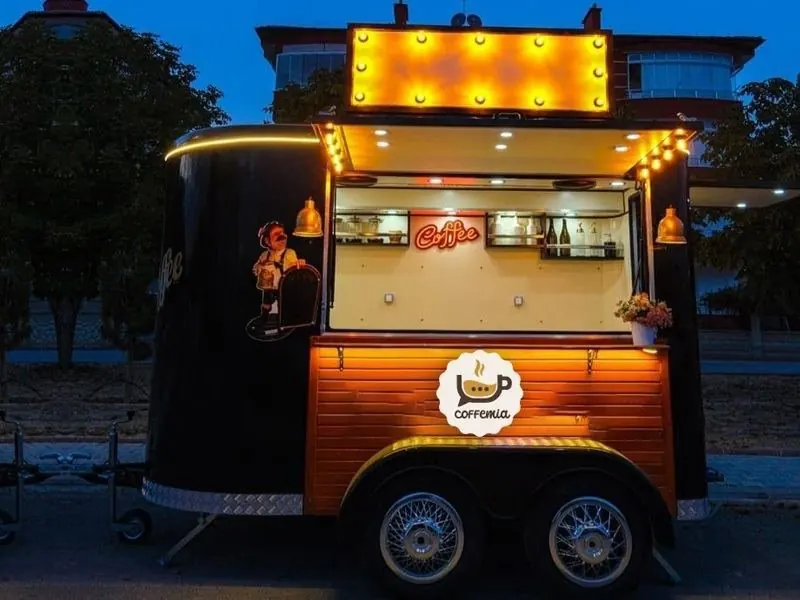
Makers publish these figures for compact one-group machines:
| Machine | Supply | Power | Water |
|---|---|---|---|
| Rancilio Classe 5 S, 1 group tank version (37 kg) | 110 V / 220-240 V | 1450 W / 1800 W | built-in 2 litre tank |
| Victoria Arduino E1 Prima, 1 group (37 kg net) | not stated | 1600 / 2600 W (supply per figure not stated) | 1.5 litre tank |
| La Marzocco Linea Mini (listed as a home product) | 115 V | 1620 W, 14 A | internal reservoir |
| Nuova Simonelli Appia Life Standard, 1 group | not stated | 1900 W | not stated |
Whatever you choose, plan from the rating plate of the version you order.
Two groups is a different class of supply. La Marzocco's US guide for the two-group Linea PB asks for 208-240 V single phase, 22 A at full load and a NEMA 6-30 outlet. Both La Marzocco US guides also give the grinder its own 15 A supply.
Our reading: the published figures make a one-group, tank-fed machine the realistic choice for a cart. A two-group machine needs a supply that is designed into a trailer or kiosk from the start.
La Marzocco's manuals add conditions. The electrical system must suit "the maximum power consumption indicated on the espresso machine", extension cords are not recommended, and a 30 mA residual current device is mandatory. The machine is "not suitable for outdoor use" and should be kept out of rain and sun, in a room range of 5°C to 32°C (41°F to 89°F).
Our reading: on an open cart the machine needs cover, and hot or cold days can limit your hours. Ask the maker whether it accepts the position you plan. The manuals say nothing about generators either, so ask about that too. Our generator guide covers sizing.
Water and handwashing on a cart
In California, a compact cart with limited food preparation and no raw meat, poultry or fish needs an integral handwashing sink with at least five gallons of drinking water for it. It is exempt from the water heater rule. For utensils it has four options. One is a stock of spare utensils, swapped for clean ones every four hours or as needed, with no washing sink on board.
Sinks on an open cart must be part of the cart or on an approved auxiliary conveyance, and washing sinks need overhead cover. The state also expects a toilet within 200 feet when you stop for more than an hour, unless the agency approves otherwise. A compact cart is exempt if more than one person works it and one can keep serving while another goes.
Oregon asks more. From Class II up, the handwash must be plumbed with hot and cold or tempered running water, with at least five gallons set aside for it. Sinks need at least 20 PSI or a continuous flow, and "gravity fed is not allowed". Handwash water must reach 100°F. Catch buckets, bladder containers, camping kits and foot pumps are ruled out. Washing up on board takes at least 30 gallons of water, though Class III may use a licensed commissary instead. The waste tank must be at least 15 percent larger than the fresh tank.
Where a health department follows the FDA Food Code, handwash water must reach 85°F, with the same 15 percent rule for the waste tank.
Our reading: three rulebooks give three answers on warm water for the same cart. Tell your builder which one applies before the water system is drawn.
Where a cart is allowed to stand
California's sidewalk vending law covers selling from a pushcart, stand, pedal-driven cart, wagon or other nonmotorized conveyance on a public sidewalk. Cities may require a permit and set time, place and manner rules tied to health, safety or welfare. They may keep stationary vendors out of areas zoned only for housing, and away from farmers' markets and specially permitted events while those run.
In the City of Los Angeles, selling food on sidewalks or in city parks takes a Sidewalk and Park Vending Permit, renewed every 12 months, on top of the County Public Health permit, a city business tax certificate and a state seller's permit. A cart must leave at least three feet of clear sidewalk. It must stay five feet from fire hydrants and 18 inches from the curb. No vending at bus stops or in bike lanes.
Our reading: measure the pitch before you pick the cart size. The cart and its queue both have to fit with three feet left for people walking past.
In England and Wales, a council can adopt Schedule 4 of the Local Government (Miscellaneous Provisions) Act 1982 and mark streets as prohibited, licence or consent streets. A "street" there includes any area the public can reach without paying. GOV.UK says the council can refuse a licence or offer fewer days and times than you asked for.
Our reading: a plaza or forecourt open to the public for free can count as a street under the Act. Ask the council before you plan a pitch on private ground.
When a trailer or kiosk is the better base
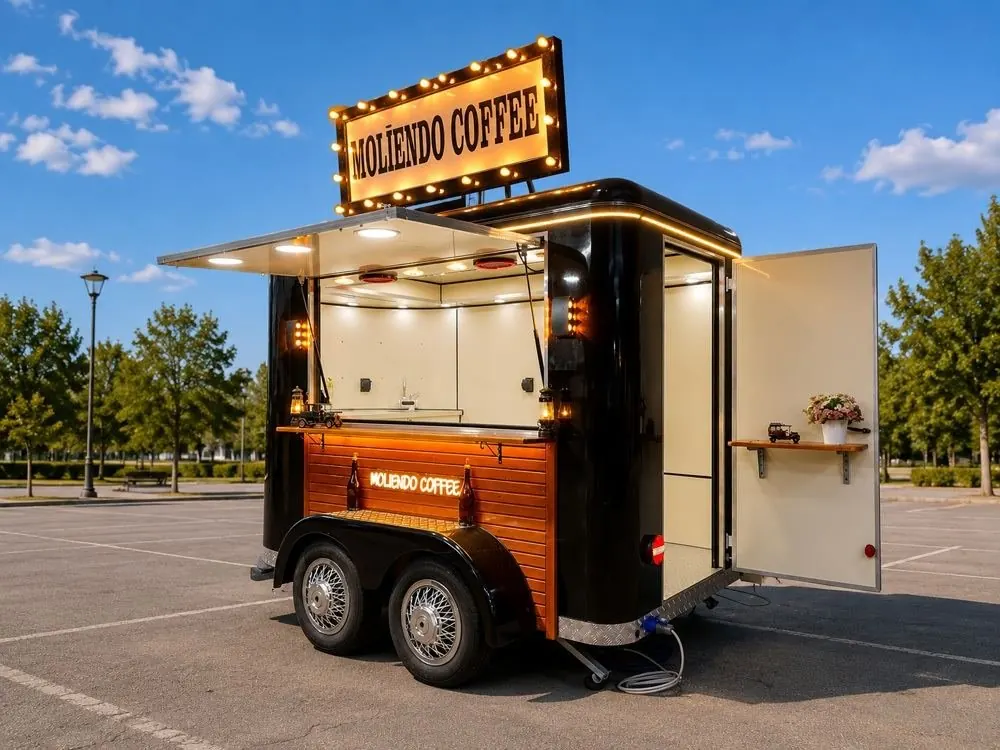
Our reading: look past the cart if one of these applies.
- Your menu needs prep your local cart class does not allow.
- You want a two-group machine and the supply it asks for.
- You want to wash up on board, or the code's water figures outgrow the cart.
- The machine maker's conditions mean it has to sit indoors.
That is the range we build. Our coffee trailers and kiosks come as a single or tandem-axle trailer, a fixed kiosk or a small vehicle, with the coffee fit-out placed for one or two baristas. Moliendo Coffee, for example, is a tandem-axle trailer with its espresso station and side door placed for a fast-moving queue.
In California, an enclosed trailer may need one more step. A mobile food facility that counts as a "special purpose commercial modular", a term that includes a trailer coach, must be certified by the state Department of Housing and Community Development. Ask the county whether your design falls under it.
What to send for a quote
- Your drinks list, marking anything with milk or frozen milk products.
- The espresso machine and grinder you want, with group count and rating plate data.
- The power at your pitch, or how you plan to supply it.
- The health department and class that will apply, such as a California compact cart or an Oregon Class III.
- How you will handle handwash water and utensil washing.
- The pitch type and space: sidewalk, park, private ground or event.
- How many baristas will work at the same time.
Frequently asked questions
What espresso machine works on a coffee cart?
In our reading of the makers' figures, a compact one-group machine with its own tank. The Rancilio Classe 5 S tank version draws 1450 W on 110 V, and the Victoria Arduino E1 Prima has a 1.5 litre tank. Check the rating plate against the supply at your pitch. In California, ask for the sanitation and UL paperwork.
Does a coffee cart need a sink?
If you make drinks on it, the codes we read ask for a handwash sink. California wants at least five gallons for handwashing on a compact cart, with no water heater if you handle no raw meat, poultry or fish. Oregon wants plumbed, pressurised water at 100°F.
Can you run a coffee cart from a generator?
The La Marzocco manuals and US guides we read do not mention generators, and they ask for a supply that suits the machine's maximum draw. Ask the machine maker before you plan one.
If you have outgrown a cart, send us your menu, your machine and your pitch through the quote form, along with how many baristas will work inside. We reply with questions first, then drawings and a quote. You can see our trailers, kiosks and a three-wheel Ape coffee bar on the coffee trailer page.
Related guides
- Starting a Coffee Trailer: Vehicle, Setup and Permit Questions to Answer First
- Coffee Trailer Equipment and Power: What the Machine Makers Specify
- New vs Used Food Truck: What to Check Before You Buy
- Taco Trucks: Kitchen Line, Holding and Service Window Planning
Sources
- California Health and Safety Code 113831 (mobile food facility, compact mobile food operation)
- California Health and Safety Code 113818 (limited food preparation)
- California Health and Safety Code 114368.2
- California Health and Safety Code 114368.4
- California Health and Safety Code 114368.5
- California Health and Safety Code 114368.7
- California Health and Safety Code 114314
- California Health and Safety Code 114315
- California Health and Safety Code 114294
- California Health and Safety Code 18012.5
- California Government Code 51036
- California Government Code 51037
- California Government Code 51038
- Los Angeles County Public Health, Food Service Trucks, Trailers, and Boats
- Los Angeles County Public Health, New Permit Fees and Categories for Mobile Food Facilities
- City of Los Angeles, StreetsLA, Sidewalk Vending
- City of Los Angeles, Sidewalk and Park Vending Program Rules and Regulations
- Oregon Health Authority, mobile food information page
- Oregon Health Authority, mobile food operation guide (Rev 04/22)
- Oregon Health Authority, Food Code Fact Sheet #24, Handwashing Systems Under Mechanical Pressure
- FDA Food Code 2026 (PDF)
- GOV.UK, Street trading licence (England and Wales)
- Local Government (Miscellaneous Provisions) Act 1982, section 3
- Local Government (Miscellaneous Provisions) Act 1982, Schedule 4
- Rancilio, Classe 5 S
- Victoria Arduino, E1 Prima
- Nuova Simonelli, Appia Life
- La Marzocco, Linea Mini U.S. installation guideline
- La Marzocco, Linea PB U.S. installation guideline
- La Marzocco, Linea PB operating manual

By
Ozan Food Truck
This guide is based on the laws, regulations, official guidance and manufacturer documents linked in the text. It is general information, not legal or engineering advice. Rules differ by country, state and city, so confirm the details with your local authority before you build or buy.