
Coffee trailers
Coffee Trailer Equipment and Power: What the Machine Makers Specify
A coffee trailer needs an espresso machine, a grinder, a fridge for milk, a water supply for the machine and a handwash sink, a waste tank and somewhere to wash up. Start with the espresso machine. Its power draw sets the electrical supply, and whether it runs from its own tank or needs a plumbed feed sets the water system.
By Ozan Food TruckPublished 10 min read
The numbers here come from what the machine makers publish: spec sheets, US installation guides and operating manuals. The hygiene points come from the FDA Food Code, EU Regulation 852/2004 and the food hygiene rules for England. We do not recommend a machine, and your health department has the final word on the layout.
Checked on 28 September 2026.
The equipment list
For an espresso menu with milk drinks, plan for:
- an espresso machine and at least one grinder,
- a fridge for milk, with a thermometer you can read,
- a fresh water tank, a water filter, and a pump or pressure system if the machine is plumbed,
- a handwash sink with warm water,
- a sink or other approved way to wash jugs and utensils,
- a waste water tank,
- dry storage for cups, lids and beans.
On the coffee trailers we build, the fit-out covers the espresso machine, grinder, drinks counter, stainless worktops, fridge, sink and storage, placed for one or two baristas. The exact machine, grinder, fridge and water system are chosen for the service you plan.
Espresso machine power: what the makers publish
Power varies widely. Here are the published figures.
| Machine (version) | Supply | Power | Water |
|---|---|---|---|
| Rancilio Classe 5 S, 1 group, tank version | 110 V / 220-240 V | 1450 W / 1800 W | built-in 2 litre tank |
| La Marzocco Linea Mini R (listed as a home product) | 120 V / 220-240 V | 1800 W (120 V), 1770 to 2100 W (220-240 V) | 2.5 litre reservoir |
| Nuova Simonelli Appia Life Standard, 1 group | not stated | 1900 W | not stated |
| Nuova Simonelli Appia Life, 2 groups compact | not stated | 2900 W | not stated |
| Wega Urban, 2 groups | 230-400 / 240-415 V | 4000 / 4790 W | not stated |
| La Marzocco Linea PB, 2 / 3 / 4 groups | single or three phase | 4600 / 6100 / 8000 W | fixed water connection |
Across the machines we read, the range runs from 1450 W to 9470 W, the maximum La Marzocco's brochure gives for the four-group Linea PB. In the model families we read, more groups means more power.
The same model can carry different numbers in different documents. For the two-group Linea PB, the web page says 4600 W, while the 2023 brochure gives 3750 W minimum and 5450 W maximum. Plan from the rating plate and the spec sheet of the exact version you buy.
Grinders draw far less. The ones we checked run from 140 W (Rancilio MD 40 ST) to 1300 W (Mahlkönig EK43).
A US circuit example
La Marzocco's US installation guides show what a circuit has to carry. The US two-group Linea PB runs on 208-240 V single phase, draws 22 A at full load and uses a NEMA 6-30 plug. The three- and four-group versions draw 28 A and 37 A on NEMA 6-50. The Linea Mini runs on 115 V at 1620 W and 14 A, with a 5-15 plug included.
Both guides show a separate 15 A supply for the grinder.
Our reading: a 14 A machine and a grinder sharing one 15 A circuit is not the setup the maker draws. Give each its own circuit, sized by an electrician from the rating plates.
What the manuals ask of the electrics
The Linea PB and Linea Mini manuals are direct about it:
- the rating plate data must match the supply the machine is connected to,
- "the capacity of the available electrical system" must suit "the maximum power consumption indicated on the espresso machine",
- grounding is "a fundamental safety requirement", checked by qualified personnel,
- adapters, multiple plugs and extension cords are not recommended,
- a residual current device (RCD) of no more than 30 mA is mandatory.
The PB manual adds that the circuit breakers and the water valve should sit where they can be reached easily and quickly.
Neither manual mentions generators or inverters, and neither do the two US guides. Planning a generator or battery inverter? Ask the machine maker or its authorised service agent first.
Warm-up counts too. The PB manual says the steam boiler reaches operating pressure in about 25 minutes. Our reading: the machine draws power well before the first cup, so the supply has to be running before opening time.
Water: tank-fed or plumbed
Some single-group machines carry their own water. Rancilio offers the Classe 5 S in a tank version, one group only, which "does not require fixed water connection". The Linea Mini R has a 2.5 litre reservoir. Where the multi-group sheets we read state it (Rancilio Classe 5 S, Linea PB), they need a fixed water connection.
A plumbed machine expects pressure. The Linea PB manual asks for 0.2 to 0.6 MPa, and the US guide lists 45 PSI dynamic pressure. Where pressure is not available, La Marzocco suggests "an additional water supply system". Our reading: a trailer running from a tank has no mains pressure, so a plumbed machine needs a pump or pressure system. The maker does not say which type, so ask.
Water quality matters too. La Marzocco asks for hardness between 70 and 100 ppm, pH between 6.5 and 8.5 and chlorides under 30 mg/l, with a filter where your water falls outside that. The US guide marks the filter as required and not supplied. With a reservoir machine, the Mini manual says to change the water daily and clean the reservoir so algae cannot form.
The hygiene rules behind the water system
In the US, the FDA Food Code is a model that states and counties adopt, often in an older edition. Where your health department follows it, these points apply:
- water under pressure to every fixture and piece of equipment that needs water,
- at least one handwashing sink, placed for convenient use where staff prepare food, dispense it and wash equipment,
- handwash water of at least 29.4°C (85°F),
- a waste tank 15 percent larger than the fresh water tank,
- a water tank inlet of 19.1 mm (three-fourths of an inch) or less,
- waste emptied at an approved servicing area.
For washing up, the code's default is a sink with at least three compartments. Alternatives such as a two-compartment sink need approval. Ask your health department what it accepts first.
In the EU, Regulation 852/2004 covers mobile sales vehicles in Annex II, Chapter III. Where necessary, it asks for facilities to wash and dry hands hygienically, smooth, washable and corrosion-resistant food-contact surfaces, and an adequate supply of hot and/or cold potable water. Chapter VII says ice that touches food must be made from potable water, and steam in direct contact with food must not carry anything hazardous. Our reading: a steam wand puts steam straight into the milk, so that rule covers it. The regulation sets no sink counts or tank sizes, so ask your national or local authority whether it does.
Milk and the fridge
Milk is where temperature rules bite.
Under the FDA Food Code, food that needs time and temperature control for safety must be held at 5°C (41°F) or below. Heat-treated animal food is part of that definition. Our reading: pasteurised milk falls under the 41°F rule where the code applies. The code also asks for a thermometer fixed in the fridge, sensing the warmest part, with a display that is easy to read.
In England, the Food Safety and Hygiene (England) Regulations 2013 make it an offence to keep food that can support harmful bacteria above 8°C at food premises. There is a defence for food on display or for service for less than four hours. Food that can safely sit at room temperature for its whole shelf life is exempt. Our reading: fresh milk falls under the 8°C rule, while a sealed carton of UHT milk does not until it is opened. Scotland, Wales and Northern Ireland have their own regulations, so check with your local authority there.
The EU regulation gives no figure. It says such food must not be kept at temperatures that risk health, and that "the cold chain is not to be interrupted". Ask your national or local authority whether it sets a number.
Layout: what the manuals fix before you draw
Counter height. The Linea PB must sit level on a counter more than 80 cm above the floor. For the Linea Mini it is more than 90 cm.
Temperature and weather. Both manuals give a room temperature range of 5°C to 32°C (41°F to 89°F) and say the machine is not suitable for outdoor use. The PB manual adds that it should not be exposed to rain or sun. Our reading: the machine belongs inside the body, behind the serving hatch.
Frost. The PB manual warns against storing the machine where water in the boiler or pipes could freeze. Our reading: if the trailer stands unheated in winter, you need a plan to drain it, heat it or take the machine indoors. Ask the maker which it prefers.
Footprint. The Linea PB is 28, 38 or 47 inches wide for two, three or four groups, and 23 inches deep. The Wega Urban two-group is 80 cm wide and 60 cm deep.
Pump and drain. The Linea PB US guide shows an external pump in a 12-inch cube, no more than 8 feet from the machine. It suggests a drain run of up to 5 feet, falling at least a quarter inch per foot, and a 2.5 inch hole in the counter.
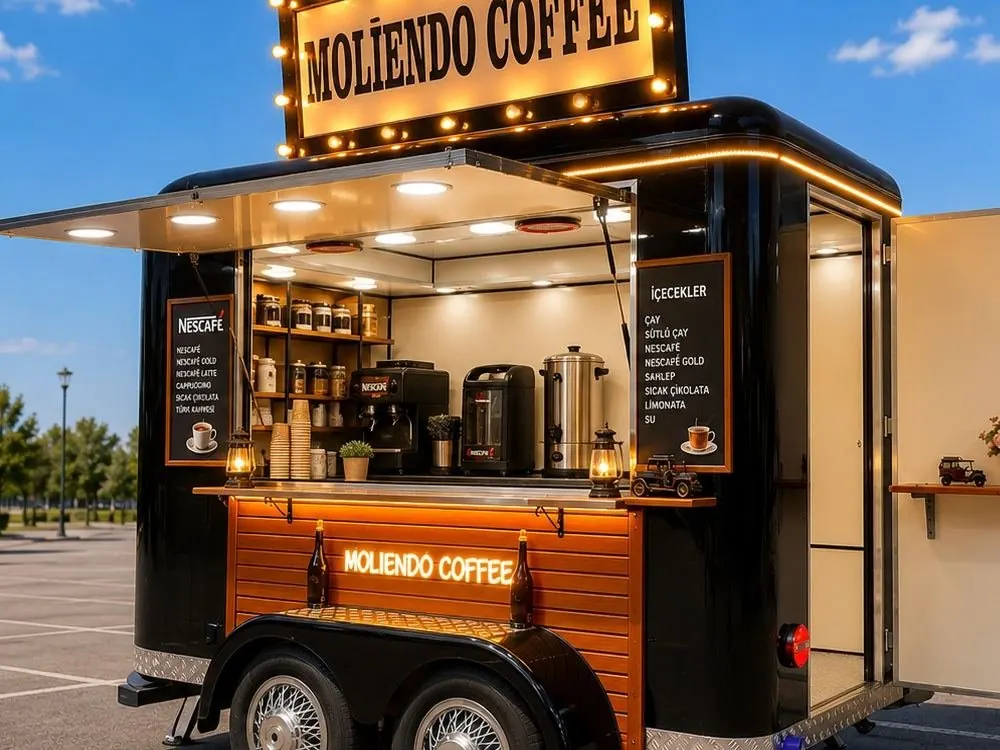
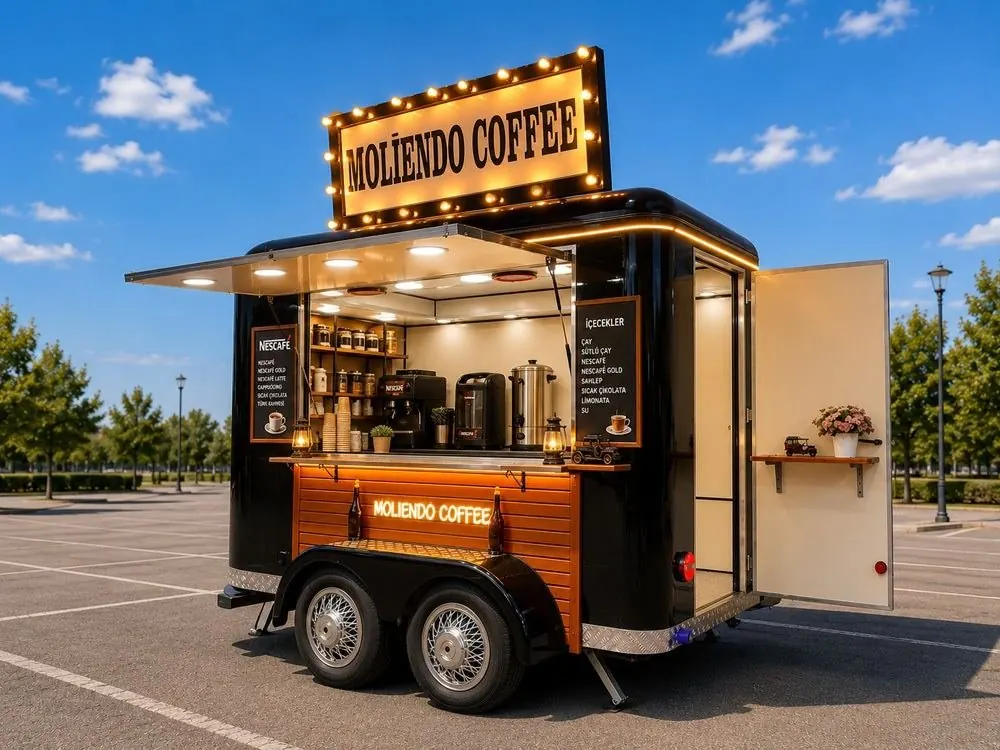
Queue side. On the Moliendo Coffee trailer, a tandem-axle build from our factory, the espresso station, menu boards and side door are placed for a fast-moving queue. For the Sauce Hotel we built a three-wheel Ape with a coffee and drinks bar inside, sized to stand on a hotel terrace.
Where the Food Code applies, the plans you submit before construction list equipment types, makers, model numbers, locations, dimensions and installation specifications. So the machine choice comes before the drawing.
Frequently asked questions
What equipment do you need for a coffee trailer?
For espresso drinks: an espresso machine, a grinder, a fridge with a thermometer, a fresh water tank with a filter, and a pump or pressure system if the machine is plumbed. Add a handwash sink with warm water, a way to wash utensils that your health department accepts, a waste tank and dry storage. Where the FDA Food Code applies, the waste tank must be 15 percent larger than the fresh tank.
How do you power a coffee trailer?
Start with the rating plate of your espresso machine. The models we read range from 1450 W to 9470 W, and La Marzocco's US guides give the grinder its own 15 A supply. La Marzocco's manuals ask for grounding, a 30 mA RCD and a system sized for the machine's maximum draw, and they advise against extension cords. They say nothing about generators, so ask the machine maker before you plan one.
How much does a mobile coffee trailer cost?
It depends on the build, so there is no single figure. The type and body size come first. Then the espresso machine, grinder, refrigeration and water system, then the serving side, branding and delivery location.
Send your menu and preferred machine through the quote form with the number of baristas and where the trailer will stand. We reply with questions first, then drawings. You can see finished builds on our coffee trailer page and the wider range on What We Build.
Related guides
- Starting a Coffee Trailer: Vehicle, Setup and Permit Questions to Answer First
- Coffee Carts: What You Can Serve from a Cart and When You Need a Trailer
- New vs Used Food Truck: What to Check Before You Buy
- Taco Trucks: Kitchen Line, Holding and Service Window Planning
Sources
- La Marzocco, Linea PB U.S. installation guideline
- La Marzocco, Linea Mini U.S. installation guideline
- La Marzocco, Linea PB operating manual
- La Marzocco, Linea Mini 2023 operating manual
- La Marzocco, Linea PB product page
- La Marzocco, Linea PB brochure (2023)
- La Marzocco, Linea Mini R product page
- Rancilio, Classe 5
- Rancilio, Classe 5 S
- Rancilio, MD 40 ST grinder
- Nuova Simonelli, Appia Life
- Wega, Urban
- Mahlkönig, EK43
- FDA Food Code 2026 (PDF), sections 3-501.16, 4-204.112, 4-301.12, 5-103.12, 5-202.12, 5-203.11, 5-204.11, 5-303.13, 5-401.11, 5-402.14, 8-201.12
- FDA, Food Code overview
- Regulation (EC) No 852/2004, Annex II, Chapters III, VII and IX
- The Food Safety and Hygiene (England) Regulations 2013, Schedule 4

By
Ozan Food Truck
This guide is based on the laws, regulations, official guidance and manufacturer documents linked in the text. It is general information, not legal or engineering advice. Rules differ by country, state and city, so confirm the details with your local authority before you build or buy.