
Coffee trailers
Starting a Coffee Trailer: Vehicle, Setup and Permit Questions to Answer First
Before you buy a coffee trailer, cart or truck, find out where you are allowed to trade and which permits that spot needs. That answer shapes the vehicle, and the vehicle shapes the setup inside it. In some places the plans must be approved before the vehicle is even built, so the order matters.
By Ozan Food TruckPublished 10 min read
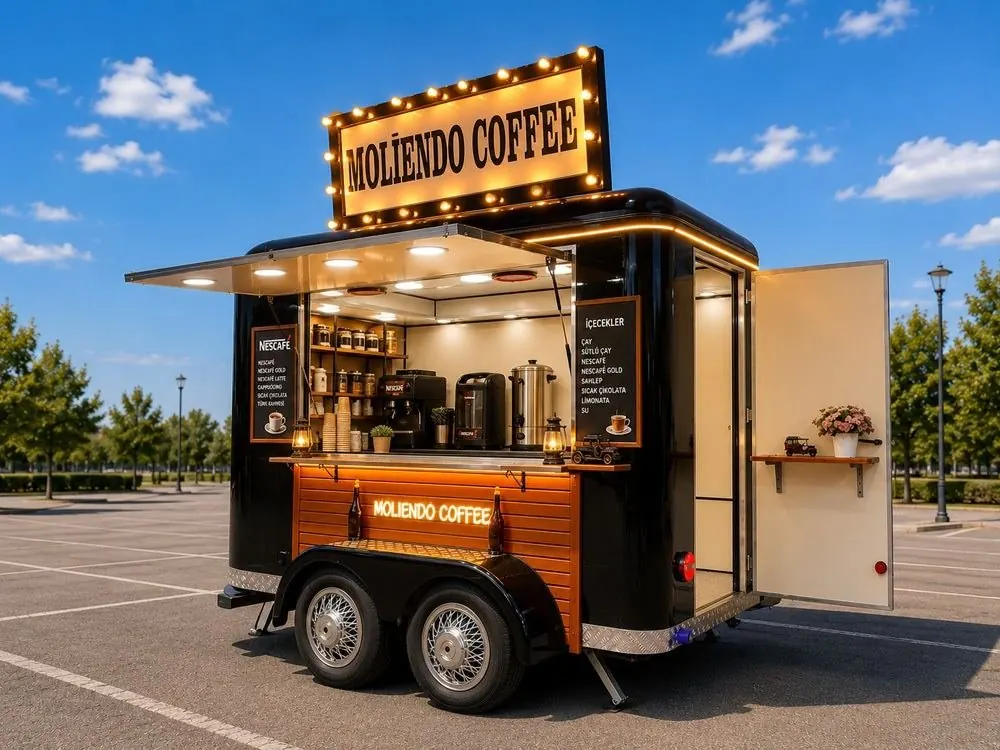
This guide covers the three decisions in that order: the pitch, the vehicle and the setup. Permit rules are local, so we use official pages from a few places as examples and point you to the office that decides in your area.
Checked on 28 September 2026.
Start with the pitch, not the vehicle
Where you plan to stand decides almost everything else. A hotel terrace, a private event and a public street can each raise different permit questions.
For England and Wales, GOV.UK tells you to contact the council to find out whether you need a street trading licence. You apply to the council for the area where you want to trade and tell them where and when. The council can refuse, or can give you a licence "for fewer days and times than you asked for", and there might be a waiting list. So your trading hours may not be the ones you planned.
On the US side, FDA notes that restaurant and retail food oversight is typically handled at the state and local levels. Los Angeles County shows how local it gets. County Public Health permits and inspects mobile food facilities across the county, except in Long Beach, Pasadena and Vernon, which run their own environmental health departments. LA County also requires every mobile food facility to report its route and schedule, and to update it when the route changes significantly.
Rules also move. Austin Public Health says that from 1 July 2026, mobile food vendors must hold a state Mobile Food Vending Permit from the Texas Department of State Health Services. Fire inspections sit with other offices: the Austin Fire Department or the Travis County Fire Marshal.
Our reading: one pitch can involve more than one office. Ask your local health department and licensing authority which permits apply to the exact spot and hours you want, before you order anything.
Cart, trailer or small vehicle
Once you know where you will stand, the vehicle choice gets easier. On our coffee trailer page we describe it this way: a single or tandem-axle trailer, a fixed kiosk or a small vehicle, "chosen for where the cafe will stand."
| Type | Suits | Check first |
|---|---|---|
| Coffee cart | A short made-to-order drinks menu, where the local code allows it | How your health department classifies an open cart and your menu |
| Coffee trailer | A workspace you tow between pitches | Loaded weight, your driving licence, brakes |
| Small vehicle or truck | A set spot such as a hotel terrace, or a base on a chassis | Who certifies the conversion, how it is registered |
| Kiosk | Fixed spots such as parks and terraces | The rules for a fixed structure at that site |
Coffee carts
Under the FDA Food Code, a cart can still be a mobile food establishment. The Code, which state and local regulators use as a model, defines one as operated from a "movable, motor-driven, mechanically, electrically, manually, or otherwise propelled vehicle, portable structure, or watercraft" that moves as part of its routine operation.
What a cart may serve depends on the local code. LA County defines a high-risk mobile food cart as an unenclosed facility with limited food preparation. One of the permitted activities is "preparing beverages that are for immediate service, in response to an individual consumer order, that do not contain frozen milk products". The county's fully enclosed truck category is the one defined for complex menu items.
Our reading: in a place like LA County, a cart can suit a short, made-to-order drinks menu. The department decides how your menu is classified, so show them the menu before you buy.
Coffee trailers
A trailer needs a vehicle and a licence that can tow it. GOV.UK says that if you got your licence from 1 January 1997, you can tow a trailer up to 3,500 kg maximum authorised mass. A trailer that weighs over 750 kg loaded needs working brakes, and you must use a breakaway cable or secondary coupling. Under the EU driving licence directive (2006/126/EC), a category B licence covers a trailer up to 750 kg, or a heavier one if the combination stays at or under 4,250 kg. Above 3,500 kg, member states require training or a test. Confirm the details with your national licensing authority.
So ask the builder for the loaded weight with the espresso machine, water and stock on board, not the empty weight. Our Moliendo Coffee build, for example, is a tandem-axle trailer with a lift-up awning and lit roof sign. Its espresso station, menu boards and side door "are placed for a fast-moving queue."
Small vehicles, coffee trucks and kiosks
A small vehicle is the third route. The Sauce Hotel build on our site is a three-wheel Ape with a wooden body and a coffee and drinks bar inside, "built for a hotel terrace". Ask your vehicle registration office how a three-wheeler is licensed and registered where you live.
A coffee truck raises a different question. If a builder fits out a truck chassis for the US, the vehicle can fall under 49 CFR Part 568, which covers vehicles built in two or more stages. There, a final-stage manufacturer has to complete the vehicle to the applicable standards. Ask who takes that role before the build starts.
Kiosks are for fixed spots. Our page lists parks, terraces and shopping centre entrances. We have not checked the rules for fixed structures, so ask the site owner and the council what a kiosk needs at your spot.
The setup your inspector will look at
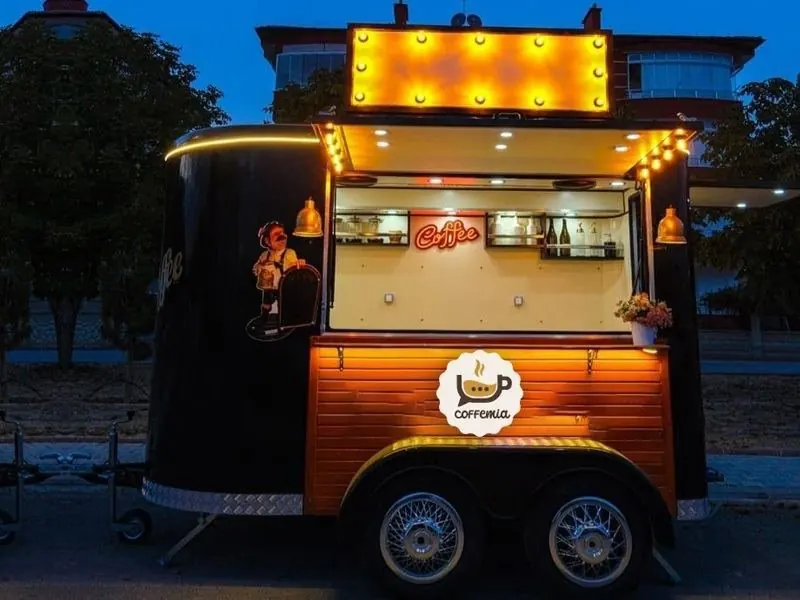
Start the layout from the hygiene rules, then add the look.
EU Regulation 852/2004 covers "mobile sales vehicles". Where necessary, it asks for handwashing facilities, a supply of hot and/or cold drinking water, storage and disposal of waste, and a way to keep and monitor food temperatures. It sets no sink counts or tank sizes. Those come from national or local rules.
Where a US jurisdiction follows the FDA Food Code, a mobile food establishment needs a handwashing sink placed for staff who prepare and dispense food, and a waste tank 15 percent larger than the water supply tank. The Code also has you submit plans for review and approval before construction, and the authority can ask for equipment model numbers.
LA County shows what that looks like in practice. Its new construction checklist asks for a permit application, a menu with operating procedures where needed, ownership documents, a complete set of plans and a commissary contract. Then it says: "After plans are approved by the Plan Check Program, build MFF." LA County defines a commissary as a food facility where, among other things, equipment is stored, utensils are cleaned, waste is disposed of and drinking water is obtained.
Our reading: get the drawings and the equipment list from your builder early, so you can file for plan approval before the trailer is made.
For power, start from the espresso machine's rated load. The manufacturer figures we read varied widely, for example from 1,450 W for a one-group Rancilio on 110 V to 9,470 W for a four-group La Marzocco. La Marzocco's manual says the electrical system must suit "the maximum power consumption indicated on the espresso machine" and does not recommend extension cords. Check the rating plate of the exact model you plan to buy.
Registration and training
Permits and registration are separate steps. The Food Standards Agency says food businesses, including those trading from a vehicle or stall, must register with their local authority, at least 28 days before they start trading. Registration is free and cannot be refused. The FSA also says to tell HMRC you are self-employed and to check licences or permits, "for example to sell food or to trade in the street".
EU law has a similar step. Regulation 852/2004 asks every food business to notify the competent authority so each establishment can be registered.
Training deadlines differ too. LA County asks for a food handler card within 30 days of operation. Austin Public Health's page says the city requires at least one Certified Food Manager per food business, and a food handler certificate for every employee who handles food within 60 days of employment.
Coffee trailer ideas that start from the pitch
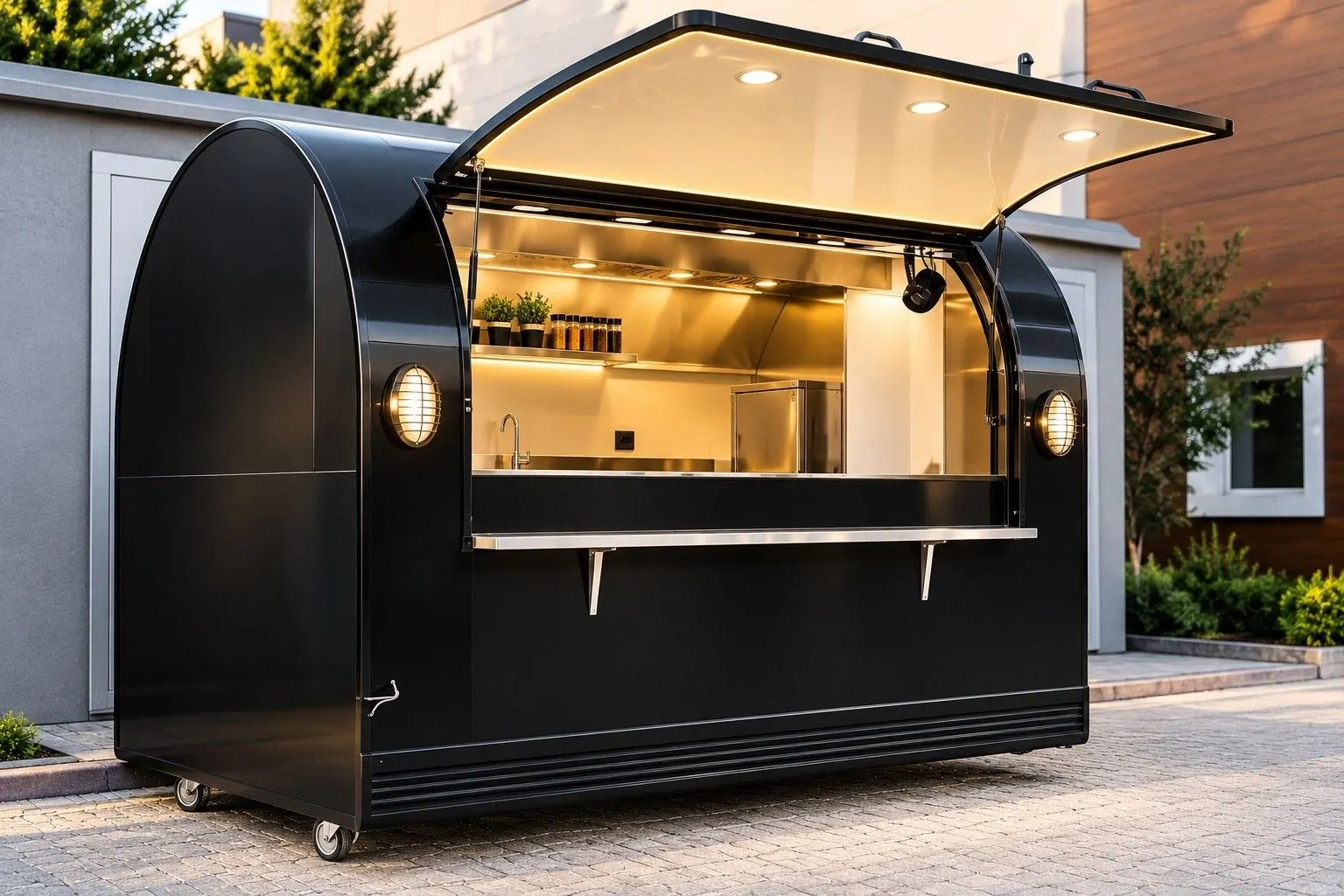
Good ideas often start from plain questions about the pitch. Where does the queue stand? Can customers see the menu from there? Will you trade after dark?
Our coffee trailer page lists lift-up awnings, lit menu boards and counters "placed for the way customers order and wait", with lighting designed with the brand "so the cafe works after dark too." Coffomus, for example, is a rounded trailer with wooden panels and a lift-up awning lined with warm lights, "built to look its best at dusk". If your pitch runs into the evening, plan the lighting with the branding, not after it. You can see more of what we build on our What We Build page, including food trucks and trailers.
Can a coffee trailer make money?
It depends, and we do not publish income figures. The honest answer comes from your own numbers, so work through these questions before you buy:
- Which pitches can you get, and for which days and hours? A council can grant fewer than you ask for.
- How many drinks can you and your staff make in the busiest hour, with the machine you plan to buy?
- Which permits and contracts come with a fee? GOV.UK says a street trading licence might, and LA County charges plan check and permit fees.
- Does your menu change your permit class? LA County links risk level to the menu, and treats refrigerated, prepared foods as high risk.
- What insurance do you need? The FSA lists it among the things to check.
The FSA puts it simply: "Having a business plan is important to running a successful food business." Write one with local quotes for each of the costs above.
Frequently asked questions
Can you make money with a coffee trailer?
It depends on your pitch, your permitted hours, the drinks you can serve per hour and the running costs your permits bring. Answer the five questions above with local figures before you buy.
How to start a coffee shop trailer?
Choose the pitch first and ask your licensing authority and health department which permits it needs. Then choose a cart, trailer or small vehicle that fits it, get drawings and an equipment list for plan approval, and register the food business. The FSA asks for that registration at least 28 days before trading.
How much do mobile coffee vans make?
None of the official sources we used publishes an income figure, and your result will depend on the pitch, the hours and the menu. We would treat any number you read online as one business's result, not a forecast for yours.
If you already know where you want to trade, tell us the spot, what you will serve and how many baristas will work inside through the quote form. We reply with questions first, then drawings and a quote. You can see our coffee trailers, kiosks and the Ape bar on the coffee trailer page.
Related guides
- Coffee Carts: What You Can Serve from a Cart and When You Need a Trailer
- Coffee Trailer Equipment and Power: What the Machine Makers Specify
- New vs Used Food Truck: What to Check Before You Buy
- Taco Trucks: Kitchen Line, Holding and Service Window Planning
Sources
- GOV.UK, Street trading licence (England and Wales)
- Food Standards Agency, Starting a food business
- Los Angeles County Public Health, Food Service Trucks, Trailers, and Boats
- Los Angeles County Public Health, Mobile Food Facility New Construction Checklist
- Los Angeles County Public Health, Mobile Food Facility New Construction Process
- FDA, Adoption of the FDA Food Code
- Austin Public Health, Mobile Food Vendors
- FDA Food Code
- Regulation (EC) No 852/2004, Article 6 and Annex II, Chapter III
- Directive 2006/126/EC on driving licences, Article 4
- GOV.UK, Towing with a car
- GOV.UK, Trailer and towing equipment
- 49 CFR Part 568, Vehicles manufactured in two or more stages
- La Marzocco, Linea PB operating manual
- La Marzocco, Linea PB brochure
- Rancilio, Classe 5 S

By
Ozan Food Truck
This guide is based on the laws, regulations, official guidance and manufacturer documents linked in the text. It is general information, not legal or engineering advice. Rules differ by country, state and city, so confirm the details with your local authority before you build or buy.