
Planning
How a Food Truck Is Built: From the First Drawing to Delivery
Building a food truck starts with the menu and a set of drawings your health department can review, and only then moves on to the metal: the chassis or trailer frame, the body, the cut-outs, the gas, water and power, the stainless kitchen and the graphics. It ends with checks, documents and delivery. Once the drawings are approved, both the build and the later inspection follow them, so the first two steps are where your decisions count most.
By Ozan Food TruckPublished 10 min read
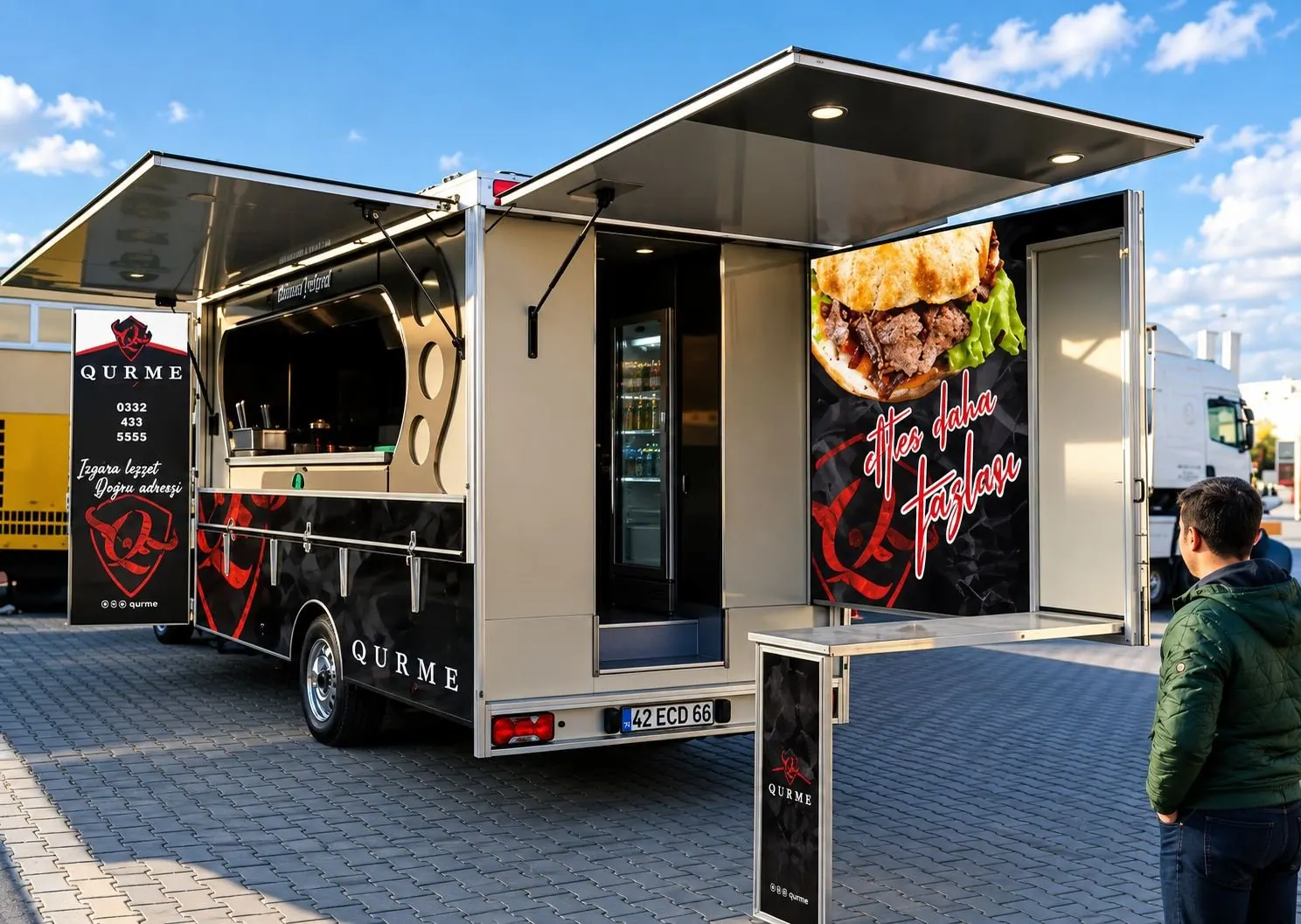
This guide follows each stage from the builder's side, with the rule behind it. For the kitchen we use the FDA Food Code, a model code that your state or county may have adopted in an older edition or used as the base for its own rules. Our own process is the one on our About us page. If you plan to build the truck yourself, the plan review and gas rules below apply to you in the same way. What changes is who carries each step.
Checked on 29 September 2026.
The stages at a glance
| Stage | What gets decided | Rule or document behind it |
|---|---|---|
| 1. Brief | Menu, volume, base vehicle, destination | Food Code 8-201.12 (menu and volume) |
| 2. Drawings and plan review | Layout, equipment models, finishes | Food Code 8-201.11 and 8-201.12 |
| 3. Chassis or trailer frame | Base and weight ratings | 49 CFR 567 and 568 (US) |
| 4. Body and insulation | Walls, roof, inside surfaces | Food Code 6-101.11, 6-202.16 |
| 5. Cut-outs and hatches | Serving side and doors | Food Code 6-202.15 |
| 6. Gas, electrics, plumbing | Tanks, gas work, power | Food Code 5-401.11; HSE; local fire authority |
| 7. Stainless fit-out | Worktops, welds, hood | Food Code 4-101.11, 4-202.11 |
| 8. Graphics | Wrap, paint, signs | Film makers' data sheets |
| 9. Checks and delivery | Inspection, labels, handover | Food Code 8-203.10; 49 CFR 567 |
1. The brief
On our side, every project starts with a meeting to agree the scope. We reply with questions first, then drawings and a quote. For a food truck we ask for your menu, the base you have in mind and where the truck will trade.
Start with the menu, because the rules do. The Food Code's mobile matrix (Annex 7, Chart 4-D) is a plan review guide read by menu and operation. If you sell prepackaged temperature-controlled food and also prepare such food on board, the stricter "food preparation" column applies.
Name the destination country now too. For export builds we engineer the electrics and gas to the destination's standards, and we assess its requirements at the design stage.
2. Drawings and plan review
Where your jurisdiction follows the Food Code, you must submit plans for review and approval before construction starts. The rule is written for the permit applicant, not the builder. Our reading: it applies whether a factory builds the truck or you do.
The plans can include, as your regulator requires:
- the intended menu and the expected volume of food,
- the proposed layout, mechanical schematics, construction materials and finish schedules,
- equipment types, makers, model numbers, locations, dimensions and installation specifications.
In our process the layout, exterior design and equipment list go to you for approval, and production starts from the approved project. Our reading: get the same drawing approved by your health department before production begins, so the plan you signed is the plan the inspector sees.
Adoption varies. FDA's 2024 report found that 11 state agencies in 7 states had adopted the 2022 edition. Ask your local health department which edition it uses and what it wants on the drawings.
3. Chassis or trailer frame
We build on three bases: a box body on a chassis cab, a converted panel van or a towable trailer. The chassis can be one you choose or one we source. Our vintage trucks have no engine and sit on a steel frame.
In the US a chassis cab is an "incomplete vehicle". Its maker must supply an incomplete vehicle document (IVD) with it. The IVD gives the weight ratings (GVWR and GAWR) of the completed vehicle and the conditions for meeting the safety standards. One example in the rule reads: the vehicle will conform "if it does not exceed any of the gross axle weight ratings".
Whoever turns it into a finished food truck is the "final-stage manufacturer". That person completes the vehicle to the standards and fixes a certification label to it. Our reading: the rule speaks of "a person", so a self-builder may take on this role. Check with NHTSA or your state vehicle registration office before you start.
A new panel van is different, because it is already certified. Part 567 has separate rules for "alterers", who add their own label without removing the original. Ask which role applies to your build. On a trailer, the label goes on the forward half of the left side.
4. Body and insulation
The Food Code asks that walls and roofs protect the food establishment "from the weather and the entry of insects, rodents, and other animals". Outside surfaces of a mobile food establishment must be weather-resistant. Inside, walls, floors and ceilings have to be smooth and easy to clean, and nonabsorbent where food is prepared or dishes are washed.
The Food Code text we read sets no rule for body insulation. Our reading: that is a choice between you and the builder. We build an insulated box body, and bodywork, insulation and stainless work are done in our own factory.
Pipes and cables are covered too. Utility lines "may not be unnecessarily exposed", and exposed horizontal pipes may not run on the floor. Our reading: the cable and pipe routes need to be on the drawing before the wall panels close.
5. Cut-outs and hatches
On our trucks the hatches lift on gas struts, and counters and awnings are placed for the way your queue forms. Some of our trucks open on both sides, so two queues can be served at once.
Under 6-202.15, an opening kept open must be protected against insects and rodents, by 16-mesh screens, air curtains or other effective means. This does not apply where pests are absent because of the location or the weather. Our reading: a hatch held open all service may count as such an opening, so ask your health department what it accepts.
Where the Food Code applies, place the handwashing sink with the hatch in mind. It has to be convenient for staff in the food preparation, dispensing and warewashing areas.
6. Gas, electrics and plumbing
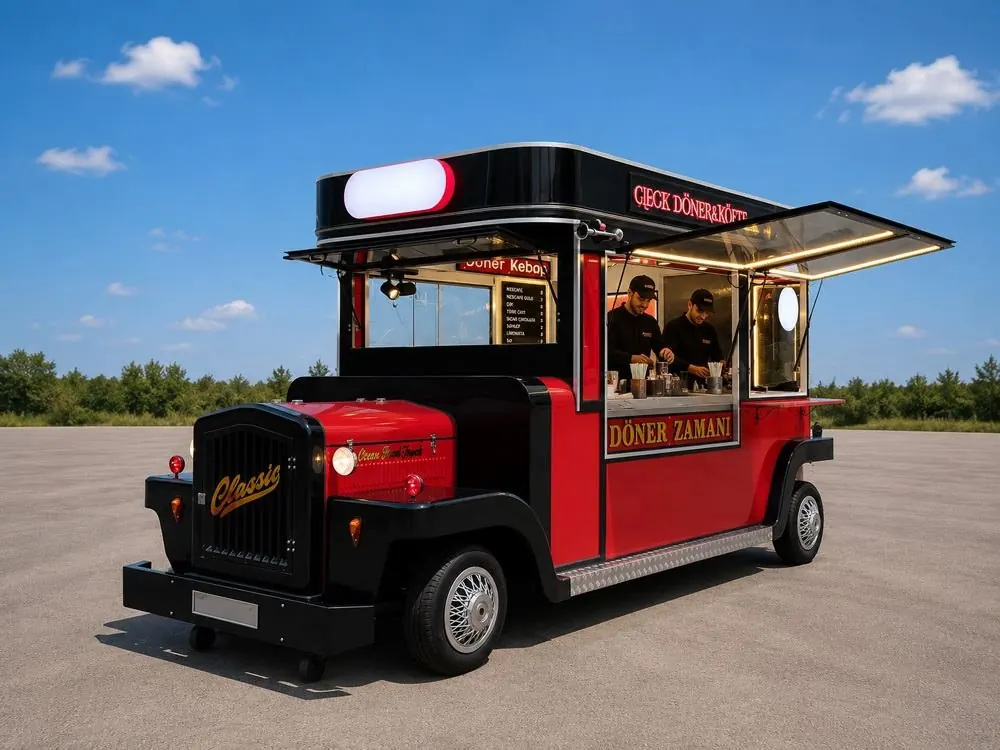
Water. Where the Food Code applies, the waste tank must be 15 percent larger than the fresh-water tank. It must slope to a drain of at least 25 mm (1 inch) with a shut-off valve. The fresh-water inlet is 19.1 mm (three-fourths of an inch) or less, with a hose connection that cannot be used for any other service. We fit clean and waste water tanks and a pump sized for a full service.
Gas. In Great Britain, HSE says gas work on catering equipment, mobile catering included, must be done by a company or individual that is Gas Safe-registered. Vehicles using LPG must be adequately ventilated, and pilot lights should not be lit while the vehicle moves. Our reading: unless your builder is Gas Safe-registered, plan for a GB engineer to check or commission the gas before you trade. In the EU, gas types and pressures differ between member states, and appliances must be compatible with the local gas supply.
In the US, ask your local fire authority. Austin, Texas is one example. There, a new permit needs a propane inspection report from a licensed LPG plumber and an explosive-gas detector, and new trucks need a Class 1 hood fire suppression system. Gas lines need manual shut-off valves at each appliance and at the supply.
Power. We found no general electrical standard for food trucks that we could read. Austin asks for a one-time inspection by a master electrician against NFPA 70. Our power systems use a generator, shore power or batteries.
7. Stainless fit-out
The Food Code's materials rule (4-101.11) sets properties rather than naming a metal. Food-contact materials must be safe, durable, corrosion-resistant and nonabsorbent, and strong enough for repeated washing.
The welds matter as much as the metal. Food-contact surfaces must have smooth welds and joints, with no sharp internal angles. The code's own yardstick for "smooth" is 100-grit number 3 stainless.
Two more rules apply above the worktop. Hoods must not drip grease or condensation onto food or equipment. Light bulbs over exposed food must be shielded or shatter-resistant. Our equipment guide covers the appliances.
8. Graphics
On our builds the paint, printed wrap, signs and LED lighting are designed together with the truck.
Film life depends on where it sits. Avery Dennison's data sheet for its SW900 colour film gives 10 years on a vertical face in Zone 1, the zone with its longest figures, but 2 years on a horizontal one. The same sheet lists stainless steel as an unsuitable surface. For printed wraps under Avery Dennison's ICS guarantee, the warranty runs for the life of the least durable component, such as the ink. Our wrap guide has more.
9. Checks, documents and delivery
On our side, the truck is built to the approved drawings and progress is shared with you regularly. Once all checks are complete, it is delivered on the committed date. Export shipping is planned by road or sea.
The Food Code calls for a preoperational inspection to verify the truck matches the approved plans and any approved changes, and nobody may operate without a valid permit. Our reading: keep the approved drawings with the truck, and send any changes made during the build back for approval.
The vehicle papers depend on the country. In the US, look for the 17-character VIN and the certification label with the weight ratings. The UK's Individual Vehicle Approval scheme covers individually built vehicles and trailers. In the EU, a type-approved vehicle comes with a certificate of conformity; otherwise an individual approval is based on information the applicant provides. Our builder guide lists what to ask for.
What to send for a quote
- Your menu and the busiest hour you expect.
- The base: chassis cab, panel van or trailer, and whether you supply it.
- The country and city where the truck will trade.
- Which Food Code edition, or local code, your health department uses.
- Your equipment list, with models where you have them.
- The number of staff working inside.
- Serving side: which side, how many hatches, and whether you need two queues.
- Gas or all-electric, and power: generator, shore power or batteries.
- The tank sizes your health department expects.
- Brand files for the wrap and signs, and how many trucks you need.
Frequently asked questions
What are the steps to build a food truck?
Brief and drawings first, then the frame, body, openings, utilities, stainless fit-out and graphics, then checks and delivery. Where the Food Code applies, plan approval comes before construction.
How hard is it to build your own food truck?
The rules we cite do not ask who does the work. You still need plan approval where the Food Code applies. In the US, the person who completes a chassis cab may become its final-stage manufacturer. In Great Britain, gas work on catering equipment needs a Gas Safe-registered company or individual.
How much does a food truck cost to build?
Every truck is built to order, so the price follows its scope. The main drivers are the base vehicle and body size, the kitchen equipment, the power and water systems, and the branding and delivery.
Send the list above through the quote form. We reply with questions first, then drawings and a quote. Our custom food trucks page shows a selection of projects.
Related guides
- Food Truck and Food Trailer Sizes: How to Plan Length, Weight and Layout
- Food Truck Ideas That Start from the Kitchen: 12 Concepts and What Each Needs
- Food Trucks for Events and Festivals: Power, Water and Pitch Questions
- Small Food Trailers: What Fits Inside and What Does Not
Sources
- FDA Food Code 2026 (8-201.11, 8-201.12, 8-203.10, 8-301.11, 6-101.11, 6-102.11, 6-201.12, 6-202.11, 6-202.15, 6-202.16, 5-204.11, 5-303.13, 5-401.11, 4-101.11, 4-202.11, 4-204.11, Annex 7 Chart 4-D)
- FDA, FDA Food Code
- FDA, Adoption of the FDA Food Code
- 49 CFR Part 567, Certification
- 49 CFR Part 568, Vehicles manufactured in two or more stages
- 49 CFR Part 565, Vehicle Identification Number requirements
- HSE, Catering Information Sheet 23, Gas safety in catering and hospitality
- Regulation (EU) 2016/426 on appliances burning gaseous fuels
- Austin Fire Department, Mobile food vending fire inspections
- GOV.UK, Individual vehicle approval
- Regulation (EU) 2018/858 (certificate of conformity, individual approval)
- Avery Dennison, SW900 Supreme Wrapping Film, Product Data Sheet (Rev. 20, 03/10/26)
- Avery Dennison, ICS Performance Guarantee Durability Chart, HP Latex (chart 1)

By
Ozan Food Truck
This guide is based on the laws, regulations, official guidance and manufacturer documents linked in the text. It is general information, not legal or engineering advice. Rules differ by country, state and city, so confirm the details with your local authority before you build or buy.