
Buying guide
Food Kiosks: When a Small Kiosk Beats a Truck or Trailer
A food kiosk beats a truck or trailer when you will trade from one spot for a long time: a mall entrance, a park, a campus square, a hotel terrace. The catch with staying put is the site question. A kiosk set down on land can count as a structure, so ask the local authority before you order.
By Ozan Food TruckPublished 10 min read
This guide is for buyers weighing a fixed or towable kiosk against a truck or trailer. It draws on England's planning law, GOV.UK, the Planning Portal, EU Regulation 852/2004 and the FDA Food Code.
Checked on 29 September 2026.
The short comparison
| Question | Kiosk that stays on one site | Truck or trailer |
|---|---|---|
| Is it "mobile" under the FDA Food Code? | Not if it stays put. The definition turns on whether it "moves as part of its routine operation" | Yes, if it moves as part of its routine operation |
| First approval to ask about | The site: planning or zoning, the landlord, sometimes street trading | Road rules first, then each pitch |
| EU hygiene chapter | Possibly Chapters I and II (general food premises) | Chapter III (mobile sales vehicles) |
| Water and waste | A mains connection and a drain are possible | Tanks, emptied at a servicing area |
| What limits the size | The site, the lease and planning | Road rules, such as 2.55 m trailer width in the UK |
When a kiosk is the better fit
Under the FDA Food Code, a food establishment can run from "a mobile, stationary, temporary, or permanent facility or location". It counts as mobile when it operates from a vehicle or "portable structure" that "can change location and moves as part of its routine operation".
Our reading: if your business will stand on one pitch for a season or longer, you are buying a stationary food business. A truck or trailer gives you mobility you won't use.
A truck or trailer still wins if you trade at events or rotate between pitches. Our food truck vs food trailer guide covers that choice.
On our mobile cafe page, the base is "a single or tandem-axle trailer, a fixed kiosk or a small vehicle, chosen for where the cafe will stand". For SIU Collection Hotel we built both: "a vintage-style food truck and a timber kiosk" for the hotel food court.
The site question: a kiosk is often a structure
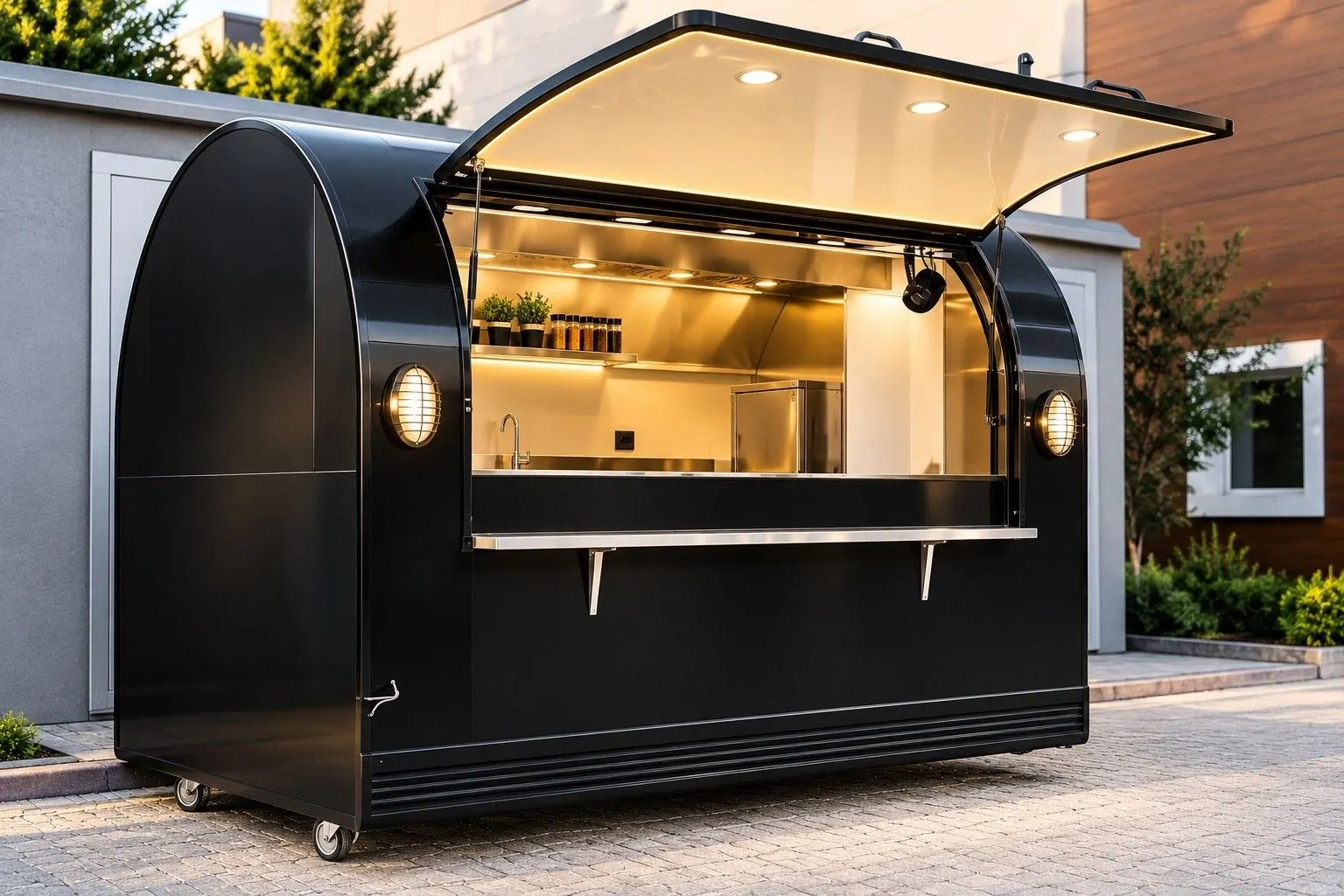
A truck or trailer is a vehicle. A kiosk is set down on land and stays. Planning law can reach it.
In England and Wales, "development" includes "building, engineering, mining or other operations in, on, over or under land" and "any material change in the use of any buildings or other land" (Town and Country Planning Act 1990, s.55). Planning permission "is required for the carrying out of any development of land" (s.57). And "building" includes "any structure or erection" (s.336).
Our reading: a kiosk placed on a site can be a "structure or erection". Whether yours needs permission is not something a builder can settle. GOV.UK says: "To find out if your project will need planning permission, contact your local planning authority (LPA) through your local council." Work done without a needed permission can lead to an enforcement notice "ordering you to undo all the changes you have made".
What the LPA looks at includes "the number, size, layout, siting and external appearance of buildings", "the infrastructure available, such as roads and water supply" and "what you want to use the development for". Bring a site plan and a drawing of the kiosk to that first conversation.
Three more points for England:
- Use class. The Planning Portal lists "E(b) Sale of food and drink for consumption (mostly) on the premises". Hot food takeaways, "where consumption of that food is mostly undertaken off the premises", are sui generis, a class of their own. Our reading: a hot food kiosk and a kiosk cafe with seats may be treated differently. Tell the LPA exactly what you sell and where people eat it.
- Signs. You may need advertisement consent for an advertisement "bigger than 0.3 square metres (or any size if illuminated)". Our kiosks are lit inside. Ask about any sign separately.
- Street trading. If the pitch is on a street, GOV.UK says: "Contact the council to find out if you need a licence to trade in the street in England and Wales."
GOV.UK sends Scotland, Wales and Northern Ireland to their own planning pages. We have not read local rules elsewhere. In the US, check with your city or county planning, zoning and building department.
The Food Code adds its own step. Plans go to the regulatory authority "before: (A) The construction of a FOOD ESTABLISHMENT; (B) The conversion of an existing structure for use as a FOOD ESTABLISHMENT". The Food Code is a model "offered for adoption by local, state, and federal governmental jurisdictions", so ask your health department which version applies. Building a kiosk from a shipping container? Our container cafe guide covers the extra points.
Hygiene: fixed premises or mobile premises
In the EU, Regulation 852/2004 splits its premises rules. Chapter I covers "food premises (other than those specified in chapter iii)". Chapter III covers "movable and/or temporary premises (such as marquees, market stalls, mobile sales vehicles)". The word "kiosk" does not appear.
| Point | Chapter I (general food premises) | Chapter III (movable or temporary) |
|---|---|---|
| Toilets | "An adequate number of flush lavatories", connected to drainage, not opening directly into food rooms | "Hygienic sanitary arrangements", where necessary |
| Handwashing | Washbasins with "hot and cold running water" | Facilities for "hygienic washing and drying of hands" |
| Water | Hot and cold water for cleaning utensils and equipment (Chapter II) | "An adequate supply of hot and/or cold potable water" |
| Siting and space | "Adequate working space to allow for the hygienic performance of all operations" | Sited and built to avoid contamination "so far as is reasonably practicable" |
Chapter II adds washable floors and walls, and ceilings finished to reduce condensation and mould. Annex II sets no sink counts or room sizes.
Our reading: a kiosk fixed to one site for years sits closer to Chapter I than to a market stall. The food authority decides which chapter it applies. Ask before the drawings are final, because a toilet and hot and cold running water change the layout.
In England, Wales and Northern Ireland, you register with the council "at least 28 days before trading", wherever you trade from, a stall or a van included. For Scotland, GOV.UK points to Food Standards Scotland. The FSA asks for washbasins "with hot and cold running water" and "adequate ventilation, lighting and drainage".
Under the FDA Food Code, a food establishment needs "at least one HANDWASHING SINK" and "at least 1 toilet". The toilet rules say toilet rooms must be "conveniently located and accessible to EMPLOYEES during all hours of operation". Our reading: the rule is about access, and it does not say the toilet must be inside the kiosk. In a mall or on a campus, a shared toilet nearby may do, if your health department accepts it.
Malls get an exception. The rule on protected outer openings "does not apply if a FOOD ESTABLISHMENT opens into a larger structure, such as a mall, airport, or office building", provided that building's own openings are protected. Outdoors, a hatch kept open must be protected by screens, "properly designed and installed air curtains" or "other effective means", unless pests are absent because of the location or weather.
Utilities: water, waste and power
The Food Code asks for drinking water from an approved source, received through "an APPROVED public water main" or other lawful means. Sewage goes to "a public SEWAGE treatment plant" or an individual system built "according to LAW". A mobile food establishment works differently. Its sewage tank must be "sized 15 percent larger in capacity than the water supply tank", and waste is removed "at an APPROVED waste SERVICING AREA".
Our reading: a kiosk connected to a water main and a drain skips tank sizing and servicing trips. A kiosk with no connections has to solve water and waste the way a trailer does. So ask the site owner what is at the pitch: water, drain and power supply.
On our container restaurant page, "electrics, water and drainage are installed in the factory, so on site the container only needs to be placed and connected". For our food trucks, the site lists "generator, shore power or batteries, with clean and waste water tanks and a pump".
We have not read the electrical rules for kiosk site connections, so check with a local electrician. Start from the rating plates of the equipment you plan to run. Our generator sizing guide shows how to add them up.
Footprint: the site sets the size, not the road
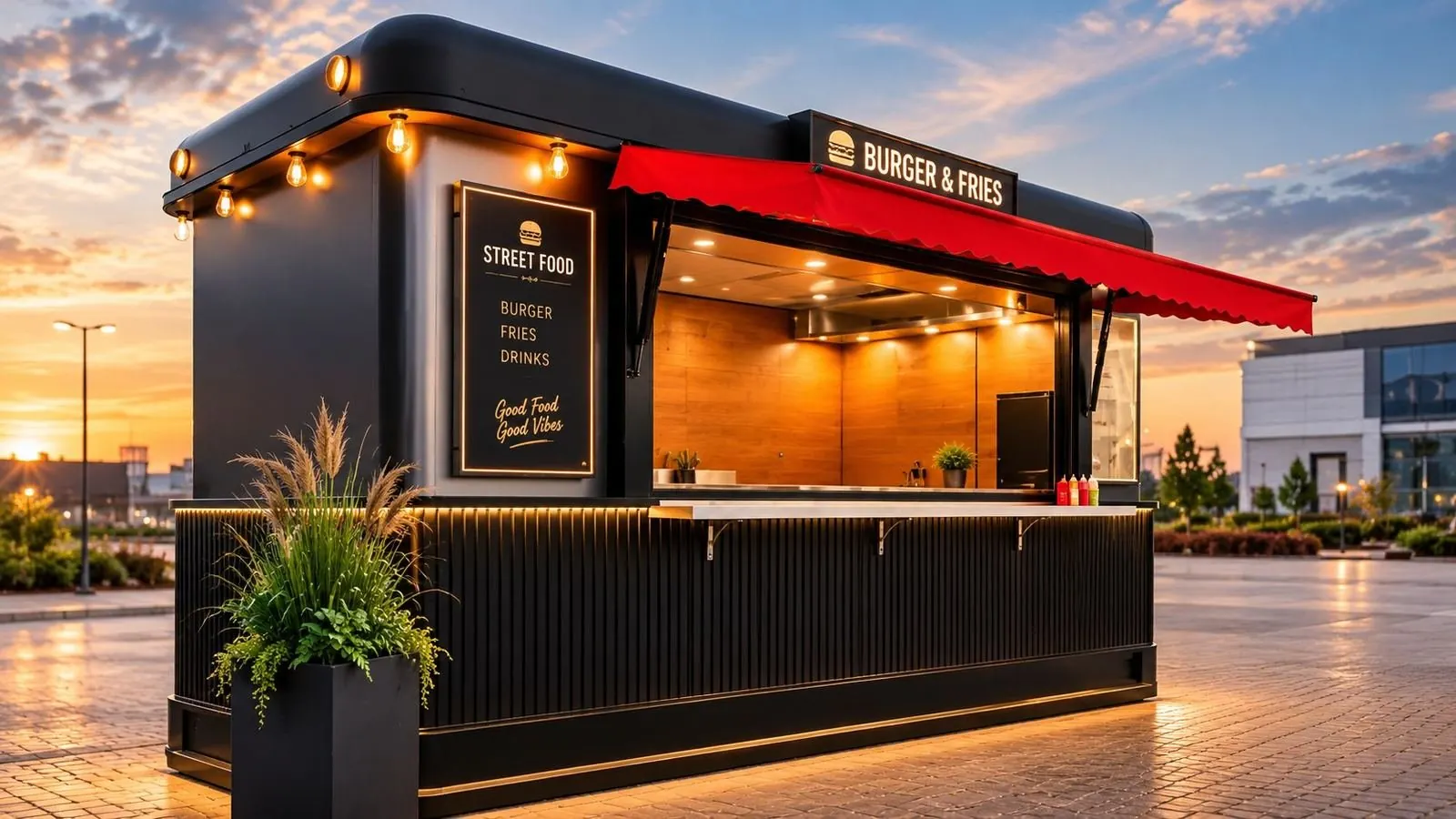
A trailer's size is capped by road rules. In the UK, "the maximum trailer width for any towing vehicle is 2.55 metres". On the US National Network, federal rules set the width limit at 102 inches.
Our reading: a kiosk that stays put is limited by the site, the lease and planning instead. It still has to be delivered, so ask the builder how it will travel and be lifted into place.
EU rules ask for "adequate working space" but give no minimum area, so send the builder your menu and staff count. For a container-based kiosk, a standard 20 ft box measures 6,058 mm by 2,438 mm outside. Its bare inside floor is about 13.9 m² before any lining, per Hapag-Lloyd's nominal figures.
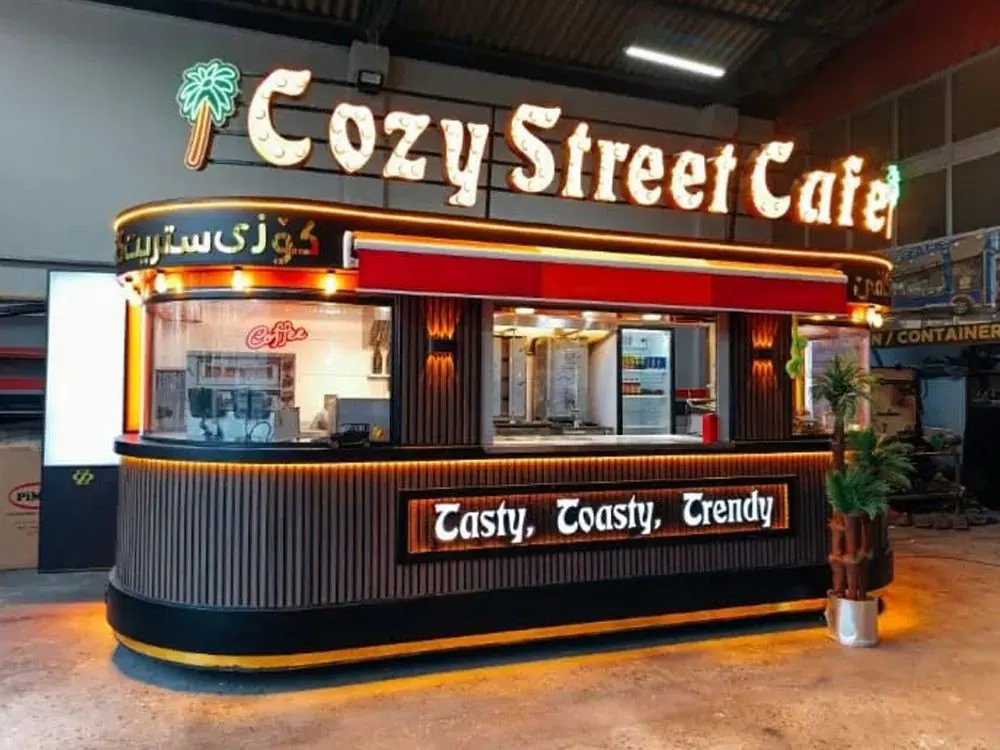
Our own are "compact kiosks with a lift-up hatch or a full-width awning, lit inside and finished in black", for "parks, terraces and shopping centre entrances". A coffee fit-out is "placed for one or two baristas". Cozy Street Cafe, a container kiosk, has "a curved glazed front, slatted body, red awning and LED trim", with "a compact stainless kitchen with fryers, griddle and refrigeration" behind the counter.
What to send for a quote
- The site: mall, park, campus or terrace, indoors or outdoors, with a site plan if you have one.
- How often it will move: never, once a season, or as part of daily trading.
- What the site has: water, drain, power supply and a toilet staff can reach.
- Your menu and the busiest hour you expect.
- How many people will work inside.
- The serving side: lift-up hatch, full-width awning or glazed front.
- Signs and lighting you want.
- The country and city, and anything the landlord or authority has already told you.
- Any size limit set by the site or the lease.
Frequently asked questions
What is a food kiosk?
The rules we read don't define the word. They sort food businesses by whether they move: the Food Code calls a business mobile when it "moves as part of its routine operation". Our own kiosks are compact, with a lift-up hatch or full-width awning, and suit fixed spots.
What is the difference between a food stall and a kiosk?
EU Regulation 852/2004 names "market stalls" among movable or temporary premises under Chapter III. A kiosk that stays on one site may be treated as general food premises under Chapters I and II instead. Your food authority decides which applies.
How much does a fast food kiosk cost?
We don't publish prices, because every build is quoted to its scope. On our cafe page, "the type of mobile cafe and its body size are the first things that set the price". The fit-out, the serving side, branding and delivery also change it. On our container restaurant page, "opening service hatches, glazing, insulation and exterior cladding" are among the lines that set the cost.
If you have a site in mind, send the list above through the quote form. We reply with questions first, then drawings and a quote. You can see our kiosks and coffee trailers on the mobile cafe page.
Related guides
- New vs Used Food Truck: What to Check Before You Buy
- Taco Trucks: Kitchen Line, Holding and Service Window Planning
- How Much Does a Food Truck Cost to Build? The Parts That Drive the Price
- Hot Dog Carts vs Hot Dog Trailers: What Changes for the Buyer
Sources
- Town and Country Planning Act 1990, section 55
- Town and Country Planning Act 1990, section 57
- Town and Country Planning Act 1990, section 336
- GOV.UK, Planning permission (England and Wales)
- Planning Portal, Change of use: Use Classes
- Planning Portal, Adverts and signs
- GOV.UK, Street trading licence (England and Wales)
- GOV.UK (Food Standards Agency), Food business registration
- GOV.UK (Food Standards Agency), Starting a food business
- Regulation (EC) No 852/2004, Annex II (consolidated text)
- FDA Food Code 2026 (sections 1-201.10, 5-101.11, 5-104.11, 5-203.11, 5-203.12, 5-401.11, 5-402.14, 5-403.11, 6-202.15, 6-402.11, 8-201.11)
- GOV.UK, Towing with a car: weight and width limits
- 23 CFR Part 658, Truck size and weight
- Hapag-Lloyd, Container Specification

By
Ozan Food Truck
This guide is based on the laws, regulations, official guidance and manufacturer documents linked in the text. It is general information, not legal or engineering advice. Rules differ by country, state and city, so confirm the details with your local authority before you build or buy.