
Design
Food Truck Design: Planning the Look, the Serving Side and the Kitchen Together
Good food truck design starts with the menu, not the paint. The kitchen, the serving side and the look all share one small body, so you have to decide them together: what you cook sets the equipment line, the equipment line limits where the hatch can go, and the hatch decides how your brand meets the queue.
By Ozan Food TruckPublished 9 min read
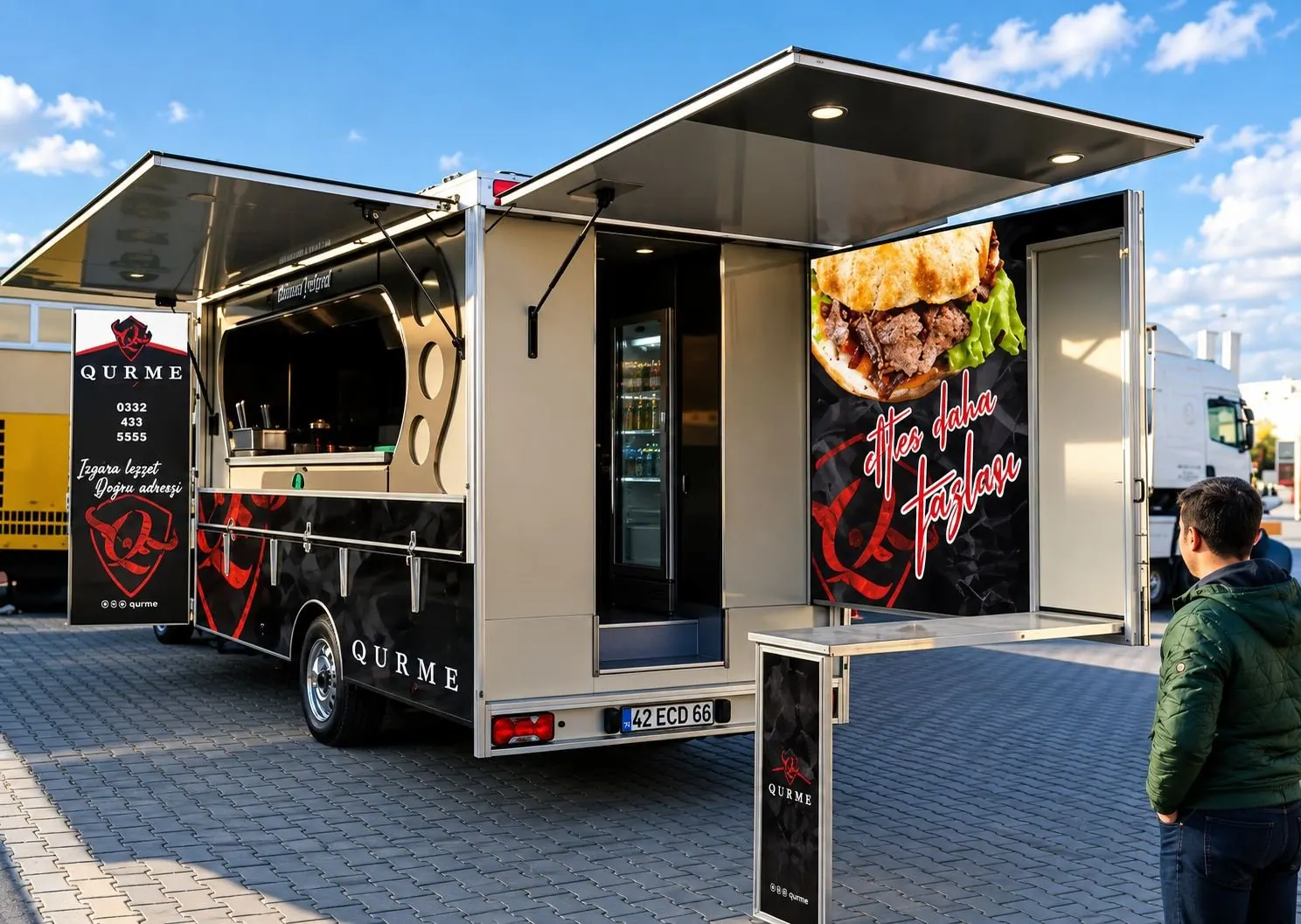
This guide follows a build from the menu to the approved drawing, with builds from our own factory as examples. Where a design choice touches hygiene law, we quote the rule from the FDA Food Code and EU Regulation 852/2004. Your local authority may add its own requirements, so check with your local health department before the drawing is final.
Checked on 28 September 2026.
Start with the menu and the crew
Treat a food truck idea as a menu first. The menu tells you what has to be fitted. That decides how much wall is left for the serving side.
Look at how different the insides of our builds are. The Lokmana van is a dessert kitchen where dough, frying and syrup are all done on board. The Kepez Belediyesi mobile kitchen truck was built for a municipality, with burners, an oven and bain-maries for soups, main dishes and rice. Ocak Başı is a grill truck on an American-style tractor. It carries an ocakbaşı grill, an extraction hood and a stainless prep line. Hemingway, a vintage truck for ice cream and bubble tea, carries a display freezer, counters and storage instead.
The second question is how many people work inside. On our custom food trucks, the layout starts with what you cook and the size of the team, so worktops, the cooking line, storage and refrigeration are placed for your team to move as little as possible during a busy service.
Then choose the base. A box body on a chassis cab, a converted panel van and a towable trailer all work, and the right one depends on where you trade and how often you move. Food trailer design can follow the same order, starting from a different base.
The kitchen: the rules that shape the line
Most of the rules we found are about the kitchen. Design to them from the first sketch.
Surfaces. In the US, the FDA Food Code asks for food-contact materials that are durable, corrosion-resistant and nonabsorbent, "finished to have a smooth, easily cleanable surface". It also wants smooth welds and joints, and no sharp internal angles, corners or crevices. Floors, walls and ceilings inside must be "smooth, durable, and easily cleanable", and nonabsorbent where they get wet. In the EU, Annex II, Chapter III of Regulation 852/2004 covers mobile sales vehicles. Where necessary, food-contact surfaces must be easy to clean and, where necessary, to disinfect, which "will require the use of smooth, washable, corrosion-resistant and non-toxic materials" unless you can satisfy the competent authority that another material is appropriate.
Installation. Fixed equipment has to be spaced so you can clean along the sides, behind and above it, or sealed to the wall or the next appliance (Food Code 4-402.11). The EU text says much the same: equipment must be installed so the equipment and the area around it can be cleaned. Hoods must be designed so grease and condensation do not drip onto food or equipment (4-204.11).
Handwashing. Where the Food Code applies, a handwash sink has to be placed for convenient use in food preparation, food dispensing and warewashing areas. It must always be accessible, and it may not be used for anything else. The EU rule asks for facilities for the hygienic washing and drying of hands where necessary.
Our reading: "food dispensing" is the serving hatch, so plan the handwash sink where both the person at the hatch and the person at the grill can reach it. Never tuck it behind stock or use it as a prep sink.
Water and waste. Where the Food Code is followed, the waste tank of a mobile food establishment must be 15 percent larger than the fresh water tank. The EU regulation asks for an adequate supply of drinking water and for liquid and solid waste to be stored and removed hygienically. It sets no tank sizes. Those come from national or local rules.
Keep in mind that the Food Code is a model that states and counties adopt, often in an older edition and with changes. FDA's adoption report, with figures as of 2024, lists 11 state agencies in 7 states as having adopted the 2022 version. The rules your inspector uses are the local ones.
The serving side
The serving side is where the kitchen and the look meet.
On our trucks, lift-up hatches on gas struts, counters and awnings are placed for the way your queue forms. That produces very different trucks:
- Yakamoz Döner Köfte has one full-length serving hatch.
- Qurme opens on two sides, with two lift-up hatches, a curved serving window, a drinks fridge by the side door and a fold-down counter.
- Paşa Döner also opens on both sides, so two queues can be served at once.
- Ekrem Coşkun Döner, built for a döner franchise, has a lit curved serving side with kitchen access from the rear.
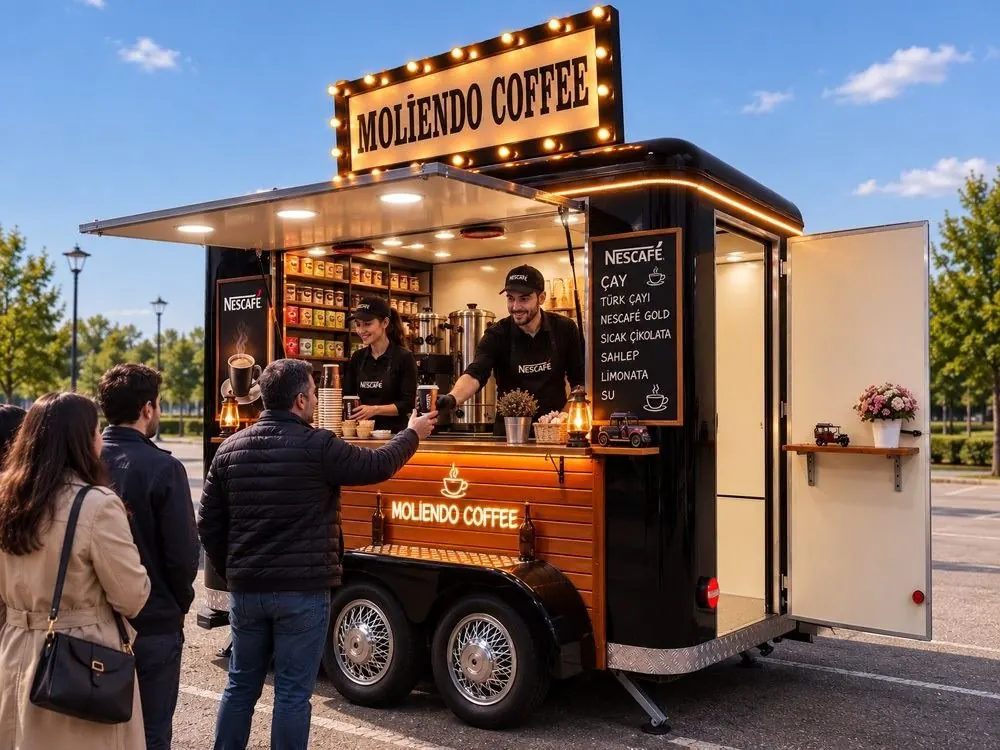
- On the Moliendo Coffee trailer, the espresso station, menu boards and side door are placed for a fast-moving queue.
Three more rules touch this side. Plan for them early.
First, food on display must be protected, by packaging, food guards, display cases or other effective means (Food Code 3-306.11). If customers will see food at the counter, draw the guard or the display case into the counter from the start.
Second, openings. The Food Code wants outer openings protected against insects and rodents, with closed, tight-fitting windows and self-closing doors. If a window or door is kept open, it needs screens, a properly installed air curtain or another effective means, unless pests are absent because of the location or the weather. The EU text asks for premises to be sited and designed to avoid contamination, "in particular by animals and pests". A serving hatch stays open while you serve. Ask your health department what it accepts before you choose the hatch type.
Third, light. The Food Code asks for at least 540 lux at a surface where staff work with food and 215 lux in handwashing areas, measured 75 cm above the floor. Bulbs in areas with exposed food must be shielded, coated or otherwise shatter-resistant. Our reading: the neon sign and the LED strip that make the hatch glow at night do not replace task lighting over the worktop. Plan both.
The look
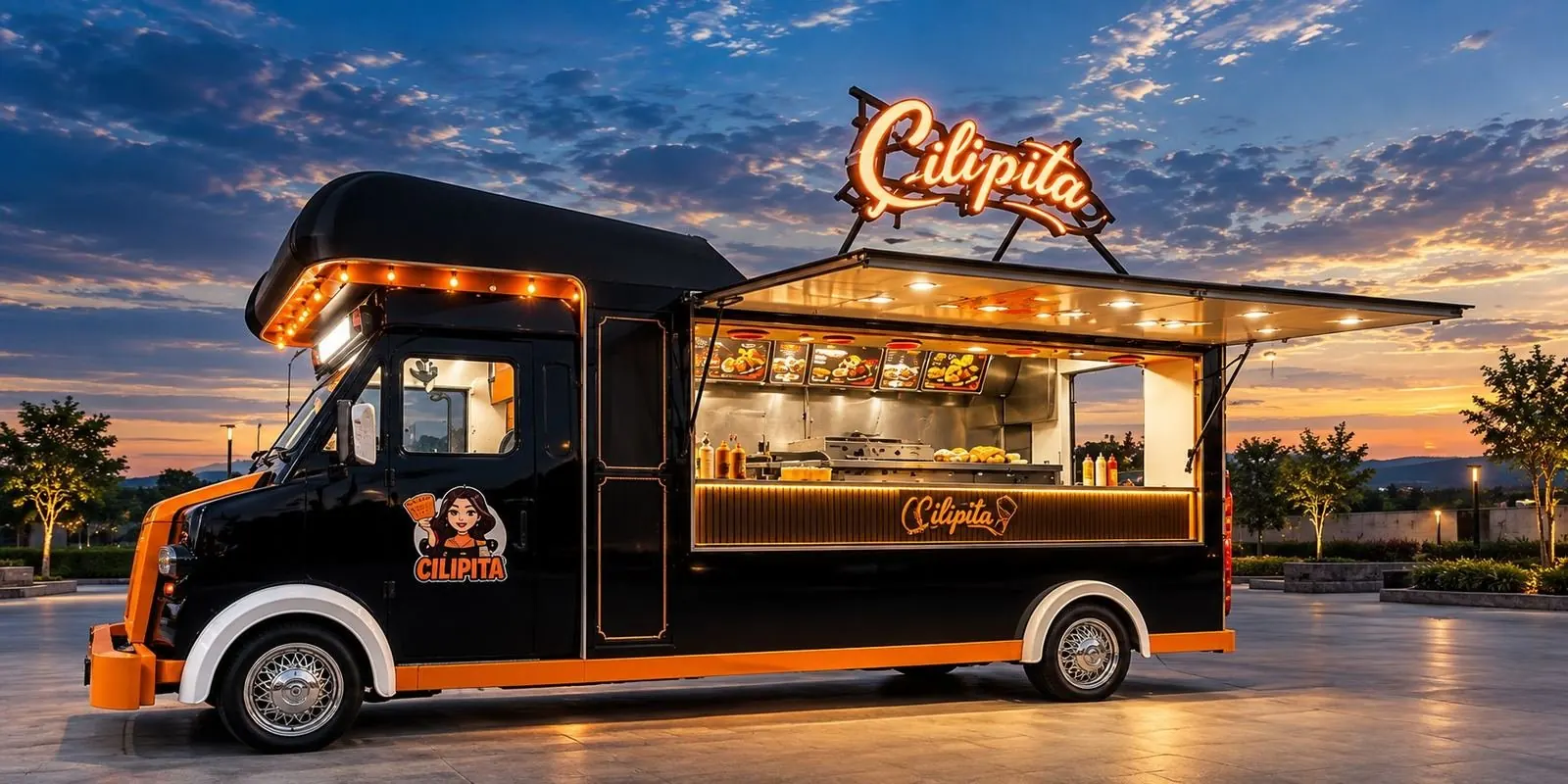
Search for food truck design ideas and you get Pinterest boards. Pictures are a start. The look still has to be drawn with the truck rather than added at the end. On our builds, paint, printed wrap, illuminated signage and LED lighting are designed together with the body, so the brand reads from across the street and after dark.
Some examples from the factory:
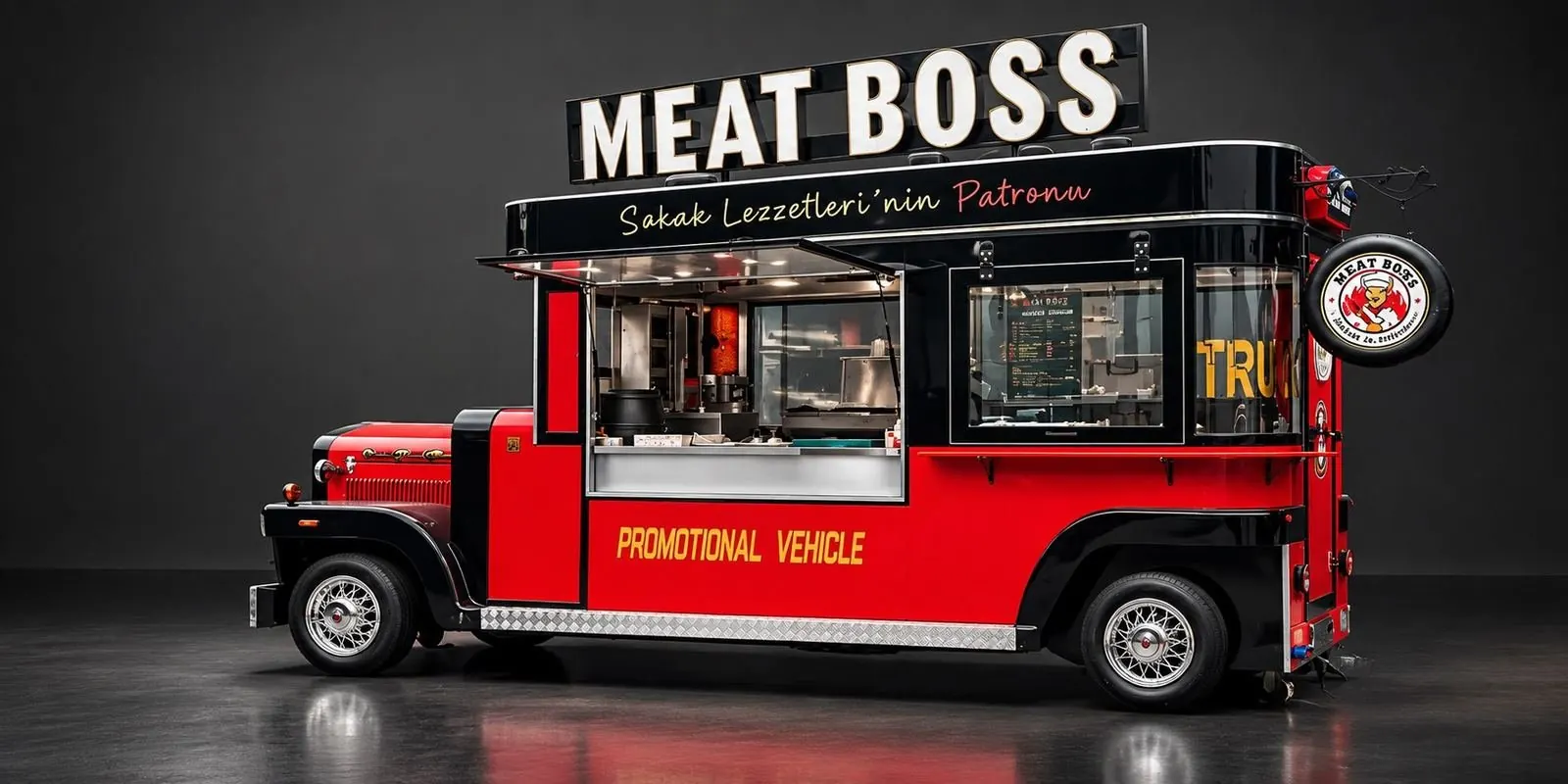
The Meat Boss vintage truck is red and black with a large illuminated roof sign, built to promote the brand at events. Behind the lift-up hatch there is a working kitchen with a döner grill.
Cilipita is black and orange, with a rounded roof, marker lights and a neon sign. Its long serving side opens onto a stainless kitchen lit for evening service.
Coffomus, a coffee trailer, has a rounded body, wooden panels and a lift-up awning lined with warm lights. It was built to look its best at dusk.
For Sauce Hotel we built a three-wheel Ape with a wooden body and a coffee and drinks bar inside, sized to stand on a hotel terrace.
Our vintage food trucks are built on a steel frame with steel cladding, shaped with a classic front, grille and wheel arches but without an engine. Inside, stainless worktops, cooking equipment, refrigeration and extraction are fitted for the menu.
The Food Code has one line about the outside: exterior surfaces of mobile food establishments must be weather-resistant and comply with the law. We found no other Food Code rule on paint, wraps or wood outside. If you want wood where food sits, remember that the EU text allows materials other than smooth, washable ones only if you can satisfy the competent authority that they are appropriate. Ask before it is built.
Put all three on one drawing
Settle the layout, the exterior and the equipment list on the same set of drawings. That is how we work: after the first meeting, the layout, the exterior design and the equipment list are prepared and sent to you for approval, and manufacturing follows the approved project.
The same drawings matter for your permit. Where the Food Code is used, you submit plans before construction, and the authority can ask for the layout, construction materials, finish schedules and the equipment with manufacturers and model numbers. So the finish you choose for the look is part of the health review, not a separate decision.
| Layer | Decide | Check against |
|---|---|---|
| Kitchen | Equipment for your menu, crew size, tank sizes | Food Code 4-101.11, 4-202.11, 4-402.11, 5-401.11; Reg. 852/2004 Annex II, Chapters III and V |
| Serving side | Hatch count and position, counter, display, handwash reach | Food Code 3-306.11, 5-204.11, 6-202.15 |
| Look | Wrap, paint, signs, lighting, materials | Food Code 6-102.11, 6-202.11, 6-303.11; your local authority |
Tell the builder the destination country at the first meeting, so its requirements are considered at the design stage.
Frequently asked questions
What is the best layout for a food truck?
There is no single best one, and neither rulebook sets one. The best layout is the one your menu and crew need, with the handwash sink within reach of the cooking line and the serving hatch, and surfaces that are smooth and easy to clean.
What is a good size for a food truck?
It depends on the equipment your menu needs and on the road rules where you trade. In the UK, for example, a trailer can be at most 2.55 metres wide, and no longer than 7 metres (not counting the A-frame) if the towing vehicle's maximum authorised mass is 3,500 kg or less. Check the limits with your vehicle registration office.
What is the most profitable food truck idea?
We found no official figures that rank food truck concepts by profit, so we will not name one. What design can do is fit the kitchen to the menu you have tested and shape the serving side around the queue you expect.
What are some unique cafe design ideas?
Among our own builds: a coffee trailer with an awning lined with warm lights, built to look its best at dusk, a wooden Ape coffee bar sized for a hotel terrace, and a rounded ice cream trailer wrapped in colourful artwork with a neon sign. You can see more on our coffee trailers and mobile cafes page.
If you have a menu and a place to trade in mind, send them through the quote form. We reply with questions first, then drawings and a quote. You can also browse finished builds on our food trucks and trailers page.
Related guides
- Food Truck Wraps and Graphics: What Decides the Look, Durability and Cost
- New vs Used Food Truck: What to Check Before You Buy
- Taco Trucks: Kitchen Line, Holding and Service Window Planning
- How Much Does a Food Truck Cost to Build? The Parts That Drive the Price
Sources
- FDA Food Code 2026 (PDF), sections 3-306.11, 4-101.11, 4-202.11, 4-204.11, 4-402.11, 5-204.11, 5-205.11, 5-401.11, 6-101.11, 6-102.11, 6-202.11, 6-202.15, 6-303.11, 8-201.11, 8-201.12
- FDA Food Code overview
- FDA, Adoption of the FDA Food Code by state and territorial agencies
- Regulation (EC) No 852/2004 on the hygiene of foodstuffs, Annex II, Chapters III and V (consolidated 24.03.2021)
- GOV.UK, Towing weight and width limits

By
Ozan Food Truck
This guide is based on the laws, regulations, official guidance and manufacturer documents linked in the text. It is general information, not legal or engineering advice. Rules differ by country, state and city, so confirm the details with your local authority before you build or buy.