
Buying guide
Mobile Kitchen Trailers for Events, Institutions and Emergency Feeding
Start a mobile kitchen trailer order with one number: the meals you must serve per day, and in how many sittings. FEMA's resource typing has mobile kitchens ordered by that count, and it drives the kettles and ovens, the power or gas supply, the water and waste tanks, and the crew. Settle it first, along with where the kitchen will work and who resupplies it.
By Ozan Food TruckPublished 9 min read
This guide is for municipalities, relief organisations, event caterers and institutions. It uses FEMA's own resource typing for mobile and field kitchens, the FDA Food Code for water and waste, and maker spec sheets for the equipment values. Rules vary by state and country, so check the details with your local health department before the layout is drawn.
Checked on 29 September 2026.
What sets a feeding kitchen apart from a food truck
A street food truck is built around a menu and a queue. A feeding kitchen is built around a count. FEMA, the US federal emergency agency, sorts mobile kitchens into types, and the requesting agency orders one "based on the number of meals necessary per day". Its typing sheet describes a kitchen on wheels, "designed for meal preparation and direct food service", whose crew can pack up and move it.
| FEMA type | Mobile kitchen, daily meals | Field kitchen, daily meals |
|---|---|---|
| Type 4 | Up to 750 | Up to 5,000 |
| Type 3 | Up to 1,500 | Up to 10,000 |
| Type 2 | Up to 2,500 | Up to 20,000 |
| Type 1 | More than 2,500 | More than 20,000 |
For the mobile kitchen, FEMA counts that daily output over two serving sessions. The larger field kitchen is different. It is pulled in by a truck or trailer, set up at a central site and "typically remains in one place until demobilization". It can also cook meals for delivery vehicles to distribute.
FEMA's field kitchen sheet counts a meal as an eight-ounce entrée, a six-ounce vegetable and six-ounce fruit, or equivalent. It calls its typed figures minimum criteria, and says operational requirements guide the actual serving sizes.
Our reading: even if you will never deploy under FEMA, write your brief the same way. Meals per day, sittings per day, and the portion you plan per meal.
Large-volume cooking equipment
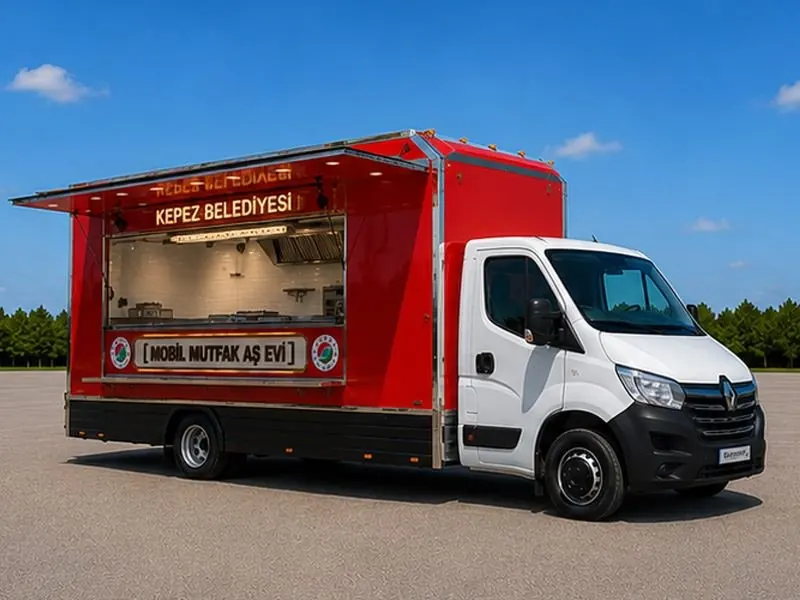
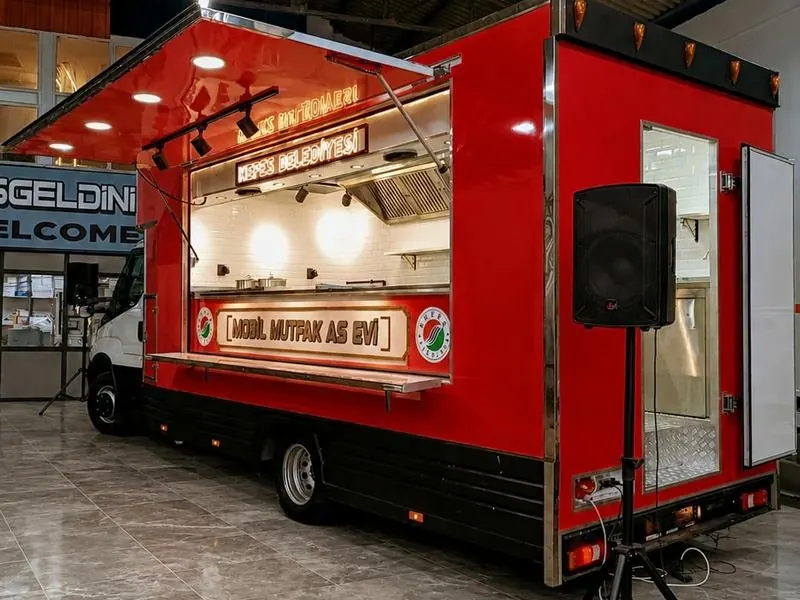
The Kepez truck on our site cooks soups, main dishes and rice with burners, an oven and bain-maries. Below are maker figures for larger versions of the same kinds of equipment: a tilting kettle, a convection oven and a drop-in food warmer. We read one spec sheet for each. They are examples, not recommendations.
| Model | Type | Capacity | Energy | Weight |
|---|---|---|---|---|
| Cleveland KEL-40-TSH | Electric tilting kettle | 40 gal (150 L), 640 servings of 8 oz | 19.6 kW at 240 V, 3-phase (14.7 kW at 208 V) | 455 lb shipping |
| Cleveland KGL-40-T | Gas tilting kettle | 40 gal (150 L), 640 servings of 8 oz | 140,000 BTU gas, plus 120 V, 10 A | 527 lb shipping |
| Blodgett DFG-100-ES | Gas convection oven, one section | Five 18 x 26 in full-size pans | 45,000 BTU/hr (13.2 kW), plus 115 V, 8 A | about 600 lb shipping |
| Wells MOD400 | Four-well drop-in food warmer | Four 12 x 20 in pans | 900 or 1,200 W per pan (208 or 240 V) | see spec sheet |
A few points from the sheets matter for a vehicle. The electric kettle is self-contained and "needs only an electrical hook-up", with a permanently filled steam jacket that needs no refilling. Its drawing marks a recommended floor drain location and asks for 12 inches of service space on the right. The Wells warmer works wet or dry, with wet recommended, and its auto-fill version needs a water connection.
Cleveland adds a line worth passing to your builder: "Many regional, state and local codes exist and it is the responsibility of the owner and installer to comply with the codes."
Our reading: one 40-gallon batch gives 640 eight-ounce servings. A FEMA Type 4 kitchen serves up to 750 meals over two sittings, or 375 entrées a sitting if split evenly. So one such kettle could cover a sitting's entrée with room to spare. Treat that as arithmetic on printed figures, not as a sizing rule, and ask your chef to check the time between batches.
Ventilation for gas equipment
Blodgett's manual is blunt about gas ovens: "the installation of a proper ventilation system cannot be over emphasized." It prefers a mechanically driven canopy hood with at least 6 inches of overhang on open sides, and about 30 CFM of make-up and exhaust air per oven section. It says damage from improper ventilation is not covered by the warranty. For the hood standard it points to local codes, then to NFPA 96, which we could not read. Ask your fire authority which hood and suppression rules apply to your vehicle.
Water and waste at scale
The FDA Food Code is a model. States and counties adopt it in their own way, sometimes an older edition. Where it applies, these sections shape a large kitchen:
- The water system must meet "peak water demands", and hot water must meet peak hot water demand too.
- Water must reach every fixture under pressure. A temporary event kitchen supplied from bottled water or closed containers is the exception.
- A mobile kitchen can draw from an enclosed vehicle tank, closed containers, bottled water, or a hose to an approved source.
- The tank inlet is three-quarters of an inch or less, with a hose fitting that cannot be used for anything else. Tank, pump and hoses carry drinking water only, and are flushed and sanitised after construction and after periods of nonuse.
- The waste tank is 15 percent larger than the fresh water tank, with a drain of at least 1 inch and a shut-off valve. Waste is emptied at an approved servicing area or by a sewage transport vehicle.
- A three-compartment sink is needed for washing, rinsing and sanitising, and each compartment must take your largest equipment. If it can't, a warewashing machine or approved alternative is needed.
For food that needs temperature control, hot holding is 135°F (57°C) or above, cold holding 41°F (5°C) or less. Holding equipment must be "sufficient in number and capacity" to keep those temperatures.
FEMA puts resupply on the requesting agency. It "coordinates access to fuel (gasoline, diesel, propane) and supporting services (freshwater replenishment, wastewater removal)."
Our reading: the Food Code gives no litres per meal, so size the tanks from your own sink and kettle use at peak, then plan where you will refill and empty. A vehicle has no floor drain, so whatever the kettle and the sinks discharge has to go to the waste tank.
In the EU and UK, Regulation 852/2004 asks mobile sales vehicles for "an adequate supply of hot and/or cold potable water" and hygienic waste disposal, but sets no tank sizes. Check national guidance and your local authority.
Power
Add up the sheet values before you choose between electric and gas. One electric 40-gallon kettle draws 19.6 kW at 240 V. Cummins notes that a 50 amp shore cord at 240 V carries at most 12,000 watts. So that kettle alone needs more than such a cord supplies, and its standard version is three-phase.
The gas route moves most of the load to gas. The gas kettle still needs a 120 V, 10 amp supply, and the oven 115 V at 8 amps. Their gas ratings add up to 185,000 BTU per hour. The four-well warmer adds 4,800 W at 240 V.
For sizing a generator, Generac's method is the sum of all running watts plus the largest single starting surge. The US Consumer Product Safety Commission says to run portable generators outside only, at least 20 feet from homes, with the exhaust facing away. That distance is written for homes. Ask your fire authority what applies at your site. Our guide to sizing a food truck generator works through the method step by step.
Feeding or selling: what changes
Under the Food Code, a food establishment includes a catering operation, an institution, a food bank and a "satellite or catered feeding location". It applies "regardless of whether there is a charge for the food". Where a state adopts that wording, a free meal after a flood and a sold lunch at a festival are held to the same food safety rules.
Institutions have one extra layer. Where a kitchen serves a highly susceptible population, such as people fed at a hospital, nursing home, day care centre or senior centre, section 3-801.11 adds menu rules. Pasteurised eggs replace raw eggs in the cases it lists, and some juices may not be served.
Our reading: what can differ between feeding and retail sale is the paperwork. Permits, vending licences, tax and any emergency arrangements are set locally, and the Food Code does not settle them. Check with your local health department and licensing authority before you commit to one route.
What we build
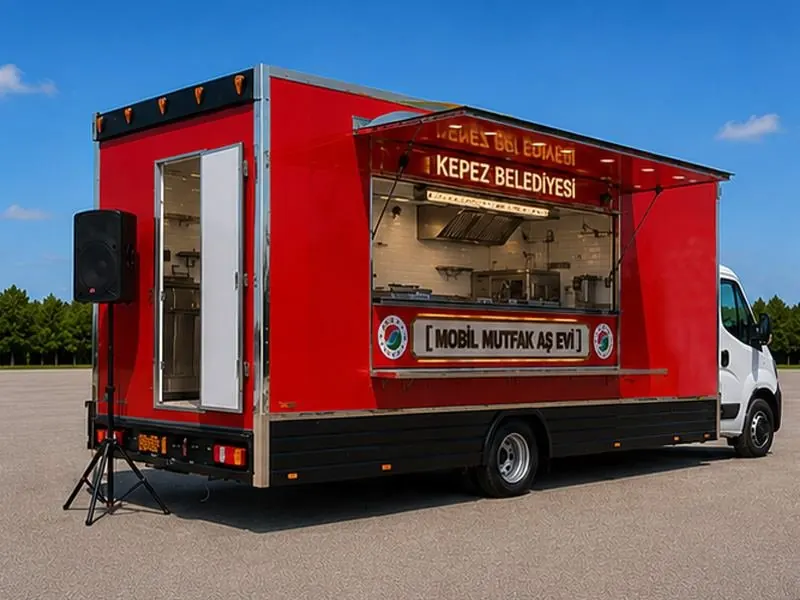
Our custom food trucks page shows the Kepez Belediyesi project, a mobile kitchen truck for a municipality. Burners, oven, bain-maries, extraction and a stainless fit-out let the team cook soups, main dishes and rice on board and serve them hot at events. It is a box body on a chassis cab, not a trailer. We also build catering trailers and mobile kitchens for catering and event companies. The food trucks and trailers page covers the vehicle types.
What to send the builder for a quote
- Meals per day, sittings per day and portion size.
- Your menu, and which dishes are cooked on board or brought in.
- Whether the kitchen moves every day or stays at one site.
- Equipment you already want, with the maker's spec sheets.
- Fuel: electric, propane or both, and what power is on site.
- How water is supplied and where waste can be emptied.
- Crew size at peak.
- Where it will work, so the local health, fire and vehicle rules can be checked.
- The tow vehicle, if it is a trailer. Our sizes and layout guide covers weight and width.
Frequently asked questions
How does a mobile kitchen work?
It cooks and serves on board. FEMA describes a kitchen on wheels for meal preparation and direct food service, run by its own crew, who can move it. A larger field kitchen is set up at one site and can cook for delivery vehicles too.
What is the cost of a mobile kitchen trailer?
We don't give prices, because every kitchen is built to order. Meals per day, the equipment list, gas or electric cooking, the power system, the tanks and the vehicle drive the figure.
How much is a trailer kitchen?
The answer depends on the same things. Send your meal count and menu, and we quote on that.
Send your meal count, menu and where the kitchen will work through the quote form. We reply with questions first, then drawings and a quote.
Related guides
- New vs Used Food Truck: What to Check Before You Buy
- Taco Trucks: Kitchen Line, Holding and Service Window Planning
- How Much Does a Food Truck Cost to Build? The Parts That Drive the Price
- Hot Dog Carts vs Hot Dog Trailers: What Changes for the Buyer
Sources
- FEMA Resource Typing Library Tool, Mobile Kitchen typing definition (9-508-1271)
- FEMA Resource Typing Library Tool, Field Kitchen typing definition (9-508-1000)
- FEMA Resource Typing Library Tool, Food Service Delivery typing definition (9-508-1272)
- FDA Food Code 2026, sections 1-201.10, 3-501.16, 3-801.11, 4-301.11, 4-301.12, 5-103.11, 5-103.12, 5-104.12, 5-302.11, 5-303.13, 5-304.11, 5-304.14, 5-401.11 and 5-402.14
- Cleveland Range, KEL-40-TSH spec sheet
- Cleveland Range, KGL-40/60/80-T spec sheet
- Blodgett, DFG-100-ES spec sheet
- Blodgett, DFG-ES installation and operation manual
- Wells, MOD400 product page and spec sheet
- Regulation (EC) 852/2004, Annex II, Chapter III
- Cummins, RV Generator Power Basics
- Generac, What Size Generator Do I Need?
- US CPSC, Carbon Monoxide Information Center

By
Ozan Food Truck
This guide is based on the laws, regulations, official guidance and manufacturer documents linked in the text. It is general information, not legal or engineering advice. Rules differ by country, state and city, so confirm the details with your local authority before you build or buy.