
Buying guide
Pizza Food Truck or Pizza Trailer: Oven, Weight and Layout Questions Before You Order
A pizza food truck is planned around its oven. Before you order, pick the oven by make and model, check its weight against the rating of the truck or trailer, and ask your fire authority how it has to be vented. Dough storage, the make line and the serving hatch follow from that choice.
By Ozan Food TruckPublished 10 min read
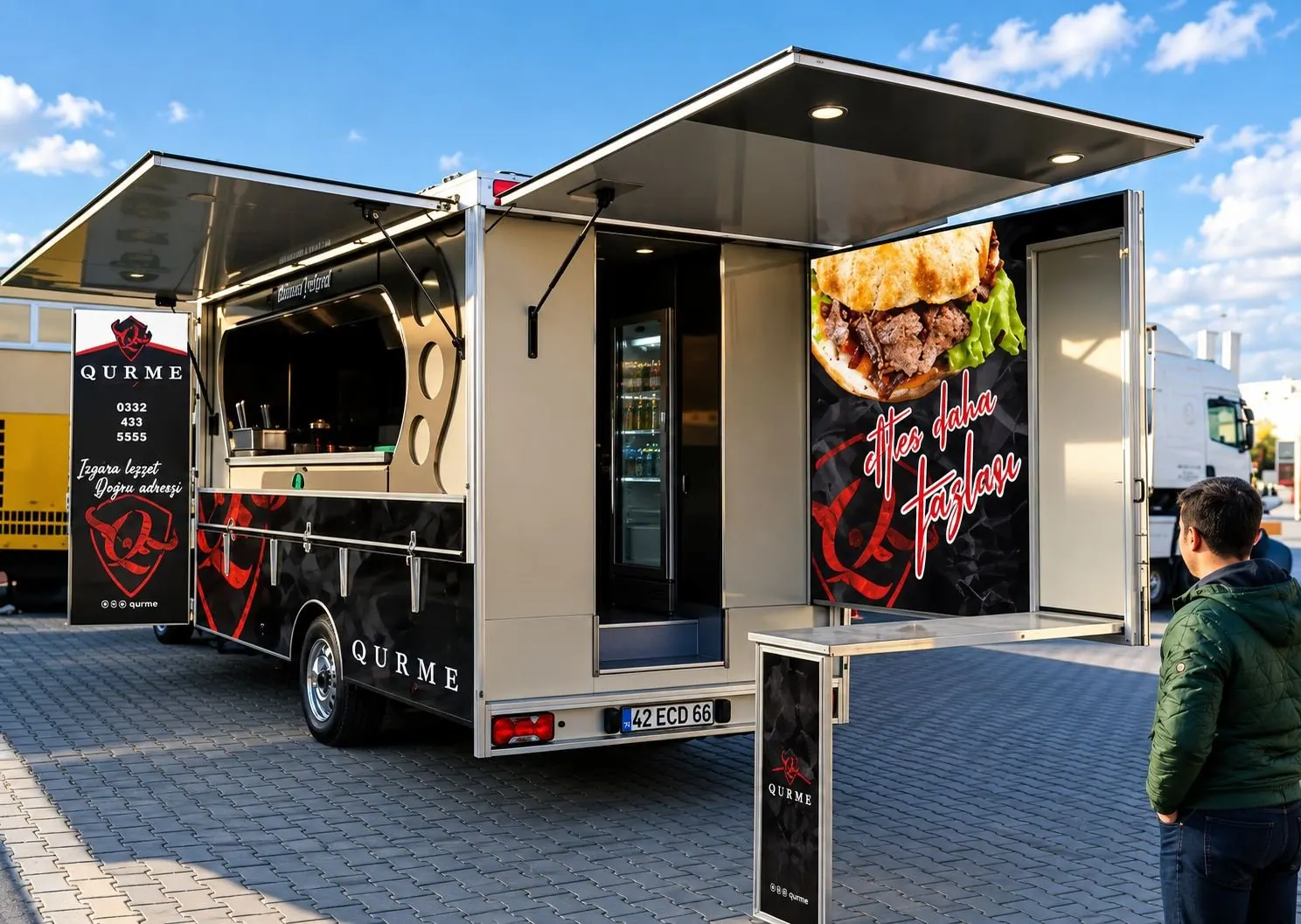
This guide compares gas deck, electric deck and wood-fired ovens using the makers' own spec sheets, then covers weight, hood and fire rules, cold storage and the serving line. The models named are examples, not recommendations. Rules differ by city and country, so confirm the details with your local health department and fire authority.
Checked on 29 September 2026.
Three oven types, side by side
Change the oven and you may have to change the chassis, the gas system or the generator. So get the spec sheet and installation manual for the exact model first.
| Oven (maker's model) | Type | Rating on the sheet | Weight on the sheet | Clearances in the maker's text |
|---|---|---|---|---|
| Bakers Pride GP-51 | Countertop gas deck | 40,000 BTU/h (11.72 kW), natural gas or propane | 414 lb (188 kg) shipping | Combustible walls: 2 in left, 1 in right, 5 in rear |
| Bakers Pride Y-600-DSP | Full-size gas deck | 120,000 BTU/h (35.15 kW) | 1,338 lb (607 kg) shipping | Combustible walls: 1 in left, 3 in right, 3 in back |
| Bakers Pride P44S | Countertop electric deck | 7,200 W at 208 or 220/240 V | 296 lb (134 kg) shipping | 3 in sides and back, on a non-combustible surface |
| Bakers Pride EP-1-2828 | Countertop electric deck | 4,750 W, also listed at 230/400 V | 310 lb (141 kg) shipping | 1 in sides and back |
| Mugnaini Commercial 120 PA | Wood-fired masonry | No gas or electricity needed | 2,900 lb | 1 in sides and back to combustibles |
| Mugnaini 120 PA, dome enclosure | Gas-fired masonry | 116,000 BTU, 120 V at 1.1 A | 3,950 lb | 1 in sides and back to combustibles |
The Bakers Pride sheets print shipping weight, so ask for the installed figure.
Gas deck ovens
The GP-51 runs on natural gas or propane, and for propane the regulator is preset to 10 inches water column. Its manual says "adequate means must be provided to limit the movement of the appliance without depending on the connector".
It vents under a hood, using the supplied flue diverter, or directly through a draft hood, and the manual says to consult local inspectors and ventilation specialists. Direct venting and propane versions are not available in European Community countries, so check what the maker offers for your gas.
The deck slabs are "heavy and fragile", so ask how they are held in place for travel. And in normal service the pilot "stays lit indefinitely, day and night or weekends". HSE's summary of the UK vehicle rules says pilot lights should not be lit while the vehicle is moving. Our reading: a standing-pilot oven has to be shut down before you drive, so plan time to relight and reheat at each pitch.
In the EU, gas appliances must suit the local gas supply. In Great Britain, gas work in mobile catering must be done by a Gas Safe-registered business.
Electric deck ovens
The P44S draws 7,200 W. At 208 V that is 34.6 A single phase or 24.3 A three phase. The EP-1-2828 sheet lists a 230/400 V version: 4,750 W, 20 A on 230 V single phase, or 6 to 7 A per line on 400 V three phase.
The P44 manual says the supply must match the rating plate, and the installer must provide a way to disconnect all ungrounded conductors at once.
Compare the supply you will have. Cummins puts a 30 A, 120 V shore cord at 3,600 W and a 50 A, 240 V cord at 12,000 W. A 7,200 W oven is twice the first and most of the second, before the fridge or lights are counted. Our generator sizing guide shows how to add up the full list.
Wood-fired ovens
Mugnaini lists its Commercial 100 PA wood oven at 2,300 lb and the 120 PA at 2,900 lb. The 120 size with a stucco dome and a gas burner is listed at 3,950 lb and needs 116,000 BTU of gas, and the sheet marks "fresh air required".
Mugnaini gives two venting methods. One is direct, through an 8 inch chimney listed to UL 103 HT and installed per UL 737. The other is a Type 1 hood installed per UL 2162. Its manual rules out single-wall and B-type vent pipes, says the exhaust must follow NFPA 96, and tells the installer to ask the local building or fire inspector which method is acceptable.
Wood also needs space. Mugnaini asks for 8 inches between the oven and any wood stored below, and a metal can with a tight-fitting lid for ashes.
Mugnaini also sells the oven mounted on a trailer. Its Mobile Model 120 sheet lists tandem 3,500 lb axles, an electronic brake system, storage compartments and a certified weight certificate for the DMV.
Oven weight against the vehicle's rating
The weight rating is on the plate or label: the GVWR in the US, with a GAWR for each axle, and the maximum authorised mass (MAM) in the UK. Both are the loaded limit.
Our reading: what you can load is the rating minus the weighed weight of the finished vehicle. The oven, water, gas bottles, dough, wood and staff all come out of that margin. The oven also has to sit where neither axle goes over its rating, so ask to see the axle loads on the drawing.
The countertop deck ovens above ship at 296 to 414 lb. The full-size gas deck ships at 1,338 lb. The masonry ovens start at 2,300 lb. Mugnaini puts its Mobile 120 at about 4,300 lb for trailer and oven combined, roughly 1,950 kg before any stock. In the UK a trailer over 750 kg loaded needs a working brake system, and 750 kg is also where the EU category B trailer rule changes. Our guide to food truck sizes and weight covers those thresholds.
The Bakers Pride manuals we read say nothing about installing the ovens in a vehicle, and the warranty excludes any product not installed as the manual directs. Our reading: ask the oven maker, in writing, whether your installation is covered.
Hood and fire rules: what we could read
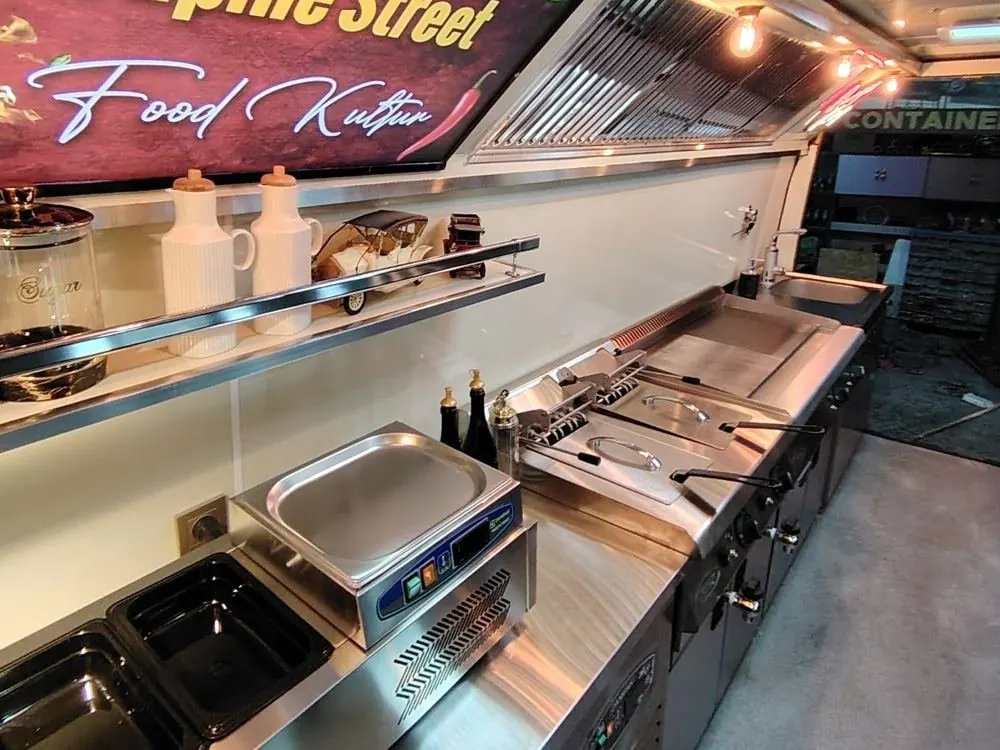
We could not read the NFPA 96 or NFPA 58 texts, so we do not quote them. Mugnaini's manual points to NFPA 96 for the exhaust, and the Bakers Pride manual cites it for hoods in Massachusetts. Ask your fire authority which parts apply.
The FDA Food Code, a model that states and local regulators use to write their own rules, asks for hoods that do not drip grease or condensation onto food, and for mechanical ventilation where heat, smoke or fumes need removing.
Austin, Texas is one example. Its fire department inspects mobile food vendors with propane or with any appliance that produces grease-laden vapors. Solid fuel such as wood or charcoal needs a Class K extinguisher. A new permit needs a gas detector and an electrical inspection, plus a hood fire suppression system where appliances produce grease-laden vapors. Propane carried for cooking is capped at 200 pounds, and each gas line needs a shut-off at the appliance and at the supply.
Austin's page does not say whether a pizza oven counts as a grease-vapor appliance, and it notes that jurisdictions use different fire code editions. Ask your own fire marshal before the body is built.
Dough prep and cold storage
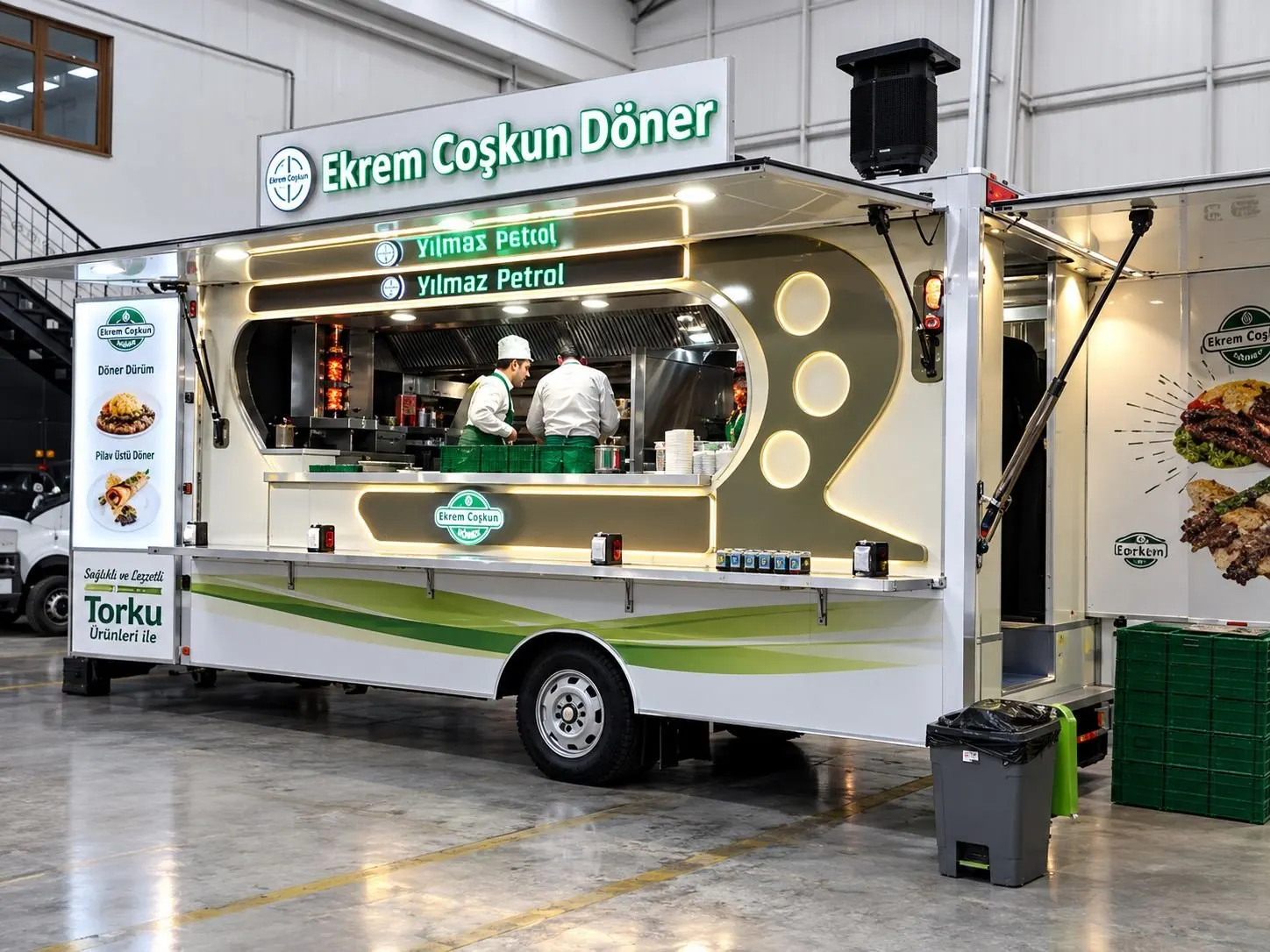
Decide early whether dough is made on board or brought in. Under the Food Code, the health department may require a commissary when the truck cannot support the preparation, storage or sanitation it needs.
Where the Food Code applies, food that needs temperature control is held at 41°F (5°C) or below, or 135°F (57°C) or above. In England, Wales and Northern Ireland, chilled food must be kept at 8°C or below, and GOV.UK advises setting the fridge to 5°C or below. We did not check whether raw pizza dough counts as temperature-controlled food, so ask your health department.
For the make line, a refrigerated prep table is one option. True's TPP-AT-44-HC holds 33 to 41°F in its pans and cabinet, has six 1/3-size pans on the rail and a 19½ inch deep cutting board, and is 44⅝ inches wide. It draws 3.9 A at 115 V or 1.8 A at 230 to 240 V, wants a 15 amp dedicated outlet, and weighs 330 lb crated.
If toppings sit out on the line, the Food Code's four-hour option lets you use time instead of temperature. It needs written procedures, containers marked with the discard time, and food thrown away after it. Place the handwash sink within reach of the people stretching dough and topping pizzas.
The serving flow
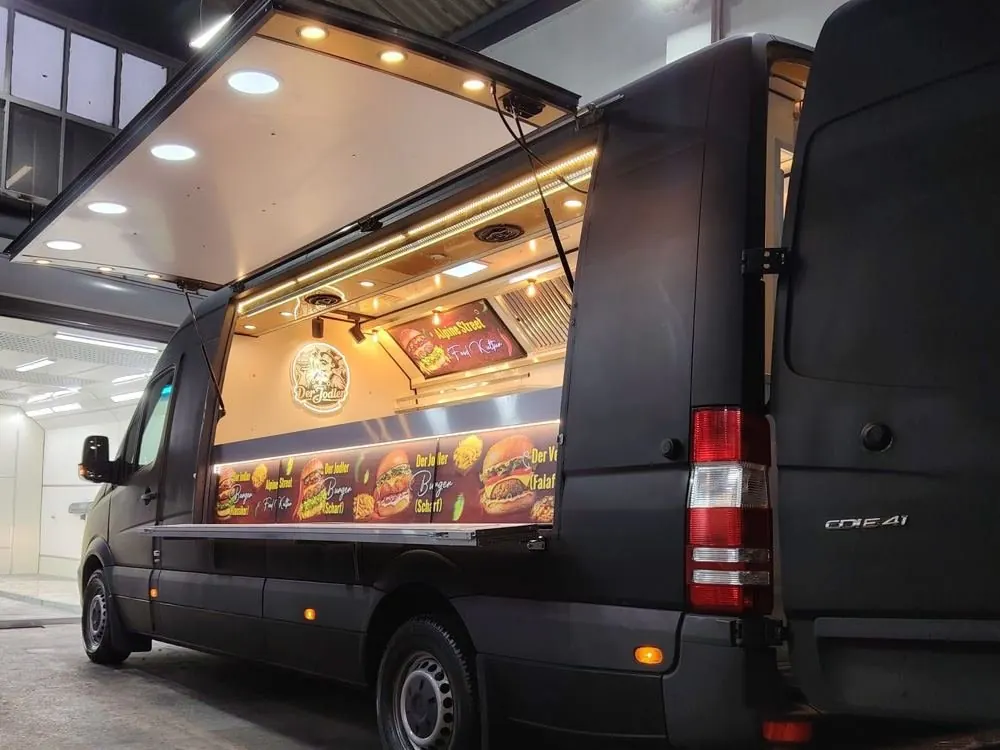
Our reading: the oven's output sets the pace. Mugnaini quotes about 100 pizzas an hour for its Mobile 120, as its own figure. Whatever your oven's number, the prep table, cutting board and hatch have to keep up, so draw that path with as few crossings as you can.
On our custom food trucks the layout starts with what you cook and how many people work inside, and hatches and counters go where the queue forms. Some of our trucks open on both sides so two queues can be served at once. If pizzas are held before serving, keep them at 135°F or above where the Food Code applies, or 63°C in the UK.
What to send the builder for a quote
- The oven make and model, with its spec sheet and installation manual.
- Your menu and how many pizzas an hour you expect at peak.
- Truck or trailer, and the base vehicle if you have one.
- Fuel, power source and the country where you will trade.
- Dough made on board or at a commissary, and the refrigeration you need.
- What your fire authority and health department have said about hoods and venting.
Our food trucks are fitted out for the menu, with worktops, cooking equipment, extraction, refrigeration, sinks, water tanks and a power system. Send the list through the quote form. We reply with questions first, then drawings and a quote.
Frequently asked questions
What is the 2 hour rule for pizza?
It is USDA advice for consumers: do not leave food out of refrigeration for more than 2 hours, or 1 hour above 90°F. A food business follows its own rules. Where the Food Code applies, that means 41°F or below, 135°F or above, or the Food Code's four-hour time control with written procedures.
Can a wood-fired oven go in a food truck or trailer?
Mugnaini sells a wood-fired oven mounted on its own trailer. Venting and fire equipment are for your local authority to approve, and Mugnaini tells installers to ask the local inspector which venting method is acceptable.
How heavy is a pizza oven?
The countertop deck ovens we checked ship at 296 to 414 lb, a full-size gas deck at 1,338 lb, and Mugnaini's masonry ovens are listed at 2,300 to 3,950 lb. Check your model against your vehicle's rating.
Does a pizza truck need a hood?
It depends on where you trade. Austin requires hood fire suppression where appliances produce grease-laden vapors, but does not say whether a pizza oven counts. Ask your fire marshal, with the oven's spec sheet in hand.
If you already have an oven in mind, send the model, your menu and where you will trade through the quote form, or see how our food trucks are fitted out.
Related guides
- New vs Used Food Truck: What to Check Before You Buy
- Taco Trucks: Kitchen Line, Holding and Service Window Planning
- How Much Does a Food Truck Cost to Build? The Parts That Drive the Price
- Hot Dog Carts vs Hot Dog Trailers: What Changes for the Buyer
Sources
- Bakers Pride, GP series countertop gas ovens, spec sheet
- Bakers Pride, GP series operation manual
- Bakers Pride, Y-600-DSP deck ovens, spec sheet
- Bakers Pride, P44S and P44-BL countertop electric ovens, spec sheet
- Bakers Pride, countertop electric ovens operation manual (2M-U4008A REV E)
- Bakers Pride, EP-1-2828 countertop electric ovens, spec sheet
- Bakers Pride, limited equipment warranty
- Mugnaini, Commercial 120 PA wood oven, spec sheet
- Mugnaini, Commercial 100 PA wood oven, spec sheet
- Mugnaini, Commercial 120 PA gas oven, dome enclosure, spec sheet
- Mugnaini, commercial wood-fired oven installation manual
- Mugnaini, Mobile Model 120 oven and trailer, spec sheet
- Mugnaini, Mobile Model 120 product page
- True Manufacturing, TPP-AT-44-HC pizza prep table, spec sheet
- Cummins, RV Generator Power Basics
- FDA Food Code 2026, sections 3-501.16, 3-501.19, 4-204.11, 4-301.14, 5-204.11, 6-304.11, 8-201.12 and Annex 3
- USDA FSIS, "Danger Zone" (40°F to 140°F)
- City of Austin Fire Department, Mobile Food Vending Fire Inspections
- HSE, Catering Information Sheet No 23, Gas safety in catering and hospitality
- Regulation (EU) 2016/426 on appliances burning gaseous fuels
- GOV.UK, Food hygiene for your business
- GOV.UK, Vehicle weights explained
- GOV.UK, Trailer and towing equipment
- 49 CFR 571.3, definitions (GVWR, GAWR)
- Directive 2006/126/EC on driving licences

By
Ozan Food Truck
This guide is based on the laws, regulations, official guidance and manufacturer documents linked in the text. It is general information, not legal or engineering advice. Rules differ by country, state and city, so confirm the details with your local authority before you build or buy.