
Buying guide
Kebab and Shawarma Trailers: Rotisserie, Power and Hygiene Setup
A shawarma trailer is built around one machine: the vertical broiler. Choose it first, gas or electric and how many pounds of meat per cone, because that choice sets the power supply, the gas system, the extraction above it and the cold storage behind it.
By Ozan Food TruckPublished 10 min read
This guide takes figures from two broiler makers' spec sheets and sets them against the FDA Food Code. Rules change from county to county. Check with your local health department and fire marshal before the layout is final.
Checked on 29 September 2026.
What you need to decide first
Under the FDA Food Code, a food business run from a vehicle that moves as part of its routine is a mobile food establishment. Where the code applies, the usual kit follows: a handwashing sink, a three-compartment sink or an approved alternative, water tanks, cold holding and thermometers. Our guide to food truck equipment covers that list.
What makes a shawarma or döner trailer different is the broiler. So start with these answers:
- What goes on the spit: chicken, beef, lamb or a gyro cone.
- How much meat you carve in a service.
- Whether you trade where you can get shore power, or run on a generator and propane.
- How many people carve, build wraps and take money at the same time.
Vertical broilers: what the makers specify
We read the spec sheets for one German range, Potis, sold in North America through Omcan, and two models from Remta, a maker in Istanbul. They are examples, not recommendations.
| Model | Fuel | Rated input | Supply | Meat capacity | Net weight |
|---|---|---|---|---|---|
| Potis MU-GD3 | Natural gas, LP with a kit | 28,500 BTU | 115 V, 60 Hz for the motor | 88 lb (40 kg) | 53 lb (24 kg) |
| Potis MU-GD4 | Natural gas, LP with a kit | 38,000 BTU | 115 V, 60 Hz for the motor | 154 lb (70 kg) | 59 lb (26.7 kg) |
| Potis MU-GD5 | Natural gas, LP with a kit | 47,500 BTU | 115 V, 60 Hz for the motor | 265 lb (120 kg) | 94.8 lb (43 kg) |
| Potis E2 | Electric | 6 kW | 208 V, single phase + N | 66 lb (30 kg) | 63.4 lb (29 kg) |
| Potis E3 | Electric | 9 kW | 208 V, three phase + N | 110 lb (50 kg) | 79.3 lb (36 kg) |
| Remta 4-radiant gas | LPG or natural gas | 11,180 kcal | 20 mbar gas pressure | 50 kg | 19.5 kg |
| Remta 4-radiant electric | Electric | 6,800 W | 220 to 230 V, single phase | 50 kg | 22.8 kg |
Gas broilers
The Potis gas models ship for natural gas. The spec pages say they convert to liquid propane with a kit that is not included, and a natural gas regulator is bought separately. The stated supply pressure is 10.5 inches water column for LPG and 6.5 for natural gas. Above 28 inches the seals fail and every gas valve has to be replaced.
Our reading: on propane, the conversion kit, the regulator and the supply pressure have to match, so ask the maker which parts you need. The manual lists LPG use per hour too: 0.66 kg for the GD3, 0.88 kg for the GD4 and 1.10 kg for the GD5.
A gas broiler still needs power, just not much. The manual lists the spit motor at 3.5 W on 230 V, while the US listing gives 115 V. The manual also mentions special voltage ratings, for example 12 V DC.
Electric broilers
The Potis E2 draws 6 kW on 208 V single phase. The E3 draws 9 kW and needs three-phase power. Both are listed with no plug or cord, so plan for an electrician to wire them in.
Our reading: 6,000 W at 208 V works out at about 29 amps for the E2 alone, before the fridge, lights and anything else. A 9 kW three-phase machine needs a three-phase generator or site supply. Remta's electric model is rated for 220 to 230 V, the grid in Turkey and Europe, so a US trailer needs a model rated for US voltage. Ask the maker. Our guide to sizing a food truck generator shows how to add up the full load.
Extraction above the broiler
The Potis manual says the gas grill may only run in a well-ventilated room, so that exhaust gases do not build up. It also says a professional technician installs it under local gas rules, and a qualified gas technician checks it at least once a year.
The Food Code adds three points. Mechanical ventilation is needed where heat, smoke and fumes would otherwise build up. Hoods must be sized so grease and condensation do not collect on walls and ceilings. And they must be built so nothing drips back onto food or equipment.
Which hood type and which fire suppression system a vertical broiler needs is set by the fire and mechanical codes your area has adopted. We could not read those codes, so we do not quote them. As one example, the Austin Fire Department inspects mobile vendors with propane or any appliance, electric ones included, that produces grease-laden vapours. For permits after 1 May 2022 it requires a fire suppression system where there are such appliances. It also caps propane carried on the vehicle at 200 pounds, and new vendors inspected after that date need a listed propane alarm inside. That is one city. Ask your fire marshal what applies where you trade.
Setting up the broiler station
The Potis manual is specific about the surface. The broiler sits on a sturdy, level stainless steel surface with smooth bevelled edges, welded so grease cannot leak through. It must not stand next to wooden or plastic surfaces, it runs with a grease pan, and the GD5 needs at least 200 mm to the wall. The maker also says a running grill must never be left unattended, and that it is cleaned after each day's use.
Height matters too. The GD4 stands 44 inches tall and the GD5 52 inches, before the counter under it.
Cooking and hot-holding temperatures
The Food Code is a model that states and counties adopt in their own way. Where it applies:
- Poultry, so chicken shawarma, is cooked to 165°F (74°C).
- Intact whole-muscle meat is cooked to 145°F (63°C) for 15 seconds. Meat that has been ground, pounded, cubed, tumbled or reconstructed does not count as intact.
- The Food Code names gyros as comminuted, so not intact. Non-intact meat is cooked to 155°F (68°C) for 17 seconds, or 150°F for one minute, or 158°F instantly.
- Hot food is held at 135°F (57°C) or above.
- Cooked food is cooled from 135°F to 70°F within two hours, and to 41°F or less within six hours in total.
Our reading: meat on a vertical broiler is carved from the outside as it cooks, so it is the carved slice that has to reach the temperature. The Food Code asks for a thermometer with a thin probe for thin foods such as patties, and that is the one you will use on slices. Which line fits a cone of stacked sliced meat depends on how it was made. Ask your health department.
One more rule. If raw meat is heated, stopped, cooled and finished later, the Food Code treats it as non-continuous cooking. That needs written procedures approved by the regulator in advance. If you intend to switch the broiler off on a part-cooked cone and restart it later, raise it with your health department first.
Cold storage for cones
Cones are heavy. The Potis GD4 takes 154 lb on one spit. Plan the freezer and fridge around the cone size you buy.
The Food Code sets the limits. Cold food is held at 41°F (5°C) or below. Frozen food is thawed in a fridge at 41°F or less, under running water at 70°F or below, or as part of cooking. Raw beef, lamb and poultry are kept apart from each other, and all of them are kept apart from cooked and ready-to-eat food such as salad and sauces. Separate equipment for each type is one way to do it. Refrigerated ready-to-eat food that needs temperature control and is kept more than 24 hours is date-marked and used within seven days.
The code also says cooling and holding equipment must be enough in number and capacity to keep those temperatures. Our reading: with chicken and red meat on the menu, a chiller with separate compartments, or two, is simpler than one shared shelf.
Laying out the carving and serving line
No source we read sets the order of a carving line. The rules fix the points around it. The handwashing sink must be convenient for the people preparing and handing out food. Food on display is protected by packaging, food guards, display cases or other effective means. Staff do not touch ready-to-eat food with bare hands and use tongs, deli paper, gloves or dispensing equipment.
Our reading: a line that runs broiler, carving board, hot-held meat pan, bread and toppings under a guard, then the serving hatch, keeps raw and cooked apart and moves the order one way. Keep the handwash sink between the broiler and the build station. The spit, the dish and the grease tray are the largest things you wash. The GD4 spit is 35 inches and its tray 21.7 inches square, so size the three-compartment sink for them.
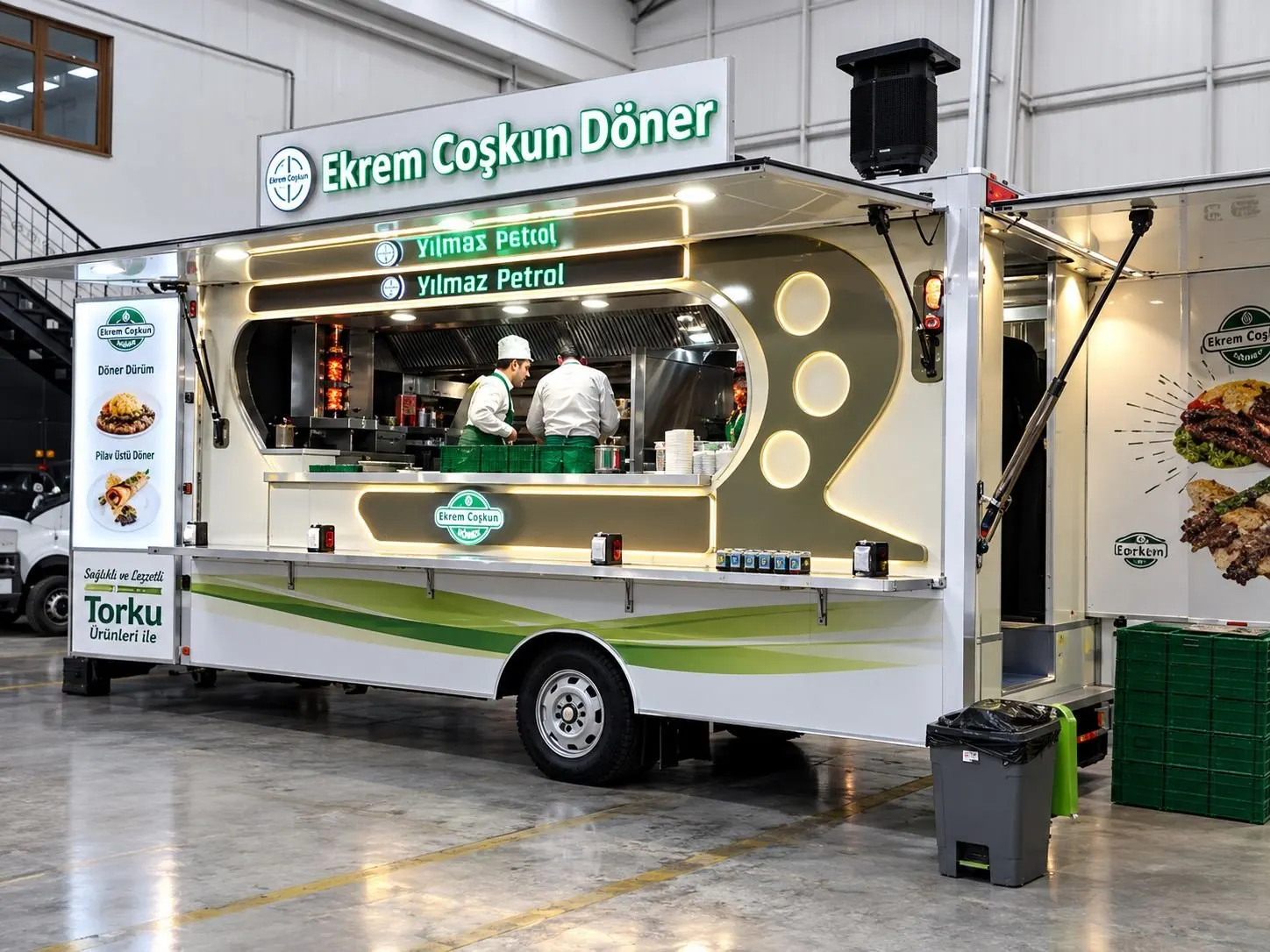
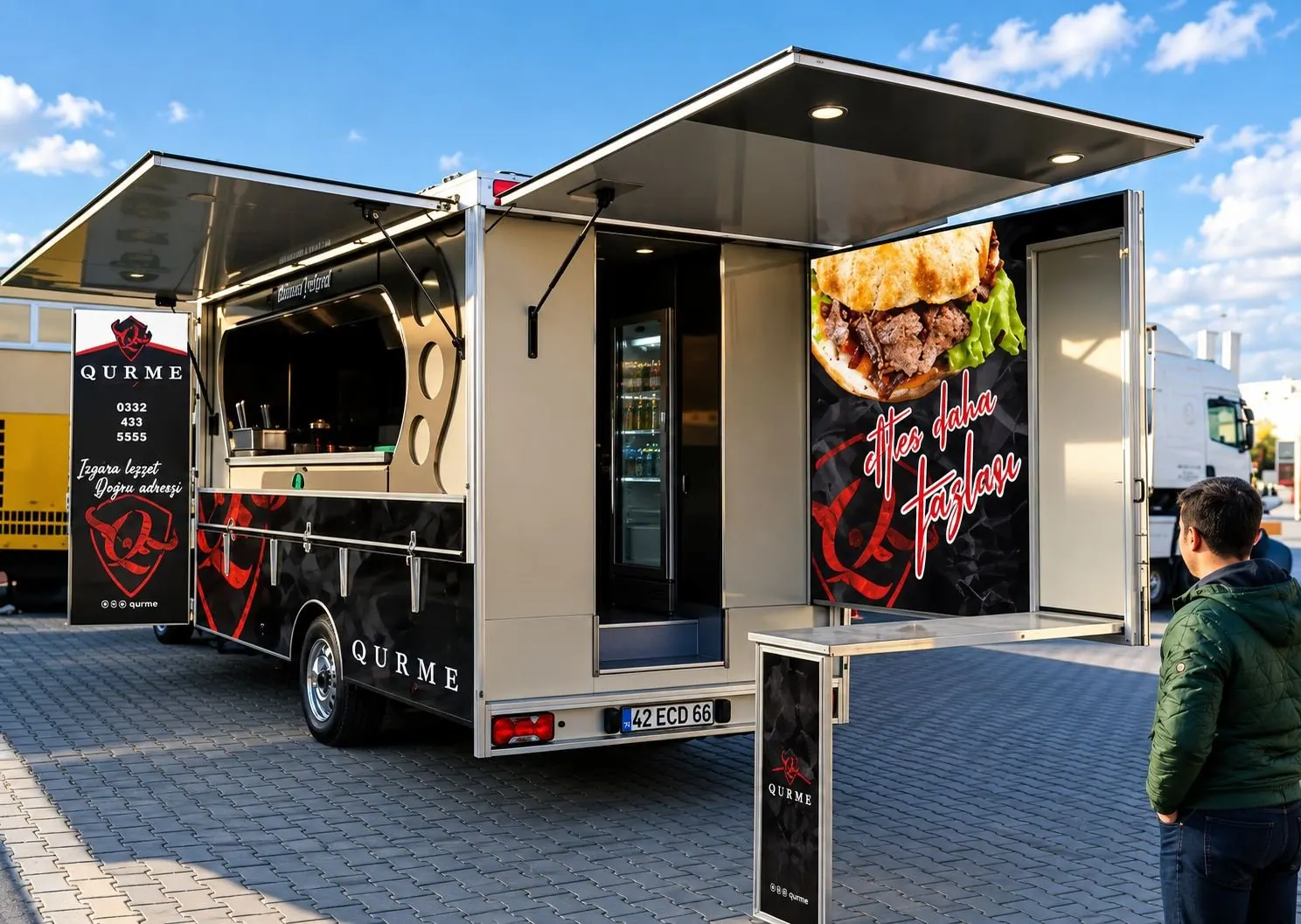
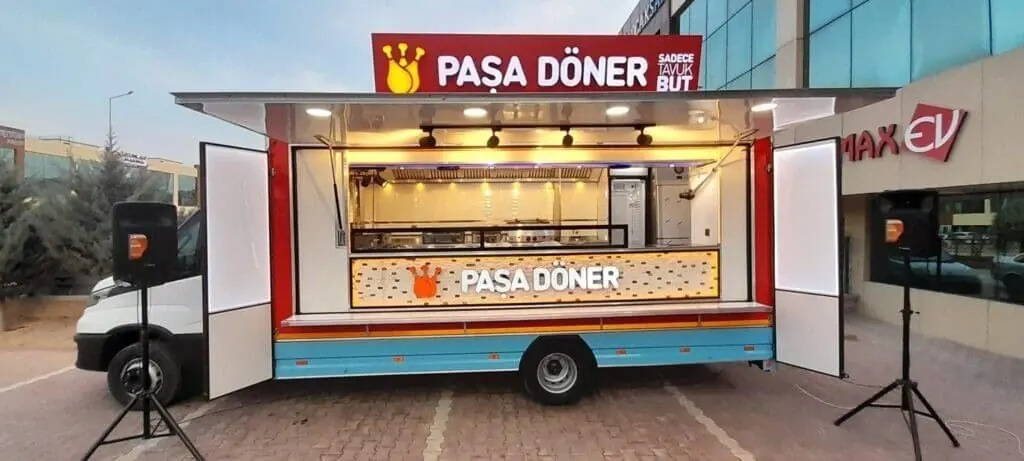
Our own döner builds are trucks, not trailers. The Ekrem Coşkun Döner truck, built for a döner franchise, has a stainless cooking line with a döner grill, burners and extraction. The Paşa Döner and Qurme trucks open on both sides, and the Paşa kitchen is laid out around the döner grill so two queues can be served at once. Our food trucks and trailers page lists the parts we lay out for a menu: stainless worktops, grill, burners, extraction, fridge, freezer and sink.
What to send the builder for a quote
- Your menu: which meats go on the spit and what you serve with them.
- The broiler you want, with the maker's spec sheet: fuel, BTU or kW, voltage and phase, capacity and height.
- Your power source: shore power, generator or both.
- Gas: propane on board or site gas, and the pressure the broiler needs.
- Freezer and fridge space for cones, with raw meats kept apart.
- How many people work inside, and whether you serve from one side or two.
- Where you will trade, so the health and fire rules can be checked.
Frequently asked questions
Is a gas or electric shawarma machine better for a trailer?
It depends on your power. The Potis gas models draw only a small motor load but need gas at the stated pressure. The electric E2 and E3 need 6 kW single phase or 9 kW three phase. On a generator, that sets its size.
Does a shawarma trailer need a hood?
The Food Code asks for mechanical ventilation where smoke and fumes would build up, and the Potis manual says its gas grill runs only in a well-ventilated room. The hood type and fire suppression depend on your local fire code, so ask your fire marshal.
How much does a shawarma stand cost?
We don't give prices, because every trailer is built to order. The broiler and its fuel, the power system, the extraction, the cold storage and the trailer size drive the figure.
What are the two types of shawarma?
For the build, the split that matters is chicken and red meat. Where the Food Code applies, poultry is cooked to 165°F and gyro-style comminuted meat to 155°F for 17 seconds, and raw meats are stored apart.
Send your menu, the broiler you have in mind and where you will trade through the quote form. We go over the scope, layout and equipment with you, then send a detailed quote. More of our döner builds are on the custom food trucks page.
Related guides
- New vs Used Food Truck: What to Check Before You Buy
- Taco Trucks: Kitchen Line, Holding and Service Window Planning
- How Much Does a Food Truck Cost to Build? The Parts That Drive the Price
- Hot Dog Carts vs Hot Dog Trailers: What Changes for the Buyer
Sources
- Omcan / Trento, Potis MU-GD4 natural gas vertical broiler (specifications)
- Omcan / Trento, Potis MU-GD3 natural gas vertical broiler (specifications)
- Omcan / Trento, MU Series Natural Gas Gyro Grills spec sheet (GD3, GD4, GD5)
- Omcan / Trento, Instruction Manual, Doner Kebab Machines, Natural Gas (revised 07/09/2026)
- Omcan / Trento, Potis Electric Doner Kebab Machines spec sheet (E2, E3)
- Omcan / Trento, Potis E3 electric vertical broiler
- Remta, 4 Radyanlı Gazlı Döner Ocağı
- Remta, 4 Radyanlı Elektrikli Döner Ocağı
- FDA Food Code 2026, Chapter 1 definitions and sections 3-301.11, 3-302.11, 3-306.11, 3-401.11, 3-401.14, 3-501.13, 3-501.14, 3-501.16, 3-501.17, 4-204.11, 4-301.11, 4-301.12, 4-301.14, 4-302.12, 5-204.11 and 6-304.11
- City of Austin Fire Department, Mobile Food Vending Fire Inspections

By
Ozan Food Truck
This guide is based on the laws, regulations, official guidance and manufacturer documents linked in the text. It is general information, not legal or engineering advice. Rules differ by country, state and city, so confirm the details with your local authority before you build or buy.