
Buying guide
BBQ and Smoker Trailers: Fire, Smoke and Layout Checks for Buyers
Before you order a BBQ trailer, settle three things: which smoker you will cook on, where it sits in relation to the prep area, and what the finished trailer weighs on its axle and hitch. The smoker decides most of the rest. An offset burns wood or charcoal, a pellet cooker needs a power outlet, and a gas-fired smoker such as the Southern Pride models needs gas and power while it still burns logs for smoke.
By Ozan Food TruckPublished 10 min read
This guide compares real smoker spec sheets, sets out what one US city and one county fire authority ask of solid-fuel cooking on mobile vendors, and quotes the FDA Food Code on hot holding. Fire and health rules differ from place to place. Check with your local fire marshal and health department before the layout is drawn.
Checked on 29 September 2026.
What you need to decide first
Under the FDA Food Code, a food business run from a movable vehicle is a mobile food establishment, so the usual hygiene points apply: a handwashing sink, a way to wash utensils, water tanks and cold holding. The fire is what changes. Burning wood or charcoal next to a kitchen brings its own clearances, ash handling and extinguisher sizes.
So start with four answers. What you will cook and how much of it per service. Which smoker type fits that volume. Whether the smoker cooks outside on the trailer or inside an enclosed kitchen. And what will tow the loaded trailer.
Smoker types and what the makers specify
We picked one model of each type and read the maker's own spec page or manual. They are examples, not recommendations.
| Model | Type | Fuel | Power | Weight |
|---|---|---|---|---|
| Meadow Creek TS250 | Offset reverse flow smoker, built on its own trailer | Wood or charcoal in a firebox | None listed | 1,630 lb net, on a 3,000 lb axle rating |
| Southern Pride SPK-500 | Gas-fired rotisserie that burns logs for smoke | LP or natural gas, 75,000 BTU burner, plus 2 to 3 logs | 120 V, 60 Hz, 15 A (or 230 V, 50 Hz) | 1,204 lb (546 kg) |
| Southern Pride MLR-150 | Smallest gas-fired rotisserie of that range | LP or natural gas, 65,000 BTU | Same as SPK-500 | 656 lb (298 kg) |
| Yoder Smokers YS1500S | Pellet cooker | Food-grade pellets, 20 lb hopper | 120 V, 15 A, GFCI-protected outlet | 787 lb |
Offset smokers
The TS250 is a 250-gallon tank with a firebox on the side, sold as a complete trailer. Meadow Creek lists a 2-inch ball hitch, safety chains, a rubber torsion axle, DOT-compliant LED lights, reflectors and a VIN plate. It also fits heat baffles on the firebox to protect the tyres from excessive heat. Brakes, a 5,000 lb single axle and a tandem axle are options. Ask the same of any offset: how is firebox heat kept off the tyres and the body?
Gas-fired smokers that burn wood
On the SPK-500, the gas burner heats the cabinet and lights the logs in the firebox. So the trailer needs gas at the pressure the maker states (11 to 13 inches water column for LP) and 120 V power for its 15 amp plug. Southern Pride offers trailer mount legs, required for mounting on a trailer supplied by the customer, and pins and clips that hold the racks in place during transit.
The maker adds that venting must follow its manual and be acceptable to the authority having jurisdiction.
Pellet cookers
The YS1500S plugs into a 120 volt, 15 amp GFCI-protected outlet, so the trailer needs power for it. Yoder's manual says to use it only outdoors, in open air, because of carbon monoxide. It asks for 18 inches from walls or combustible surfaces and 40 inches under overhead combustibles. It also says to use food-grade pellets, not heating pellets, and to keep them dry.
Yoder's warranty covers the cooker when used for "residential, non-commercial use". Our reading: check the warranty terms for trading use before you design a trailer around any pellet cooker. If a pellet cooker or a gas-fired smoker is on your list, add its draw to the power budget, as set out in our guide to sizing a food truck generator.
Fire: what one city and one county ask for
We found no single US rule for smokers on food trailers. We could not read the national fire codes (NFPA 96 and the International Fire Code), so we quote nothing from them. What we could read are two local pages from Texas. Treat them as examples of what a fire marshal may ask, not as your rules.
Austin Fire Department. Every vendor it inspects needs a 2A10BC extinguisher. Vendors with a fryer or using solid fuel, wood or charcoal, also need a Class K extinguisher. For permits issued after 1 May 2022, a hood fire suppression system is required when the vehicle has appliances that produce grease-laden vapours, and the department lists charcoal grills among them. Propane is capped at 200 pounds on the vehicle, and cylinders may not sit on rear bumpers or on the exterior sides.
Travis County Fire Marshal. Its checklist goes further on solid fuel:
- All cooking equipment mounted on non-combustible surfaces.
- Hot surfaces and cooking areas protected from the public.
- At least 3 feet between fryers and solid-fuel appliances (wood or smokers).
- A solid-fuel appliance with a firebox needs one 2.5-gallon or two 1.5-gallon Class K extinguishers.
- A carbon monoxide detector and a combustible gas detector inside.
- The vendor at least 20 feet from any structure.
The county adds that its inspection is not an approval of the vehicle's structural design or roadworthiness.
What the smoker makers add
Southern Pride's manual gives minimum clearances from combustible material: 18 inches at the back, top and service side, 24 inches on the firebox door side and 48 inches at the front. It recommends a non-combustible floor under the firebox, running at least 6 inches past each side. Ash goes into a lidded metal can of no more than 20 gallons, and never into a common dumpster, because embers can start a fire.
Our reading: the manual's installation section is written for a building, but the numbers show how much free space a smoker needs on a trailer too. Ask your builder to draw them.
Hot holding and the Food Code
Barbecue is often held for hours, so the temperature rules matter too. The FDA Food Code is a model that states and local regulators adopt in their own way. Where it applies:
- Hot food is held at 135°F (57°C) or above. Whole roasts cooked to the Food Code roast chart may be held at 130°F (54°C) or above.
- Poultry is cooked to 165°F (74°C). Intact cuts of meat are cooked to 145°F (63°C) for 15 seconds, and whole roasts such as beef and pork follow the time and temperature chart.
- Cooked food is cooled from 135°F to 70°F within two hours, and to 41°F or less within six hours in total.
- Food cooked, cooled and reheated for hot holding reaches 165°F for 15 seconds, and the reheat takes no more than two hours.
- Holding equipment must be enough in number and capacity to keep those temperatures, and food thermometers must be on hand.
There is one rule written for smoking itself. A variance from the regulator is needed before smoking food as a way to preserve it rather than to flavour it. Our reading: ordinary barbecue smoked for flavour falls outside that line, but jerky or smoked sausage sold as a kept product may not. Ask your health department how they class your menu. It also helps to size the warmer for a full service and to put a reheating method and a cooling plan on the drawing.
Separating the smoker from the prep area
No source we read sets a distance between a smoker and a prep counter, but they fix the points around it. The Food Code wants unpackaged food protected from environmental contamination during preparation, and mechanical ventilation where smoke and fumes would otherwise build up. A handwashing sink has to be convenient to the prep area, and a three-compartment sink must take the largest pans and racks you wash, unless an alternative is approved.
Our reading: the simplest way to meet all of that is to keep smoke and ash on one side and open food on the other. A cooker whose maker says it must run in open air, like the Yoder, stays outside the enclosed kitchen, on the deck or the tongue. Prep, holding and service stay inside, with the handwash sink near the prep counter. If the smoker goes inside, Southern Pride's manual asks for a venting method approved by the local code agency before installation, and warns that sharing a hood with other appliances may be prohibited.
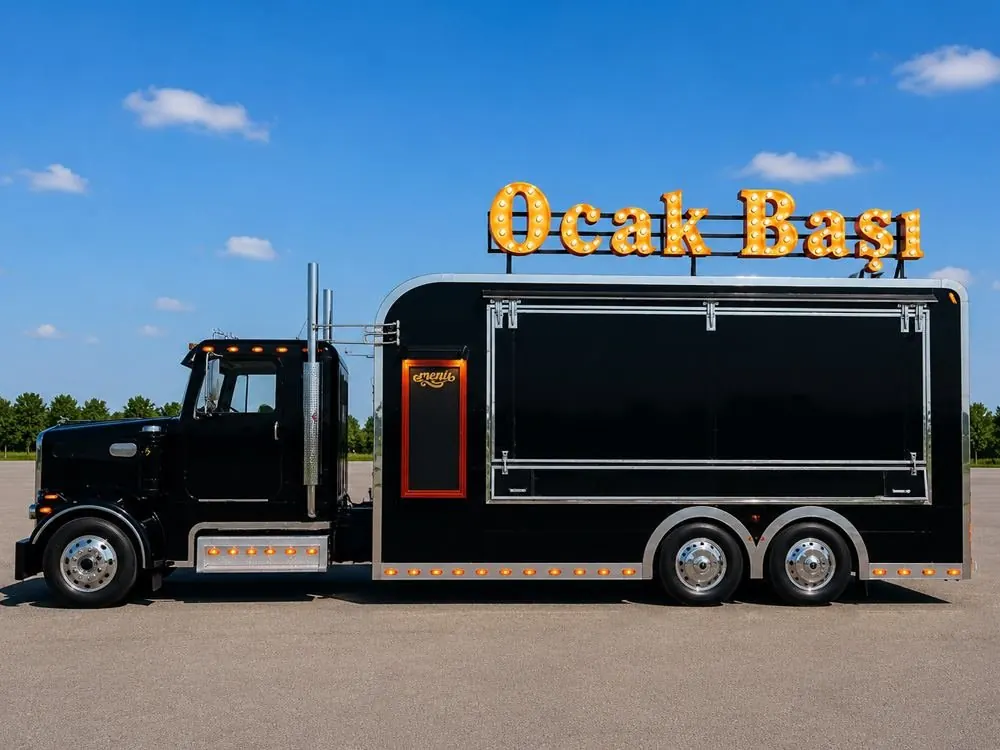
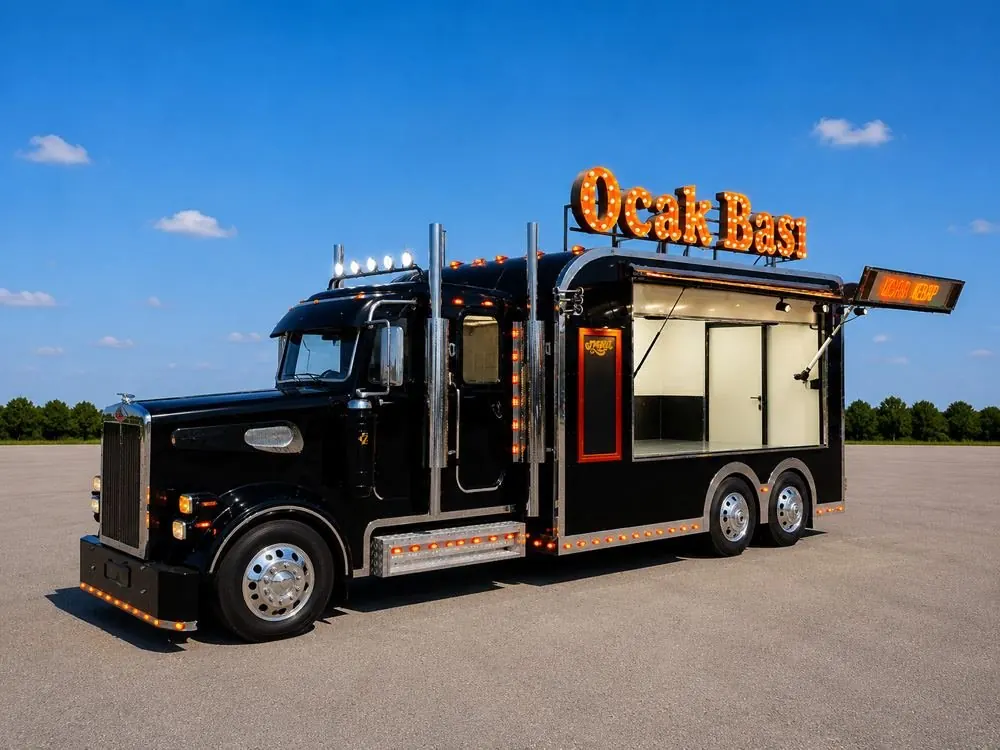
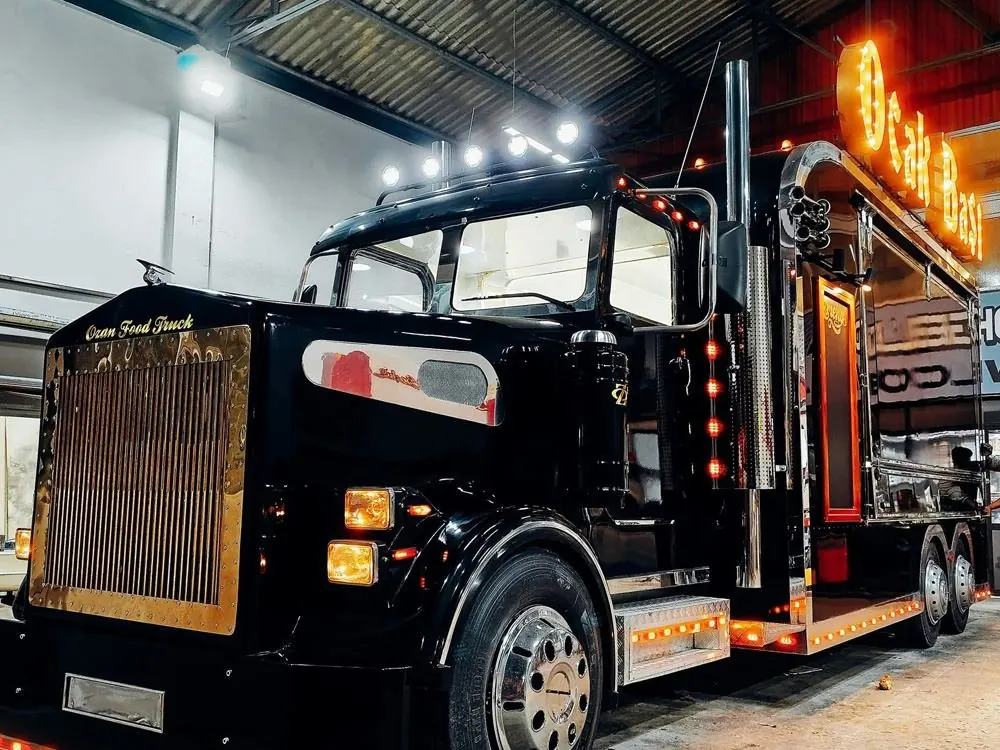
One of our own builds shows the parts involved. The Ocak Başı grill truck carries an ocakbaşı grill, an extraction hood and a stainless prep line on an American-style tractor. Our custom food trucks start from what you cook and how many people work inside.
Hitch, weight and towing
A smoker is heavy. The SPK-500 alone weighs 1,204 lb, and the TS250 puts 1,630 lb on an axle rated for 3,000 lb.
In the US, a trailer's certification label shows its GVWR and the GAWR for each axle. Our reading: what you can load is the rating minus the weighed trailer. Wood, pellets, gas bottles, water, meat and staff all count against it, and the smoker's position changes the load on each axle. Ask to see axle loads on the drawing.
The tow vehicle and the licence set a limit too. In California, a Class C licence may tow a single vehicle rated at 10,000 lb GVWR or less. Federally, a combination of 26,001 lb or more, towing a vehicle of over 10,000 lb (by rating or actual weight, whichever is greater), is a commercial motor vehicle when used in commerce, and needs a CDL. In the UK, a trailer over 750 kg loaded needs working brakes. Check with your vehicle registration office before you fix the size. Our food truck vs food trailer guide covers towing in more detail, and the sizes and layout guide covers width and weight limits.
What to send the builder for a quote
- Your menu and the portions you expect per service.
- The smoker you want, with the maker's spec sheet: fuel, BTU rating, power, weight and clearances.
- Whether it cooks outside on the deck or inside the kitchen.
- Your holding plan: warmers, reheating and cooling.
- The other cooking equipment, especially any fryer.
- The tow vehicle, its towing limit and your licence.
- Where you will trade, so the fire and health rules can be checked.
Frequently asked questions
Can you put a smoker inside a food trailer?
It depends on the smoker and your fire authority. Yoder says its pellet cooker is for outdoor, open-air use only. Southern Pride's manual covers indoor installation, with a venting method your code official approves first. Ask your fire marshal.
Does a BBQ trailer need a sink?
Where the Food Code applies, yes. You need a handwashing sink placed for the prep area and a three-compartment sink for washing, rinsing and sanitising, unless your health department approves an alternative.
How much does a BBQ trailer cost?
We don't give prices, because every trailer is built to order. The trailer and its size, the smoker and other kitchen equipment, and the power and water systems drive the figure.
Do I need a fire suppression system on a BBQ trailer?
In Austin, new permits require one when the vehicle has appliances that produce grease-laden vapours, charcoal grills included. Other places set their own rules, so ask your local fire marshal.
Send your menu, the smoker you have in mind and where you will trade through the quote form. We reply with questions first, then drawings and a quote. You can see the trucks and trailers we build on our food trucks and trailers page.
Related guides
- New vs Used Food Truck: What to Check Before You Buy
- Taco Trucks: Kitchen Line, Holding and Service Window Planning
- How Much Does a Food Truck Cost to Build? The Parts That Drive the Price
- Hot Dog Carts vs Hot Dog Trailers: What Changes for the Buyer
Sources
- Meadow Creek, TS250 Reverse Flow Smoker Trailer (specifications)
- Southern Pride, SPK-500 Mobile Gas Rotisserie (specifications)
- Southern Pride, SPK-500 120 V specification sheet
- Southern Pride, MLR-150 (specifications)
- Southern Pride, 120 V Gas Rotisserie Owner's Manual
- Yoder Smokers, YS1500S (specifications)
- Yoder Smokers, YS1500S Operation Manual (2026)
- City of Austin Fire Department, Mobile Food Vending Fire Inspections
- Travis County Fire Marshal's Office, Mobile Food Vending Requirements
- FDA Food Code 2026, sections 3-305.11, 3-305.14, 3-401.11, 3-403.11, 3-501.14, 3-501.16, 3-502.11, 4-301.11, 4-301.12, 4-302.12, 5-204.11 and 6-304.11
- 49 CFR Part 567, certification labels
- 49 CFR Part 383, section 383.5
- California DMV, Driver's Licenses
- GOV.UK, Trailer and towing equipment

By
Ozan Food Truck
This guide is based on the laws, regulations, official guidance and manufacturer documents linked in the text. It is general information, not legal or engineering advice. Rules differ by country, state and city, so confirm the details with your local authority before you build or buy.