
Buying guide
Beer Trailers and Draft Beer Trucks: Cooling, Taps and Licensing Questions
A beer trailer is specified around one question: how the beer stays cold from the keg to the glass. You choose between a keg cooler with towers on top, a cold box with taps through its wall, or a glycol system, and that choice sets much of the power and the layout. The alcohol licence is a separate question, and it is local.
By Ozan Food TruckPublished 10 min read

This guide covers the draft system. Equipment figures come from True and Micro Matic documents, gas safety from OSHA and the Compressed Gas Association, and hygiene from the FDA Food Code. Glass washing and ice machines are in our mobile bar trailer guide.
Checked on 29 September 2026.
Three ways to keep draft beer cold
Draft equipment maker Micro Matic puts it simply: where the kegs stand and how far they are from the faucet decide the system.
| System | How the beer is cooled | Where it fits (Micro Matic) |
|---|---|---|
| Direct draw keg cooler | kegs, lines and tower chilled by cold air from one cabinet | keg "within a few feet" of the faucet |
| Cold box, taps through the wall | kegs and lines in a walk-in; shanks mounted through its wall | direct draw from a walk-in cooler |
| Forced air remote | a blower pushes cold air through ducts to the tower | up to 25 ft (double duct) or 15 ft (single duct) |
| Glycol | chilled glycol runs beside the beer lines to the faucet | long draw, "typically, running 25 feet or longer" |
The maker calls glycol "the most complex and the most expensive" of the three draft systems it describes.
Our reading: on a compact trailer the keg can sit a few feet from the tap, so direct draw is the first thing to price. A refrigerated body used as the keg room, with faucets on its outside wall, is the walk-in version of the same layout. Glycol earns its place when the towers stand far from the kegs, or when the tower you want only works with glycol.
For the walk-in layout, the maker advises a thin wall, so the shanks do not warm up inside it, and a cooler kept for keg beer, with little foot traffic. If staff can step into the cold room, read the walk-in cooler rules in our shipping container bar guide.
Keg sizes decide the cooler
Start from the kegs your supplier delivers, because sizes vary by brand and area. US federal beer regulations define a barrel as 31 gallons, so a half barrel holds 15.5, a quarter 7.75 and a sixth about 5.2.
Schaefer's SUDEX kegs show how the sizes compare:
| Keg | Height | Diameter |
|---|---|---|
| 1/2 barrel | 23.23 in | 15.91 in |
| 1/4 barrel | 23.23 in | 11.14 in |
| 1/6 barrel | 23.23 in | 9.17 in |
| 50 L | 20.94 in | 16.06 in |
Other keg lines differ slightly, and some quarter kegs are 17 inches across. Then add the coupler. Micro Matic asks for at least 5 to 6 inches above the keg for the coupler and hose, 4 inches with an elbow fitting, or 1 inch with a low-profile coupler.
Our reading: draw the cooler around the tallest keg plus its coupler, and the widest keg you might be sent.
What a keg cooler spec sheet tells you
True's TDD direct-draw dispensers are a useful reference. The TDD-3-HC holds three half barrels, keeps the cabinet at 33 to 38°F and draws 2.8 A at 115 V. It asks for a 15 A dedicated outlet. It has two insulated 3-inch beer columns, with cold air directed into them "to reduce foaming".
Three other lines matter on a trailer. The crated weight is 400 lb. There is a 1/2-inch drain fitting on the front. The condensing parts are reached from behind the front grill.
Our reading: the drain needs a route to the waste tank, and the grill must stay reachable. The sheet gives no ambient range and says nothing about vehicles, so ask True or your builder before you rely on it at a hot site.
Towers, faucets and line length
A tower has to match the cooling. An air-cooled tower, Micro Matic says, needs an open space of at least 2 1/2 inches inside for cold air to circulate around the hoses. Some designs lack that space, and a glycol tower should only be used with glycol.
Temperature matters all the way up. In the maker's words, "even a few inches of beer hose" that is not kept at 36 to 38°F will cause foam.
Then comes balance. Most US breweries recommend 12 to 14 lb of CO2 pressure for ales and lagers at 38°F, the maker says, and the hose should add about as much restriction. That is why most towers carry 5 feet of 3/16-inch vinyl hose. Longer runs need wider tubing, and over real distance the maker points to a CO2 and nitrogen blend.
Our reading: fix the tower positions on the drawing before the cooler is ordered. The distance from keg to faucet decides the hose and the cooling method.
When glycol makes sense
In a glycol system the kegs stay in the cold box. A power pack chills a food-grade propylene glycol mix and pumps it beside the beer lines, up the tower and back. Two of Micro Matic's air-cooled packs:
| Micro Matic model | Cooling | Electrical | Glycol bath | Shipping weight |
|---|---|---|---|---|
| MMPP4300-35 | 1,700 BTU/h, 1/4 HP | 115 V, 5 A running, 5-15P plug | 4.5 gal | 77 lb |
| MMPP4302 | 3,600 BTU/h, 1/2 HP | 115 V, 15.4 A running, 5-20P plug | 11.5 gal | 157 lb |
The service manual that covers the MMPP4302 rates capacity at 90°F ambient. The maker's sizing page warns that a pack loaded beyond 60 percent of its capacity runs longer and wears out sooner.
The manual asks for at least 18 inches clear above and in front, and a room between 50 and 90°F. It advises against mounting the pack on top of a walk-in or outside. The pack must be wired to a ground fault circuit interrupter, and the glycol mix is changed about every 18 months.
Our reading: the MMPP4302 draws more than five times the running current of a TDD-3-HC. That goes straight into your generator sizing, which our generator guide walks through. The pack also needs a ventilated compartment inside the body. Ask the builder how that space stays under 90°F at a summer event.
Event coolers. A trailer can also pour through a coil or cold-plate box packed with ice. The maker says a cold plate's meltwater must be drained continuously, and warns against direct sunlight. Where the Food Code applies, ice that has cooled coils or tubes may not then go into drinks, so plan separate ice.
CO2: secure the cylinder, vent the space
The gas that pushes the beer needs its own plan. CO2 is colorless and odorless. OSHA and the Compressed Gas Association (CGA) both say it is 1.5 times heavier than air, and CGA says it tends to collect in low or confined areas.
OSHA's workplace limit is 5,000 ppm averaged over 8 hours. A 1996 OSHA bulletin on filling bulk CO2 systems, such as those at beverage dispensing sites, says 10 percent or more can cause unconsciousness or death. It concerns bulk tanks, not cylinders, but its ventilation advice rests on the density of the gas: exhaust from the lowest level, make-up air higher up. It also warns that an oxygen reading is not enough, since CO2 can be toxic with adequate oxygen.
For the cylinder itself, CGA's poster says to secure it with a chain, strap, rack or similar device, keep it valve up, and fit valve protection when it is not in use. The cylinder need not sit in the cooler, Micro Matic adds, but it must stand upright, away from heat, strapped or chained. Heat raises the pressure and may burst the relief valve. Under perfect conditions a half barrel uses about half a pound of CO2.
Our reading: a closed keg compartment on a trailer is the kind of low, enclosed space these sources warn about. Ask the builder for a strapped rack away from heat, a low vent and a CO2 detector. CGA says to monitor and ventilate "as required by code", so ask your fire authority which code applies to your trailer.
Line cleaning belongs in the design
Where your health department follows the Food Code, beverage dispensing lines are cleaned at the frequency the manufacturer specifies. Without one, they are cleaned often enough to prevent soil or mold building up.
For commercial systems, Micro Matic's guidance is at least every two weeks, or as state guidelines say. It recommends a recirculating pump for at least 15 minutes, with the coupler and faucet taken apart and soaked, and only chemicals made for beer lines. Its method pushes the beer out with water first and flushes the solution out with water after.
Our reading: on a tank trailer, that flush water comes from your fresh tank and goes to your waste tank, so size both with cleaning in mind. The mobile bar trailer guide covers the tank rules.
Licensing: local, and not built in
In England and Wales, GOV.UK says you need a licence or other authorisation from a licensing authority, usually the local council, and the Licensing Act counts a vehicle as premises. In California, the Type 58 caterer's permit is open only to holders of certain existing licences, and the Type 91 permit lets a beer manufacturer cater beer at approved events. Both need ABC authorization for each event.
Our reading: the licence follows the seller and the place, and neither source says a trailer can arrive licensed from the factory. Check with your local licensing authority before you fix the design.
What to send the builder for a quote
- where the trailer will pour: one site or events, and in which country, state or council
- the tap count, and the keg sizes your supplier delivers
- how many kegs you hold in reserve
- your preferred system: keg cooler, cold box with taps through the wall, or glycol
- where the towers or tap wall should face the customer
- the power on site, or the generator you plan to use
- whether the trailer runs on water tanks, and how you will clean the lines
- where the CO2 cylinders will go, and anything your fire authority has asked for
- your licence route and branding
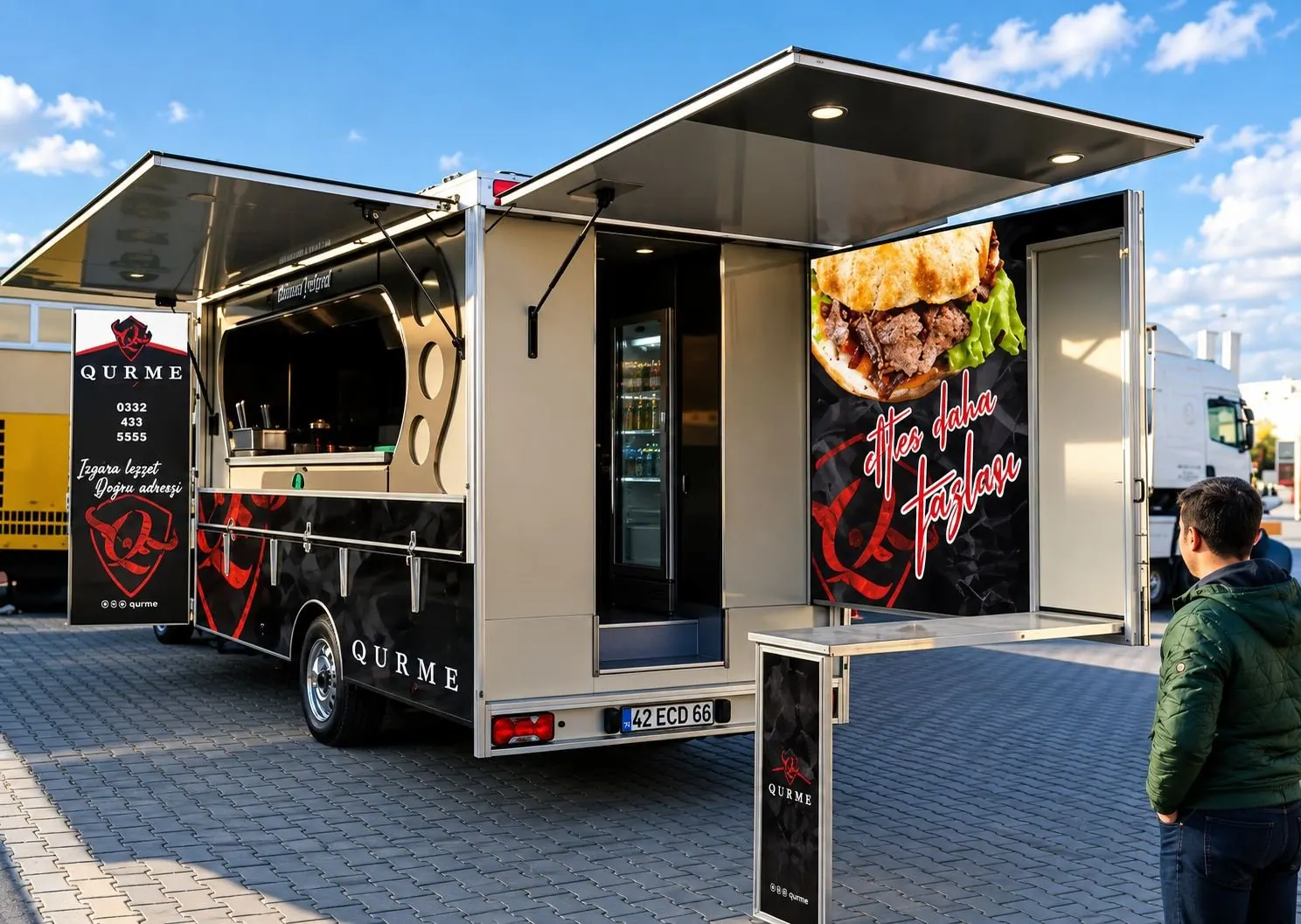
We build custom food trucks with the body, the serving side, the fit-out and the branding made in our own factory, for a single truck or a series. Lift-up hatches on gas struts, counters and awnings are placed for the way your queue forms.
Frequently asked questions
What is a keg trailer?
A trailer that keeps kegs cold and pours from them. It can use a keg cooler, a cold box with taps in its wall, or glycol.
What is a refrigerated beer trailer?
In our reading, one whose body works as the keg cooler, with the faucets through its wall.
Glycol or direct draw for a beer trailer?
Direct draw suits kegs within a few feet of the faucet. Glycol suits long runs and some tower designs. It adds a power pack, which needs power and airflow of its own.
How often should beer lines be cleaned?
Where the Food Code applies, at the frequency the equipment maker specifies. For commercial systems, Micro Matic says at least every two weeks, or as state guidelines say.
Send your tap count, keg sizes and site through the quote form. We reply with questions first, then drawings and a quote. You can see our builds on the custom food trucks page.
Related guides
- New vs Used Food Truck: What to Check Before You Buy
- Taco Trucks: Kitchen Line, Holding and Service Window Planning
- How Much Does a Food Truck Cost to Build? The Parts That Drive the Price
- Hot Dog Carts vs Hot Dog Trailers: What Changes for the Buyer
Sources
- True Manufacturing, TDD-3-HC spec sheet
- Micro Matic, Beer on tap (system types)
- Micro Matic, What is a direct draw dispensing system?
- Micro Matic, What is a glycol-cooled dispensing system?
- Micro Matic, What is an air-cooled dispensing system?
- Micro Matic, Why are some towers only available in glycol cooling?
- Micro Matic, What is restriction?
- Micro Matic, What pressure do I need to set the regulator at?
- Micro Matic, What temperature do I need to store draft beer at?
- Micro Matic, Keg sizes
- Micro Matic, Does the CO2 cylinder need to be inside the refrigerator?
- Micro Matic, How many kegs from a CO2 cylinder?
- Micro Matic, Do I need to clean the equipment and how often?
- Micro Matic, Party cooler / jockey box, cold plate vs coil
- Micro Matic, Power pack BTU calculator
- Micro Matic, MMPP4300-35 spec sheet
- Micro Matic, MMPP4302 spec sheet
- Micro Matic, Pro-Line Power Pack Service Manual
- Schaefer Container Systems, SUDEX keg
- 27 CFR 25.11, definition of barrel
- OSHA, Compressed Gas and Equipment
- OSHA, Hazard Information Bulletin, Potential CO2 Asphyxiation Hazard When Filling Stationary Low Pressure CO2 Supply Systems (1996)
- OSHA, Occupational Chemical Database, Carbon dioxide
- Compressed Gas Association, Carbon Dioxide Safety
- Compressed Gas Association, Cylinder and Equipment Safety
- Compressed Gas Association, poster SP-23, Safe use of compressed gas cylinders and containers
- FDA Food Code 2026 (PDF), sections 3-303.11 and 4-602.11(E)
- GOV.UK, Alcohol licensing
- Licensing Act 2003, section 193
- California Department of Alcoholic Beverage Control, Caterer's Permit

By
Ozan Food Truck
This guide is based on the laws, regulations, official guidance and manufacturer documents linked in the text. It is general information, not legal or engineering advice. Rules differ by country, state and city, so confirm the details with your local authority before you build or buy.