
Planning
Promotional Food Trucks and Brand Activation Vehicles: A Buyer's Guide
A promotional food truck is a food vehicle first and an advert second. Under the FDA Food Code and EU food law, handing out samples still counts as providing food, even when nothing is sold. The body also has to fit the road rules for size and lights. So before you brief the design, decide what the truck will serve, where it will travel and how it will move between stops.
By Ozan Food TruckPublished 10 min read
This guide is for brand teams ordering a vehicle for sampling, launches or a tour.
Checked on 29 September 2026.
Free samples still count as serving food
The FDA Food Code defines a food establishment as an operation that "serves, vends FOOD directly to the CONSUMER, or otherwise provides FOOD". It covers "a mobile, stationary, temporary, or permanent facility" and applies "regardless of whether there is a charge for the FOOD". It is a model code, and state and local adoption varies.
EU food law reads the same way. Regulation 178/2002 defines a food business as any undertaking "whether for profit or not". Placing food on the market includes "any other form of transfer, whether free of charge or not". The version that applies in the UK uses the same words.
Our reading: a launch where you give food away is treated much like one where you sell it. Ask the local health department or food authority before you plan the tour.
One exception: the definition does not include "an establishment that offers only pre-PACKAGED FOODS" that are not time/temperature control for safety foods. If you give out only packaged, shelf-stable products, ask the health department whether that changes anything. If you cook or portion food on board, it does not apply.
What the sampling counter needs
A tray of samples on the counter is food on display. The Food Code asks for it to be protected "by the use of PACKAGING; counter, service line, or salad bar FOOD guards; display cases; or other effective means". Where guests serve themselves with ready-to-eat food, it asks for "suitable UTENSILS or effective dispensing methods".
Plan a guard or a display case into the serving side, or hand out covered, pre-portioned samples. In the EU, Chapter III of Annex II to Regulation 852/2004 adds handwashing, potable water and waste storage for "mobile sales vehicles".
Permits for a launch or a tour
Under the Food Code, nobody may run a food establishment "without a valid PERMIT to operate". The application goes in "at least 30 calendar days before the date planned for opening". A permit cannot be transferred from one food establishment to another. The code also defines a temporary food establishment: one that runs "for a period of no more than 14 consecutive days in conjunction with a single event or celebration".
Our reading: a one-day launch may be handled as a temporary event, while a summer tour across several counties may need a permit in each one. Start with the health department of every stop, and start early.
In England, Wales and Northern Ireland, a food business registers with the local authority at least 28 days before trading. FSA guidance for England says a mobile business registers where the vehicle is ordinarily kept or returns to, and recommends that other councils on the route do not ask it to register again. The GOV.UK page speaks of businesses that "sell food and drink". If your tour only gives food away, ask your council how to register. In the EU, Article 6 of Regulation 852/2004 asks for each establishment to be notified to the competent authority.
Sampling alcohol? We did not research those rules. Ask the licensing authority.
Graphics and wrap: plan for the next campaign
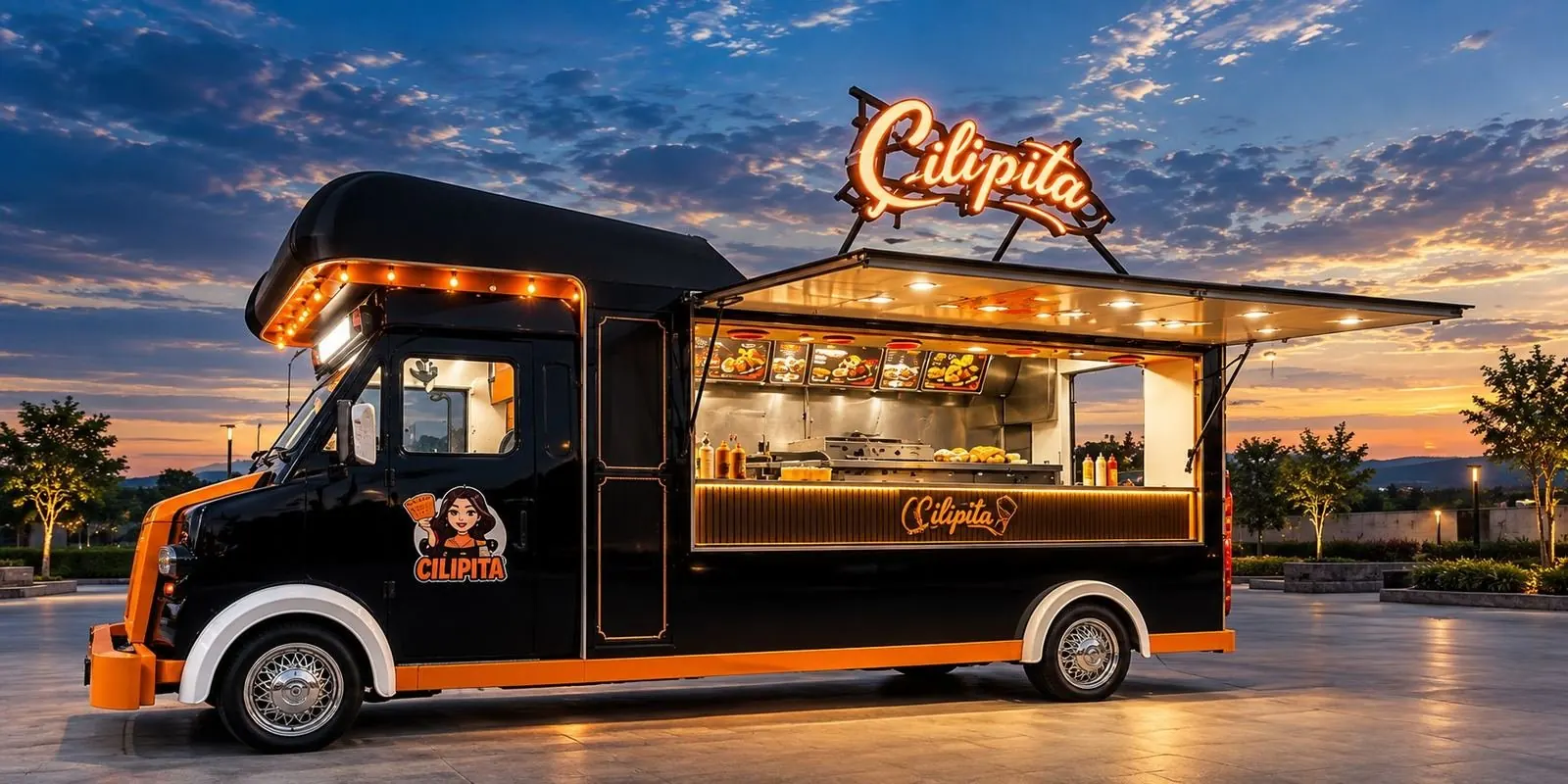
On our custom food trucks, "Paint, printed wrap, illuminated signage and LED lighting are designed together with the truck." On our vintage trucks, colours, signage, lighting and graphics "come from your identity, so the food truck becomes part of the venue or the campaign."
If the graphics change with each campaign, read the removal terms before the first wrap goes on:
- Avery Dennison's SW900 sheet gives no removal warranty on automotive paint "greater than 5 years old".
- Its printed MPI 1105 film is not warranted for removal from horizontal outdoor faces.
- 3M says of its IJ180 film that "Removal may require heat" and makes "no claims as to the ease or speed of removal".
Avery rates SW900 colour film at 10 years on a vertical face in its zone 1 and at 4 months on a horizontal face in zone 3. Printed MPI 1105 is rated "up to 7 years". Our reading: a roof sign box and the roof are horizontal faces, so expect them to age before the sides.
Avery also lists non-OEM painted vehicles and paint that is not fully cured as unsuitable uses. Our reading: a body painted by its builder is close to what Avery calls non-OEM paint, so tell the builder early if you plan to wrap. Our wrap guide goes through the data sheets.
In the US, leave space for legal markings. A self-propelled commercial motor vehicle covered by 49 CFR 390.21 shows the carrier's name and USDOT number on both sides, readable from 50 feet in daylight while stationary. Check with FMCSA whether your truck is covered.
The look versus the road rules
Roof signs and awnings sell the brand. They also count toward the size of the vehicle.
| Market | Width | Length | Height |
|---|---|---|---|
| EU type-approval (goods vehicles and trailers) | 2.55 m | 12.00 m (a drawbar trailer includes the drawbar) | 4.00 m |
| Great Britain, trailers | 2.55 m | 7 m behind a vehicle of 3,500 kg MAM or less, A-frame excluded | Not covered here |
| US | 102 in on the National Network (Hawaii 108 in) | Set by the states for straight trucks | No federal limit; FHWA gives state standards of 13.6 to 14.6 ft |
Federal US rules measure width and length with every component "not excluded by law or regulation". Our reading: a roof sign or a fixed awning that stays on while you drive is part of the vehicle. Ask for the overall height and width with everything fitted. Our guide to food truck sizes covers weight as well.
Lights and lit signs
In the US, FMVSS 108 asks trucks and trailers 2,032 mm (80 inches) or more wide to carry clearance lamps near the top edges and a row of three identification lamps. No added equipment may be installed "that impairs the effectiveness" of the required lamps. If equipment blocks a required lamp so that it fails the visibility requirements, the vehicle needs an extra lamp of the same type. Our reading: a sign box or awning can be that equipment. Ask to see the lamp positions on the drawing.
In Great Britain, Schedule 1 of the Road Vehicles Lighting Regulations exempts trailers up to 1,600 mm wide from front position lamps and trailers up to 2,100 mm wide from end-outline marker lamps. On trailers, side retro reflectors start above 5 m in length and side marker lamps above 6 m, drawbar excluded. The same regulations say no vehicle may be fitted with a lamp that can show red light to the front, with narrow exceptions. To the rear, only red is allowed, apart from listed lights such as indicators and reversing lamps. No lamp may flash automatically unless it is a listed type, such as an indicator.
We found no definition that settles whether a lit advertising sign counts as a lamp under those rules. If your sign shows red at the front, white at the back or animates, ask DVSA before the design is final.
Vintage bodies without an engine
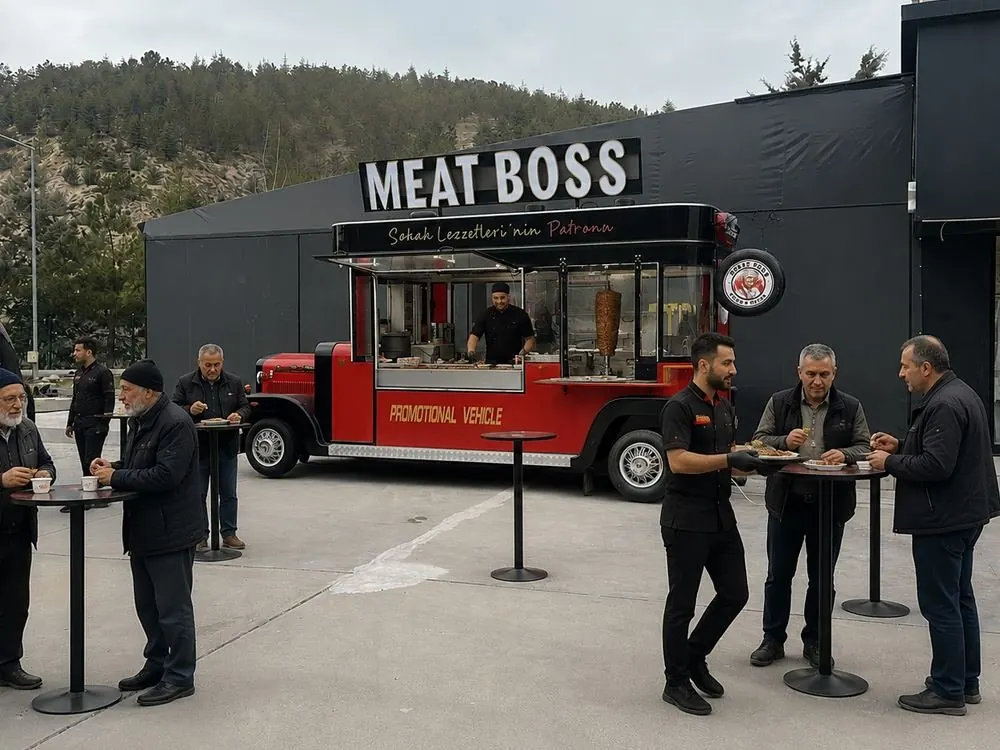
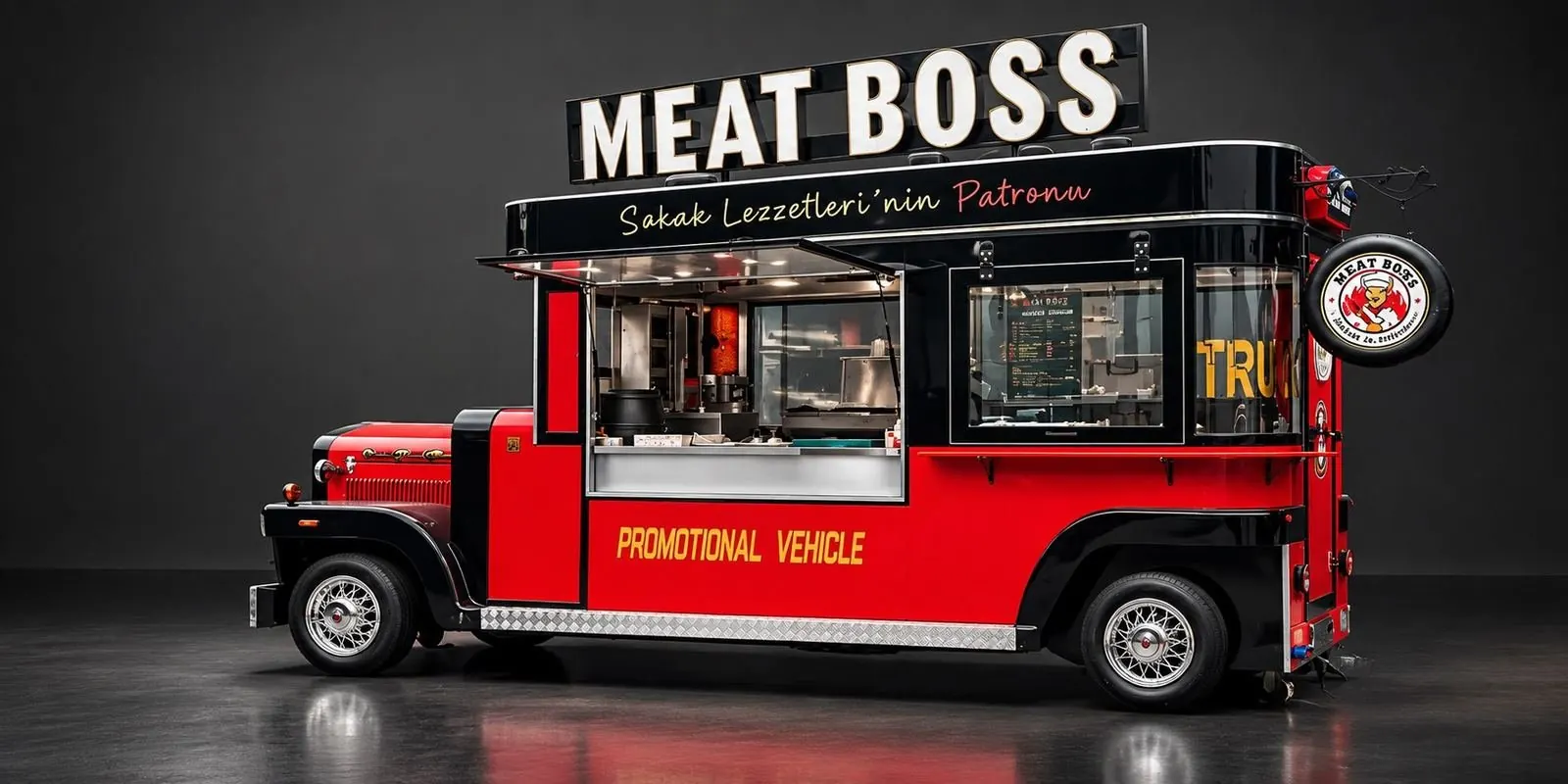
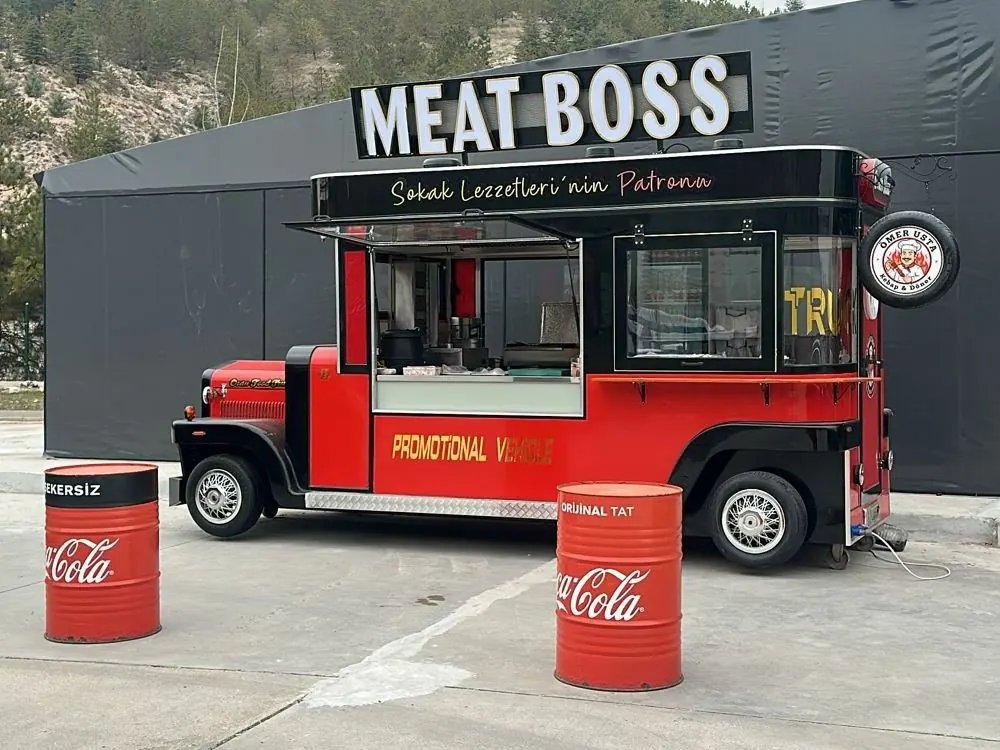
Our vintage food trucks have "no engine" and are "built on a steel frame and steel cladding". The Meat Boss truck is one of them, listed on that page as a promotional vintage food truck: "A red and black vintage food truck with a large illuminated roof sign, built to promote the Meat Boss brand at events. Behind the lift-up hatch is a working kitchen with a döner grill and a stainless line."
In Türkiye, the Highway Traffic Law defines a trailer as a motorless vehicle built to carry people or goods and towed by a motor vehicle. Article 19 exempts motorless vehicles from registration, but not those towed by motor vehicles that must be registered. Our reading: in Türkiye, a vintage body towed on the road is treated as a trailer. We found no rule for a body that is carried to a site and never goes on the road.
That is Turkish law. For the US, the UK or the EU, ask your vehicle registration authority (a state DMV, the DVLA or your national approval authority) how a motorless body is classed, and say whether it will be towed on public roads or carried on a truck. Our reading: if it is towed in Great Britain, trailer rules such as brakes on trailers over 750 kg loaded may apply. Our truck vs trailer guide covers towing limits.
Touring logistics
Water and waste. The Food Code expects liquid waste to be removed "at an APPROVED waste SERVICING AREA or by a SEWAGE transport vehicle". A servicing area is a base the vehicle returns to "regularly". Our reading: if the truck does not go back to one base each night, you need approved places to empty and refill along the route. Ask each health department.
Power. HSE's event guidance lists mains power, generators and "power supplies for catering equipment" among the things UK organisers plan. Ask each venue what it can supply. If you bring a generator, CPSC advice (written for homes) is to run it outside, at least 20 feet away, exhaust facing away.
Arrival. HSE asks organisers to plan work-vehicle tasks in public areas so they are done "before the audience is admitted". Send each venue the truck's length, height and set-up time.
Drivers. In Great Britain, category B covers petrol and diesel vehicles up to 3,500 kg MAM, and C1 covers 3,500 to 7,500 kg. In the US, a single vehicle rated at 26,001 lb or more is a commercial motor vehicle for CDL purposes when used in commerce. Confirm with your licensing authority.
What to send the builder for a quote
- The campaign: sampling, launch, tour, or a truck parked at one venue.
- What you will serve, and whether it is cooked, portioned or pre-packaged.
- The countries on the route, and how the truck will move: driven, towed or carried.
- Power and water at the stops, if you know them.
- Your brand guidelines, and how often the graphics will change.
- Any roof sign or lit feature, with the height you must stay under.
- The number of vehicles and the delivery country.
Frequently asked questions
Can you give me an example of a commercial vehicle?
Under 49 CFR 390.5, a commercial motor vehicle includes a self-propelled or towed vehicle used on a highway in interstate commerce to transport passengers or property, with a weight rating or weight of 10,001 pounds or more. Check with FMCSA.
Do you need a licence to sell food from a trailer?
In England, Wales and Northern Ireland you register with the local authority at least 28 days before trading. Under EU and UK food law, a food business is one "whether for profit or not". Ask your council how free sampling is treated.
What is the best truck to use as a food truck?
We choose the base "for where you trade and how often you move": a chassis cab, a converted panel van or a towable trailer. We also build vintage bodies without an engine.
Planning a sampling tour or a launch vehicle? Send us the campaign, the menu and the route through the quote form. We reply with questions first, then drawings and a quote. You can see the Meat Boss truck and our other classic builds on the vintage food trucks page.
Related guides
- Food Truck Ideas That Start from the Kitchen: 12 Concepts and What Each Needs
- Food Trucks for Events and Festivals: Power, Water and Pitch Questions
- Small Food Trailers: What Fits Inside and What Does Not
- Starting a Food Truck Business: The Vehicle Decisions to Make First
Sources
- FDA Food Code 2026 (PDF), sections 1-201.10, 3-306.11, 3-306.13, 5-402.14, 8-301.11, 8-302.11, 8-304.20
- FDA Food Code
- Regulation (EC) No 178/2002, Article 3
- Regulation (EC) No 178/2002 as it applies in the UK, Article 3
- Regulation (EC) No 852/2004, Article 6 and Annex II, Chapter III
- GOV.UK, Food business registration
- GOV.UK, Starting a food business
- Food Standards Agency, Food Law Practice Guidance (England)
- Avery Dennison, SW900 Supreme Wrapping Film data sheet
- Avery Dennison, MPI 1105 SuperCast data sheet
- 3M, IJ180 Product Bulletin
- 49 CFR 390.5 and 390.21
- Commission Implementing Regulation (EU) 2021/535, Annex XIII
- GOV.UK, Towing with a car: weight and width limits
- GOV.UK, Towing with a car: trailer and towing equipment
- 23 CFR Part 658
- FHWA, Commercial Vehicle Size and Weight Program
- 49 CFR 571.108 (FMVSS No. 108)
- Road Vehicles Lighting Regulations 1989, regulations 11 and 13 and Schedule 1
- Karayolları Trafik Kanunu No. 2918 (Türkiye)
- HSE, Event safety: electrical safety
- HSE, Event safety: transport
- CPSC, Carbon Monoxide Information Center
- GOV.UK, Driving licence categories
- 49 CFR Part 383

By
Ozan Food Truck
This guide is based on the laws, regulations, official guidance and manufacturer documents linked in the text. It is general information, not legal or engineering advice. Rules differ by country, state and city, so confirm the details with your local authority before you build or buy.